

Megalolamna was a large lamniform shark known from isolated teeth. Teeth from the United States, Peru and Japan were the basis for its original description. A comparison with European material later connected the genus to a tooth that had been described in 1879.
Quick facts
| Family | Otodontidae |
|---|---|
| Principal age | Miocene |
| Fossils | Isolated teeth |
| Dental traits | Smooth cutting edges and lateral cusplets |
| Estimated length | At least 3.7 m for one individual under the published model |
| Original holotype | UCMP 112146 from California |
What can the fossils tell us?
The tallest, most symmetrical crowns were interpreted as anterior teeth. Lower, more inclined teeth likely sat farther back. No complete jaw has been recovered.
The 2024 revision gave priority to the name published in 1879 after comparing the historical tooth with material already recognised as Megalolamna.
The authors regarded their identification of the Chandler Bridge Formation specimen as tentative. The Miocene records are better established.
Recognising the teeth
Kenshu Shimada and colleagues named the genus in a paper posted online in 2016 and published in its journal issue in 2017. The original holotype of Megalolamna paradoxodon, tooth UCMP 112146, came from the Pyramid Hill Sand Member of the Jewett Sand in Kern County, California. The same paper described two North Carolina teeth and individual teeth from the Chilcatay Formation of Peru and the Oi Formation of Japan.
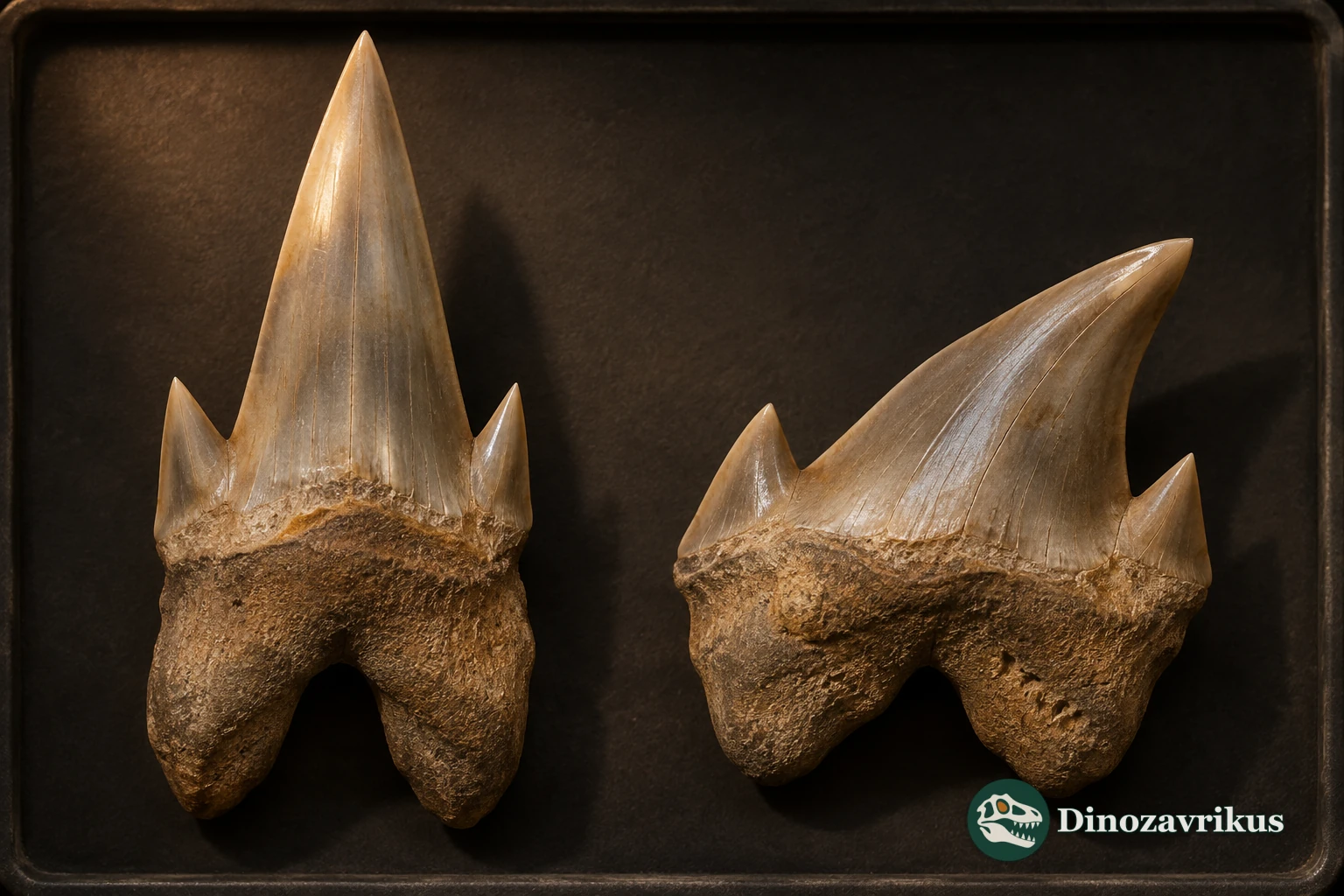
A tall central cusp with smooth edges is flanked by smaller pointed cusplets. The root is stout and divided into two rounded lobes. The inner base of the crown is concave. It is the combination, including the shape of the base and the smaller cusps, that helps distinguish these teeth from those of other lamniform sharks.
How one tooth gave a length estimate
One of the large North Carolina teeth, NCSM 30012, has a crown 38.8 mm high. Shimada and colleagues treated it as an anterior tooth, then used equations relating tooth crown height to total length in living lamniforms. The estimates ranged from 3.7 to 7.2 m once the common thresher, with its unusually long tail, was excluded. The authors treated the low end as a conservative estimate for the individual represented by that tooth.
For Cardabiodon, associated teeth provided a second approach based on the length of the lower dental arcade. The Megalolamna estimate depends on the presumed position of an isolated tooth and the proportions of the modern shark selected for comparison. Sharp, smooth cutting edges could grip and slice prey. The teeth cannot identify its prey directly.
A name from 1879 and new European records
In 2024 Jürgen Pollerspöck and Kenshu Shimada examined Early Miocene teeth from Germany, Austria, France and Italy. Josef Probst had already described one German specimen, GPIT-PV-31738, as Otodus serotinus in 1879. About 8.2 mm high, its distinctly inclined crown suggests a tooth from the side or back of a small individual's jaw. The revision regarded paradoxodon and bassanii as junior synonyms and used the combination Megalolamna serotinus.
Earlier reports placed the genus in the United States, Colombia, Ecuador, Peru and Japan. Teeth from the Calvert Formation added Maryland to the known occurrences. The European material documents the shark in the Mediterranean and Paratethys seas. A single tentative identification from the Chandler Bridge Formation of South Carolina could extend its record into the Late Oligocene.
Frequently asked questions
Why do publications use two species names?
The original paper used paradoxodon. The 2024 revision gave priority to the earlier name serotinus after comparison with a historical German tooth.
What makes a Megalolamna tooth distinctive?
The crown has smooth cutting edges, a tall main cusp and smaller side cusps. The root divides into two stout, rounded lobes.
Was it 3.7 metres long?
That figure is the low estimate for the shark represented by one large tooth. It comes from a model based on a modern shark.
Where have its teeth been found?
Miocene occurrences span both sides of the Pacific, Atlantic coastal deposits of the Americas and the European Mediterranean and Paratethys seas.