

Melanopelta was an Early Triassic temnospondyl from European Russia. It was described from part of the interclavicle, a bone of the shoulder girdle. Isolated bones from other sites broadened the material available for comparing it with other plagiosaurids.
Quick facts
| Group | Temnospondyls, plagiosaurids |
|---|---|
| Age | Early Triassic, late Olenekian |
| Region | Europe, Russia (Arkhangelsk Region and southern Ural foreland) |
| Type species | Melanopelta antiqua |
| Scientific name | Melanopelta |
| Diet | Exact prey is unknown |
What can the fossils tell us?
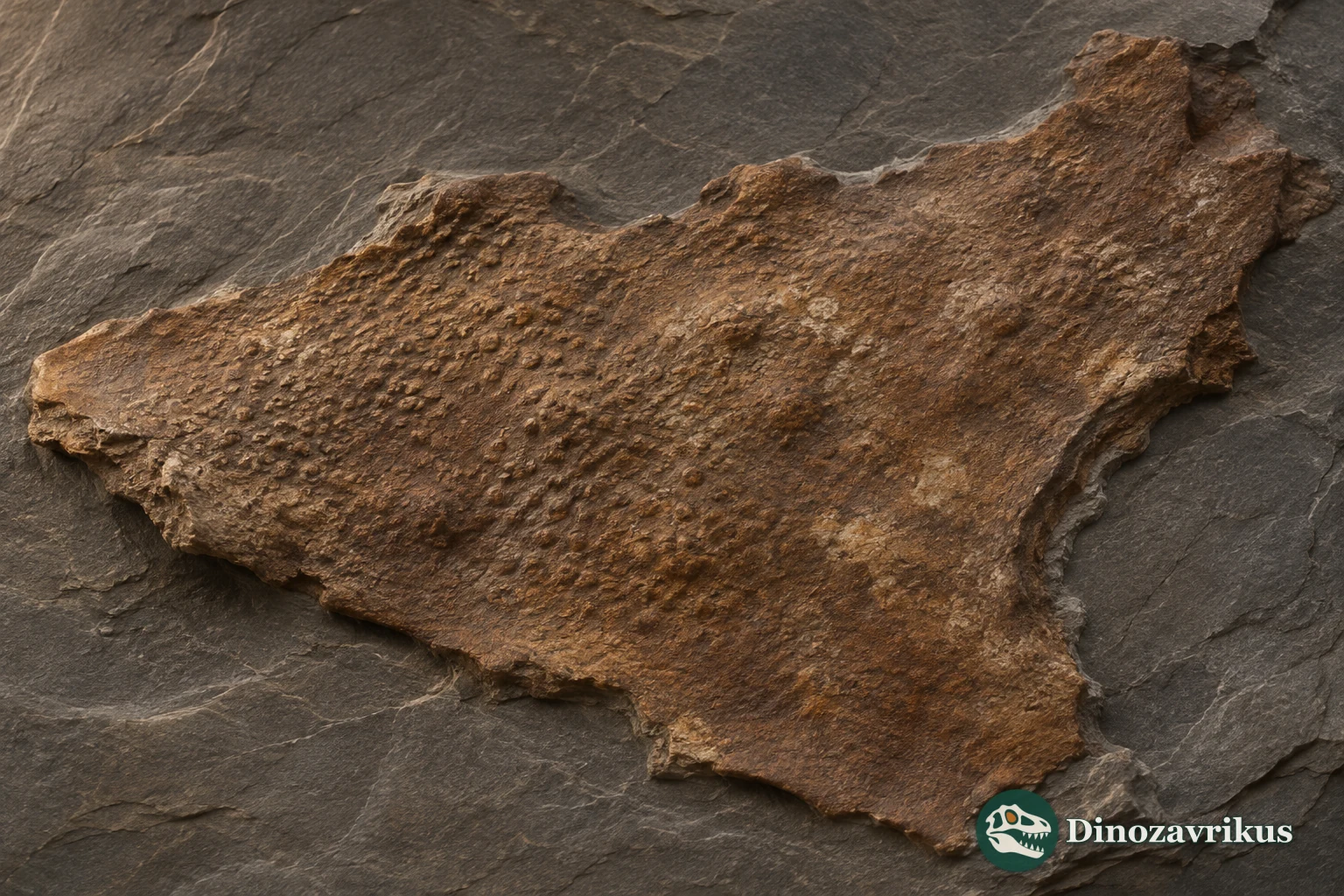
Holotype PIN 1584/7 preserves part of the interclavicle. It was found in beds of the Gamian Horizon.
Features of the shoulder girdle inform comparisons with other plagiosaurids. Published classifications place Melanopelta in the Plagiosterninae.
The material consists of isolated elements. It leaves the shape of the head, overall body proportions and total length uncertain.
A fossil from the Gamian Horizon
Mikhail Shishkin named Melanopelta antiqua in 1967. The fragmentary interclavicle is housed at the Paleontological Institute as PIN 1584/7. It comes from the Yarenga locality in the Lensky District of Arkhangelsk Region. The same horizon yielded Yarengia, named from a different part of the skeleton, the floor of the skull.
Isolated finds from other sites
An inventory of Early Triassic amphibians lists two quadratojugals and a rib from Okunevskoye, part of a clavicle from Yurokonsk and a vertebral centrum from Sukhoy II. The assignments provide evidence from several parts of the skeleton. The bones come from separate localities and cannot be assembled as one individual.
Comparing the shoulder girdle
The interclavicle lies between the clavicles on the underside of the body. Its outline and surface texture help palaeontologists compare plagiosaurids. Clavicles provide additional clues. When comparing a fossil from Poland, researchers noted a more massive plate and a stronger dorsal process in the clavicle assigned to Melanopelta. They pointed out that growth might account for part of the difference.
Frequently asked questions
What is the type specimen of Melanopelta?
Part of an interclavicle, catalogued as PIN 1584/7 at the Paleontological Institute.
When did Melanopelta live?
The type fossil comes from the Gamian Horizon, correlated with the late Olenekian of the Early Triassic.
Where was the holotype found?
At the Yarenga locality in the Lensky District of Arkhangelsk Region, Russia.
Is a complete skull known?
Only isolated elements have been assigned to the genus, including quadratojugals from the rear sides of the skull.