

Menomonia is distinguished by its long trunk and tiny tail shield. One specimen from Utah preserves 44 thoracic segments. Some of the rear segments are misshapen, and the cause is unresolved.
Quick facts
| Group | Trilobites, Menomoniidae |
|---|---|
| Age | Cambrian |
| Region | North America: United States and Canada |
| Type species | Menomonia calymenoides |
| Scientific name | Menomonia |
| Diet | Unknown |
What can the fossils tell us?
Paratype BPM 1010 is 39 mm long and preserves 44 thoracic segments.
Skeletons on one slab mainly face in two directions. The original study interpreted the alignment as evidence of some transport before burial.
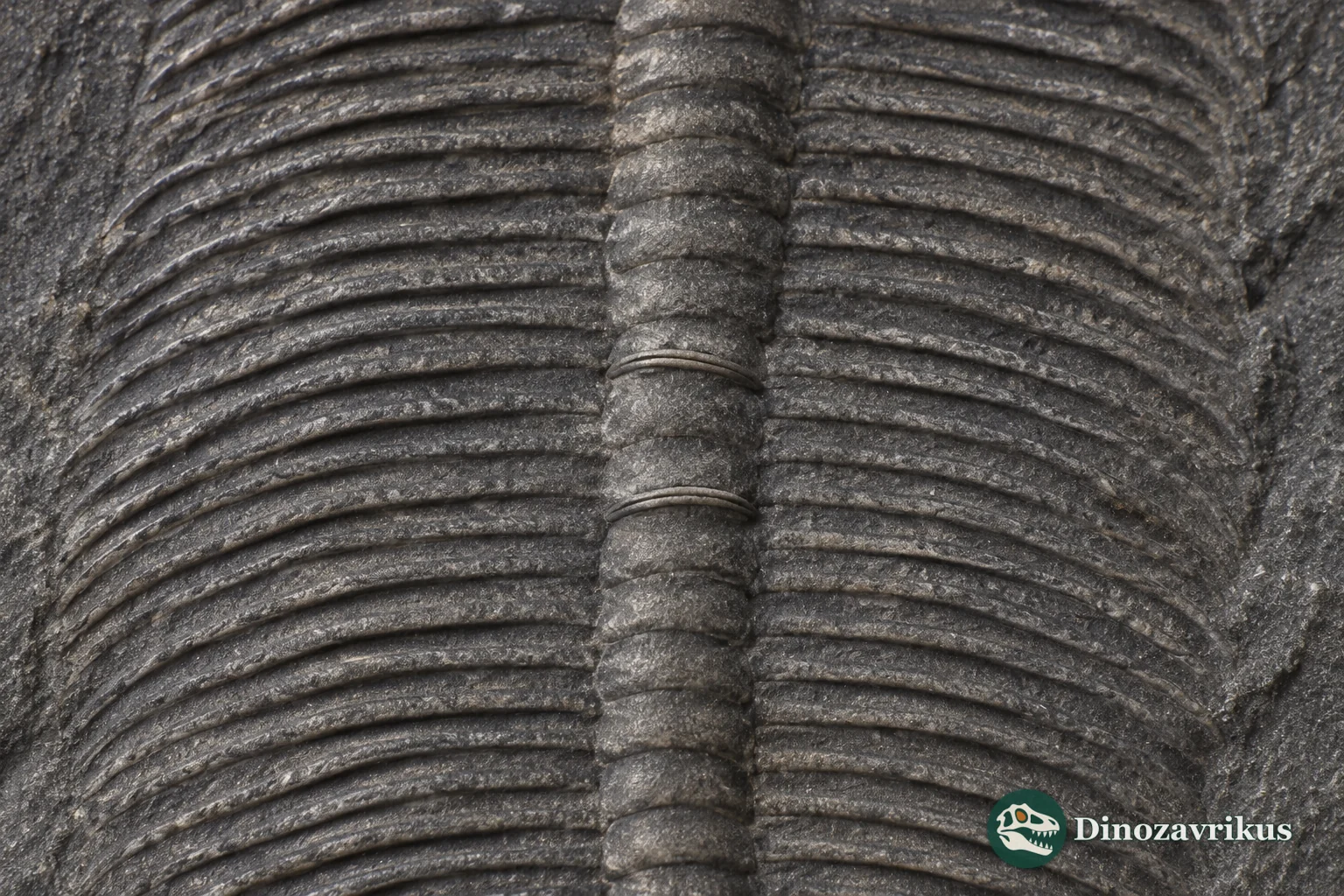
The incomplete rings may reflect a developmental abnormality or a healed injury. The fossil does not distinguish between these possibilities.
The long thorax in the Utah specimens
The outer ends of the thoracic segments are rounded in Menomonia sahratiani. Its tiny wing-shaped tail shield is much wider than long and has two axial rings. The holotype, UU 10051.52, measures 19 mm, with the pygidium hidden. The much larger paratype BPM 1010 is the specimen with 44 thoracic segments. Its posterior axis is locally distorted around incomplete axial rings.
The type species and its eyes
Whitfield described the type species in 1878 from material from the Eau Claire Formation in Wisconsin. Walcott established Menomonia in 1916. M. calymenoides has small but distinct palpebral lobes. The widespread M. semele has short eye stalks, whereas the low eye lobes of M. sahratiani are less sharply defined.
Several revisions treat Densonella as a junior synonym of Menomonia. Material of M. semele includes specimens from the Rabbitkettle Formation in northwestern Canada.
A slab from the Weeks Formation
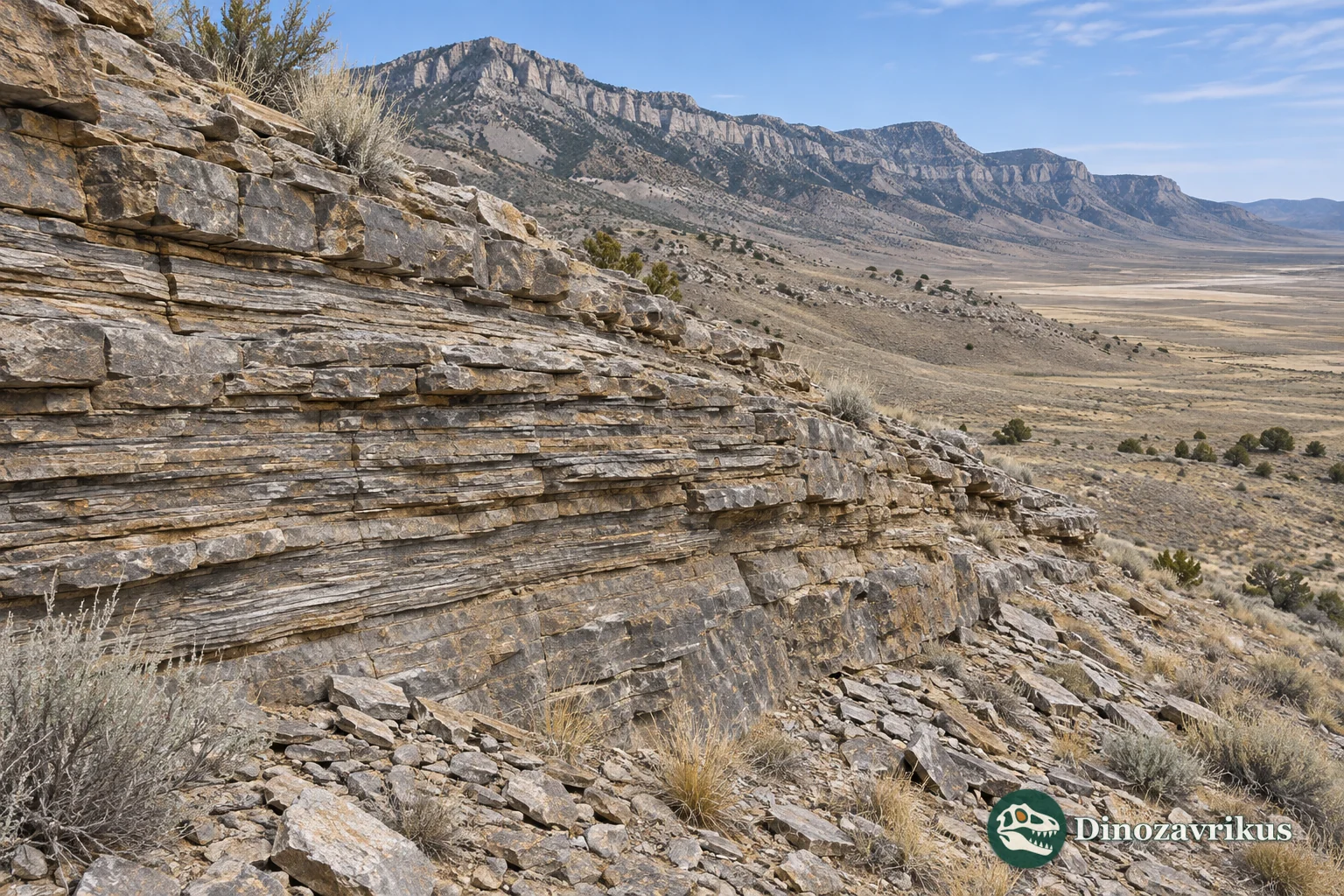
Articulated specimens of M. sahratiani come from the upper Weeks Formation in western Utah. Its fossil assemblage places these beds in the Cedaria Biozone, dated here to the late Guzhangian.
One slab contains sixteen outstretched, articulated shells of M. sahratiani alongside other trilobites. Their preferred alignment suggests some current transport before burial. The association alone leaves open whether the animals lived together.
Frequently asked questions
How many segments did Menomonia have?
A large specimen of M. sahratiani preserves 44 thoracic segments. The count comes from one named specimen.
How large was that specimen?
Paratype BPM 1010 is 39 mm long. The holotype of M. sahratiani measures 19 mm.
Did Menomonia have a prominent tail shield?
The pygidium of M. sahratiani is very small, short and wide. It is visible in the better preserved specimens.
Where were the long specimens found?
They were collected from the upper Weeks Formation in the House Range of western Utah.