

Menucocelsior arriagadai was a titanosaur from Late Cretaceous northern Patagonia. Its tail vertebrae were found alongside a handful of limb bones. Their association gave palaeontologists a rare opportunity to tell which features belonged together among the titanosaurs of the Allen Formation.
Quick facts
| Group | Sauropods (Titanosauria) |
|---|---|
| Age | Late Cretaceous (Maastrichtian) |
| Region | South America (Río Negro Province, Argentina) |
| Diet | Herbivore |
| Type species | Menucocelsior arriagadai |
| Holotype | MPCN-PV-798, an incomplete skeleton |
| Locality | Salitral Ojo de Agua, Allen Formation |
| Preserved material | Tail vertebrae and limb bones |
What can the fossils tell us?
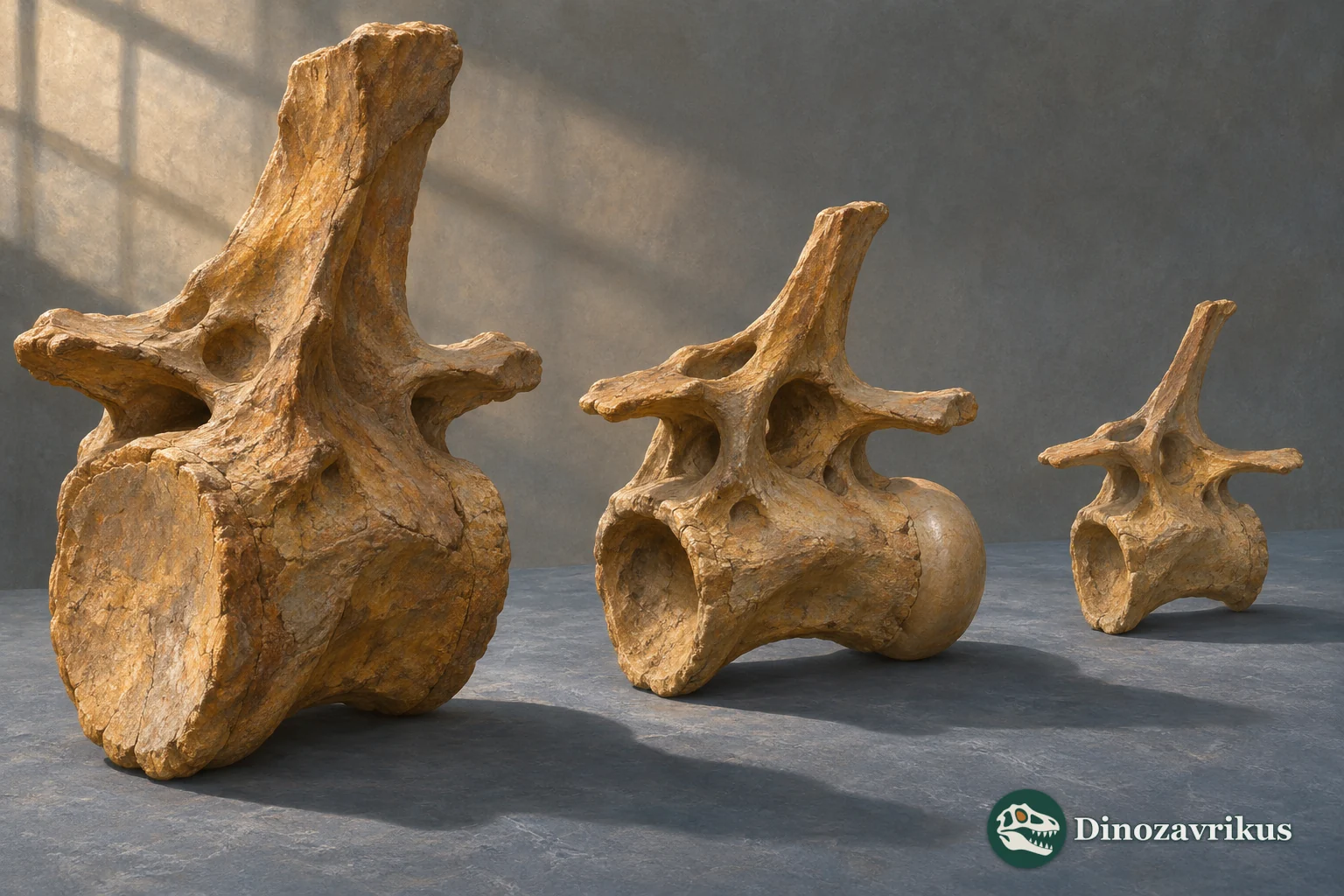
Tall vertebrae near the base of the tail give way to longer ones farther from the pelvis. The researchers used more complete titanosaur tails to infer their positions.
The flange extends over more than a quarter of the length of the bone. The authors considered this feature together with the shape of the upper arm and tail bones.
Isolated bones and armour plates from the area may belong to different animals. Anatomical details and their positions in the rock help test individual assignments.
An associated skeleton from Salitral Ojo de Agua
Mauro Aranciaga Rolando and colleagues described the genus from MPCN-PV-798. The paper went online in 2021 and appeared in the 2022 print volume. The genus name refers to its locality, and the species honours Beto Arriagada and his family for their help in finding and preserving fossils.
The Museo Patagónico de Ciencias Naturales holds the holotype. It includes vertebrae from the front and middle parts of the tail, a right humerus, a left fibula and an incomplete hand or foot bone. The positions of the vertebrae were inferred from their proportions and the shapes of their projections. No skull or neck bones are known from this skeleton.
How the tail and limbs distinguish the species
The tail vertebrae have a concave front and a convex back, as in many titanosaurs. Vertebrae close to the pelvis are relatively short and high. Farther back their bodies lengthen. These changes matter when comparing isolated vertebrae from different skeletons.
The deltopectoral crest, where muscles attached to the upper arm bone, ends before the midpoint of the humerus. The strong fibula has a projecting flange close to its lower end. Taken together with the tail bones, these features distinguish the holotype from other sauropods in the Allen Formation.
Several titanosaurs at one locality
Salitral Ojo de Agua also preserves Rocasaurus and material attributed to relatives of Aeolosaurus. Fossil armour plates of several shapes occur in the area. Their proximity alone cannot establish the presence of armour in Menucocelsior.
The authors proposed that the local titanosaurs might have used different food resources. Sauropod relationships support the broad plant-eating category for Menucocelsior, while the known skeleton leaves its specific diet unresolved.
Frequently asked questions
When did Menucocelsior live?
Its skeleton comes from the Maastrichtian part of the Allen Formation, near the end of the Cretaceous.
How are isolated vertebrae placed along the tail?
Palaeontologists compare their length and height and the arrangement of their bony projections with more complete tails.
Which part of the leg helps identify the species?
A conspicuous flange on the front of the lower fibula is among the anatomical features used in its diagnosis.
Did Menucocelsior have armour?
Armour plates occur at the locality. The type skeleton has no associated plates, so the presence of armour in this species remains uncertain.