

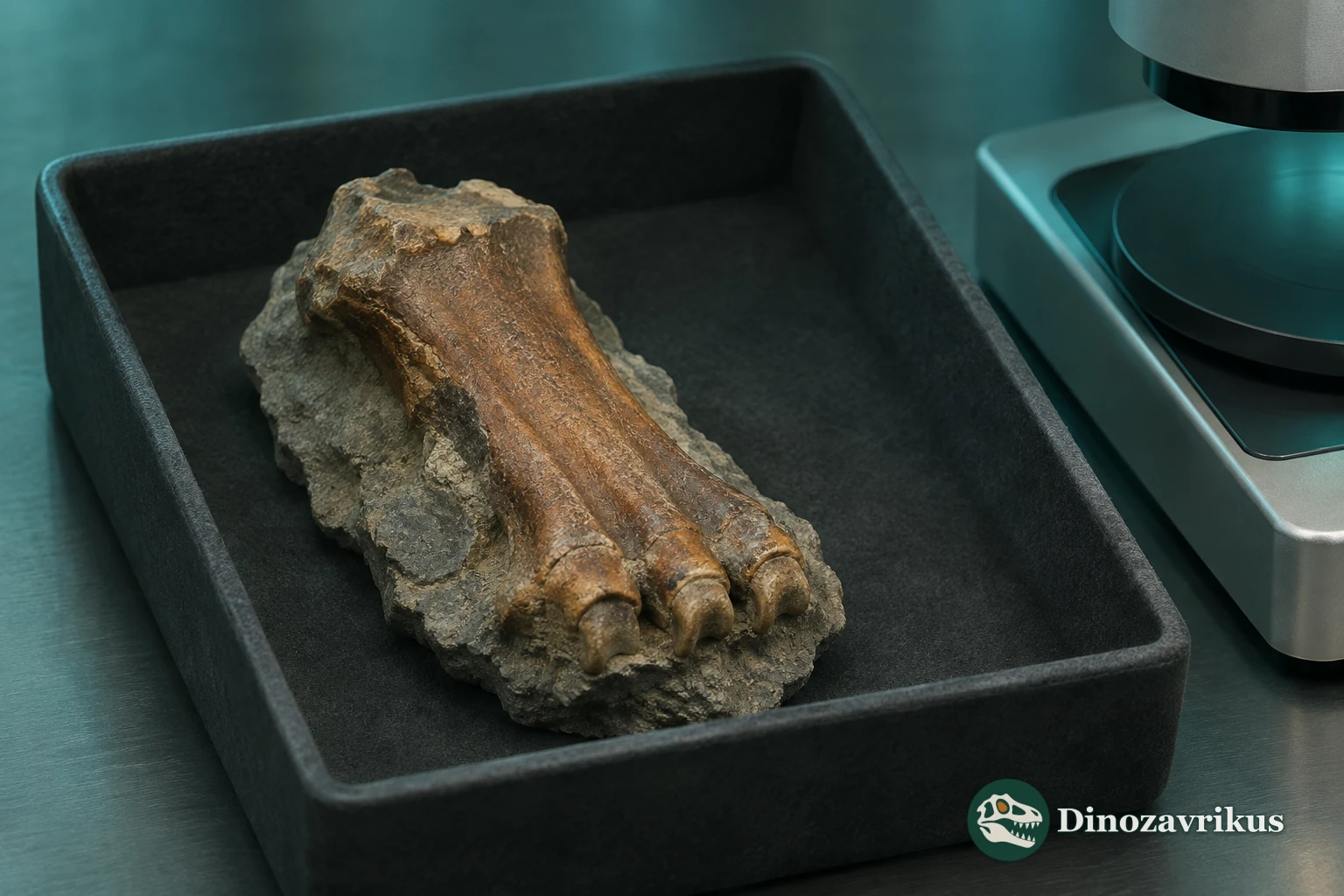
A foot bone about five centimetres long provided the first evidence of Mesetaornis. Its proportions and vascular openings distinguish the bird from other small penguins of Seymour Island. Nearly two decades after the original description, researchers used micro-CT to compare a second specimen with the type.
Quick facts
| Group | Penguins |
|---|---|
| Age | Late Eocene, Priabonian |
| Locality | Seymour Island, Antarctic Peninsula |
| Holotype | IB/P/B-0278 |
| Type foot bone length | 49.6 mm |
| Second diagnostic specimen | NRM-PZ A824 |
What can the fossils tell us?
The large medial vascular opening near the top of the type bone and its position help identify the species. A narrow groove on the underside also separates it from similar penguins.
The scans allowed digital removal of the sediment around NRM-PZ A824. They also revealed a dense framework of bone struts with relatively little space for large cavities.
The boundary between two parts of the foot bone is still visible internally. The authors took it as evidence of a relatively young bird. Its age in years remains unknown.
The type from Seymour Island
Andrzej Myrcha and colleagues named Mesetaornis polaris in 2002 after revising Polish and Argentine fossil collections. The type, IB/P/B-0278, is a near-complete left tarsometatarsus from scree attributed to Telm 7. The original description treated this as part of the La Meseta Formation. Later work calls this upper part of the succession the Submeseta Formation.
The genus name combines Meseta with Greek ornis, bird. The Latin epithet polaris refers to the polar region. Another small tarsometatarsus from scree, IB/P/B-0279b, shares some of the type’s features but was left unassigned at species level.
Recognising Mesetaornis from its foot
The type bone measures 49.6 mm at its greatest length and 16.1 mm across the middle. Of the vascular openings near the top of the bone, the one nearer the inner edge is appreciably larger. There is also a relatively narrow groove between two ridges on the underside. This combination helped distinguish Mesetaornis from Marambiornis, another small penguin from the Seymour Island deposits.
A second specimen under the scanner
Piotr Jadwiszczak, Marcelo Reguero and Thomas Mörs described NRM-PZ A824 from the Swedish Museum of Natural History in 2021. The new bone is 48.4 mm long and has nearly the same proportions as the type. Both have a conspicuous depression at the upper end of the third metatarsal, which is much less pronounced in Marambiornis.
Cemented sediment covered parts of the bone, including its toe joints. Micro-CT allowed the authors to inspect their surfaces virtually. The scans also revealed relatively small marrow spaces and a trace of the fusion between the tarsal and metatarsal parts. The authors interpreted the latter as evidence that the bird was relatively young.
A Late Eocene coast
The Submeseta Formation preserves shallow marine deposits off what is now the Antarctic Peninsula. Analyses of fossil shells record cooling through the succession. The feet identify Mesetaornis among the smaller penguins of those waters. They preserve no direct evidence of its colouring, precise body size or diving depth.
Frequently asked questions
What is a tarsometatarsus?
It is the long bone between the ankle and the toes of a bird. This is where the best diagnostic features of Mesetaornis are known.
How many specimens are securely identified?
The 2021 study described NRM-PZ A824 as the second secure record after the holotype. Other fragments have been assigned more tentatively.
Why was the second fossil scanned?
Hard sediment covered important parts of it. Micro-CT exposed their shapes digitally and revealed internal features associated with growth.
How can the bones be separated from Marambiornis?
Useful features include the position of the vascular openings, the narrow groove on the underside and the pronounced depression at the upper end of the third metatarsal.