

Mesodermochelys lived in the seas around Japan in the Late Cretaceous. Its bones place it in the leatherback lineage, and it retained a substantial bony shell. Grooves on a few midline bones give a partial record of the outer scutes.
Quick facts
| Group | Turtles, leatherback sea turtles (Dermochelyidae) |
|---|---|
| Age | Late Cretaceous (Campanian and Maastrichtian) |
| Region | Asia (Hokkaido and Kagawa, Japan) |
| Type species | Mesodermochelys undulatus |
| Holotype | HMG 5, partial skeleton with shell |
| Scientific name | Mesodermochelys |
| Diet | Exact diet unknown |
What can the fossils tell us?
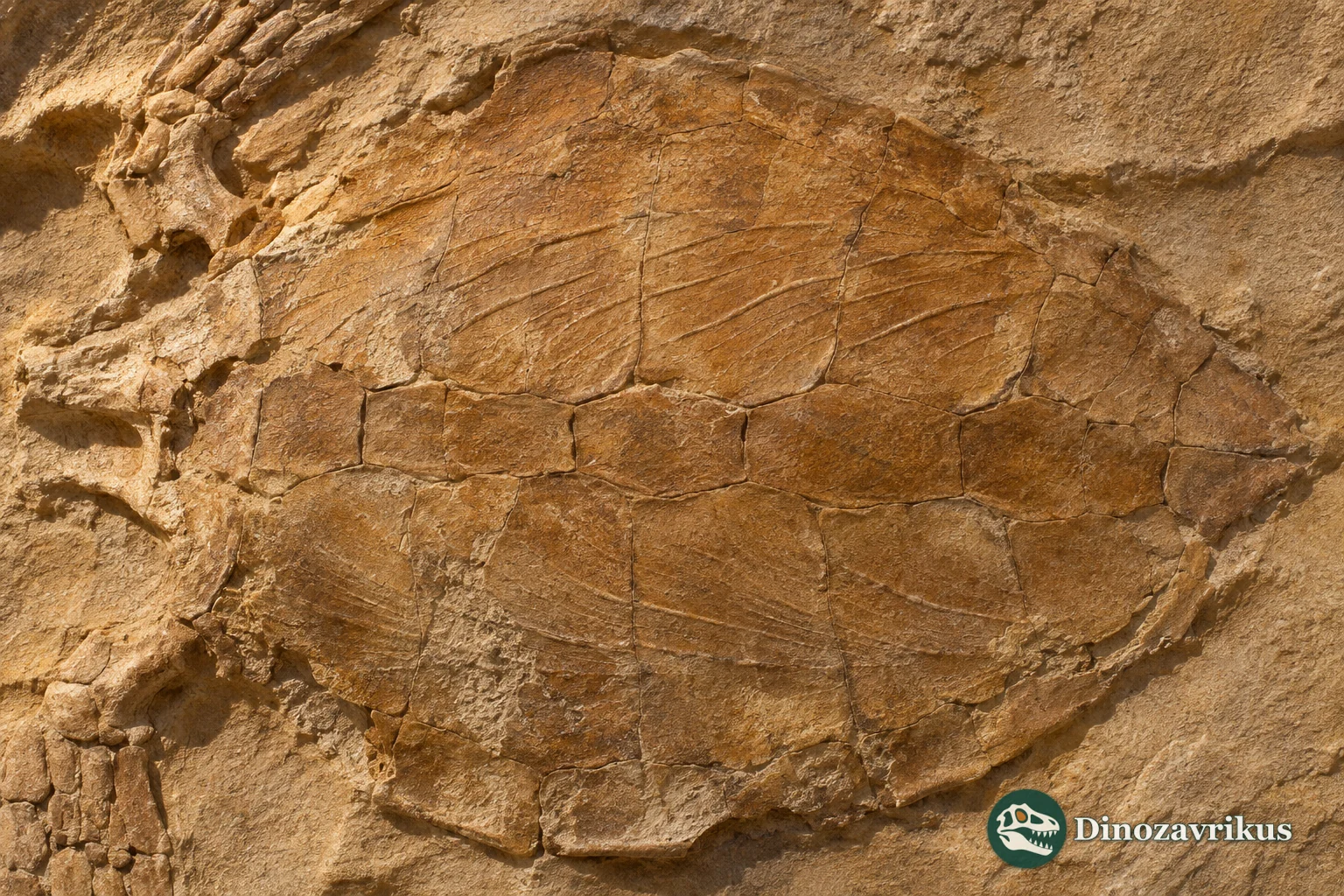
The type includes vertebrae and limb bones with much of the shell. Its upper shell is missing the front.
A few grooves on and near the midline record the positions of some scutes. The outer covering as a whole is harder to reconstruct.
The Izumi Group skeleton dates to the Campanian. It extends the record of the species beyond the Maastrichtian type locality.
The Hokkaido specimens
Ren Hirayama and Tsutomu Chitoku named Mesodermochelys undulatus in 1996. The type, HMG 5, was collected near Inasato in 1980. The early Maastrichtian specimen preserves vertebrae, limb bones, much of the carapace and an almost complete plastron. The authors described 15 specimens, including finds with portions of the skull or lower jaw.
Heavy bones beneath the outer covering
The third and fifth midline shell bones and the adjacent parts of neighbouring plates show traces of scute grooves. Broad peripheral bones have a distinctly wavy inner edge, the feature referred to by undulatus. The later leatherback relative Psephophorus had a mosaic of small bony elements in its covering. Mesodermochelys helps document an earlier form of shell in that lineage.
A diagnostic arm bone and a western find
The lateral process on the humerus extends forward. That feature allowed an isolated bone from northern Hokkaido to be identified. A partial skeleton from the late Campanian Izumi Group in Kagawa, catalogued as TKPM-GFV126, extends the record to western Japan. Its carapace was estimated at about 1.3 metres long.
Frequently asked questions
How old is the type specimen?
It is from early Maastrichtian deposits on Hokkaido.
What does undulatus refer to?
The wavy inner edge of the peripheral shell bones.
What do the grooves on the carapace show?
They preserve evidence for the position of certain scutes on the bony shell.
What was found in western Japan?
A partial late Campanian skeleton from Kagawa, catalogued as TKPM-GFV126.