

Psephophorus was a leatherback turtle whose type species is known from the small bones that made up its shell. Some of those bones rose into ridges along the back, with flatter pieces filling the spaces between them. Thin sections show how bone tissue developed in both parts of the mosaic.
Quick facts
| Group | Turtles, leatherbacks |
|---|---|
| Age | Miocene, middle Miocene for the type species |
| Region | Europe: Slovakia |
| Type species | Psephophorus polygonus |
| Neotype | NHMW 2011/0330/0001, slab with shell ossicles |
| Scientific name | Psephophorus |
| Diet | No direct evidence |
What can the fossils tell us?
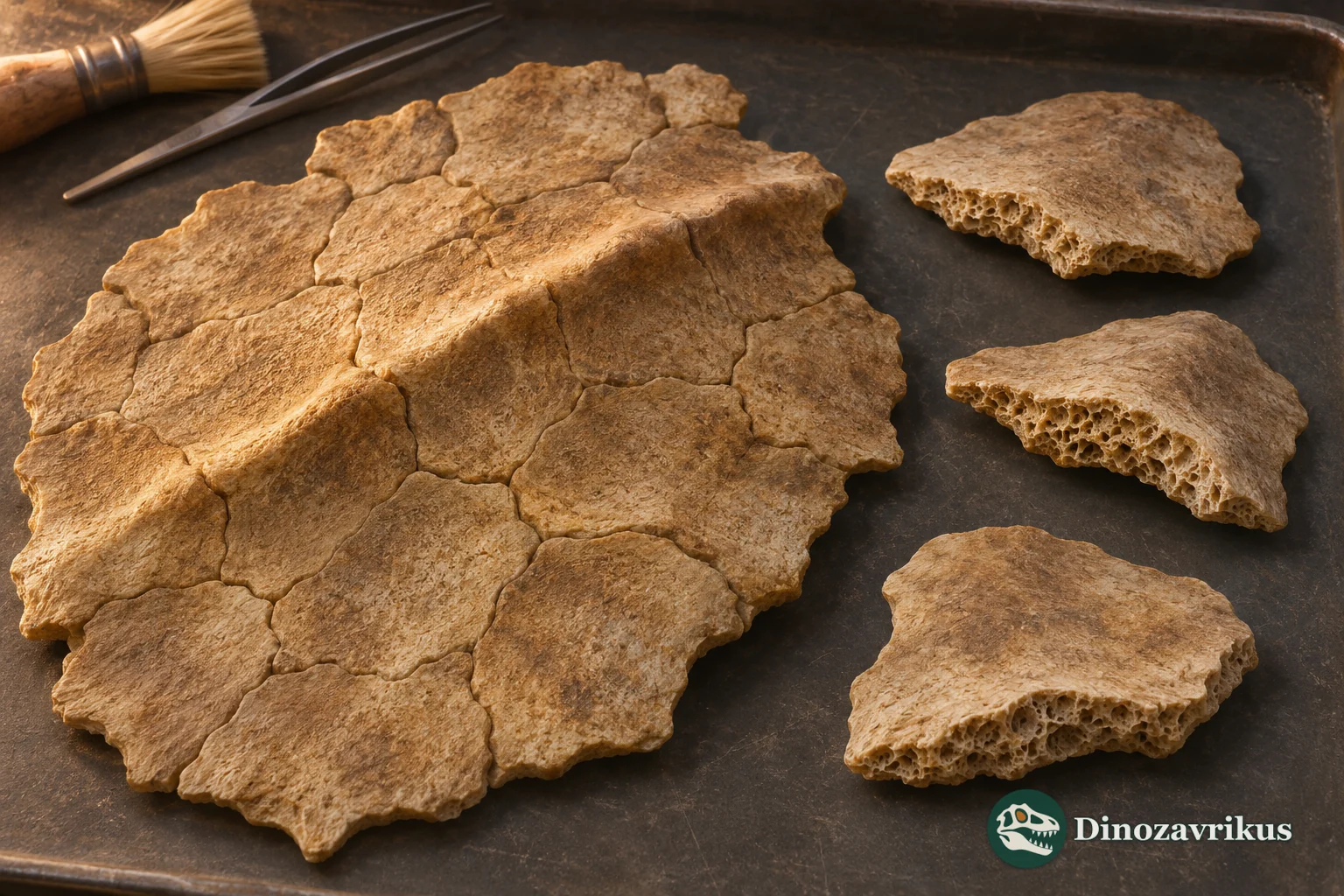
Slab NHMW 2011/0330/0001 shows how parts of the ridge and adjacent flatter plates fitted together. It preserves only part of the shell.
Sections through both ridge and flatter plates expose spongy bone between outer and inner dense layers.
Fossils from Sandberg come from marine deposits, placing the turtle near present-day Bratislava during the middle Miocene.
Shell fragments from Sandberg
Hermann von Meyer named Psephophorus polygonus in 1847 from shell bones found in what is now Slovakia. The locality is Sandberg, near Devínska Nová Ves on the outskirts of Bratislava. Sediments at the site accumulated in shallow water during the middle Miocene. The whereabouts of Meyer’s original material remain uncertain. A slab of adjoining ossicles in Vienna’s Natural History Museum now serves as the neotype.
A later study compared museum labels, older names for the locality and sediment attached to the bones. It documented additional material from Sandberg in collections in Vienna and Budapest, including small patches with neighbouring shell plates still together.
How to recognise the shell
The mosaic was made of small bones, known as ossicles, that formed in the skin. The plates on the ridges are thicker. In section some have a roof-like profile over a concave inner surface. The living leatherback often has a more sharply pronounced external keel on comparable plates.
Researchers also examined thin slices of the ossicles. The fossil plates contain spongy bone between dense inner and outer layers. In living leatherbacks, the inner layer is often reduced or lost during growth. That difference helps when an isolated fossil gives little indication of where it sat on the animal’s back.
What the material can tell us
The microscopic structure preserves signs of bone growth. Skin colour, flipper proportions and diet are poorly constrained by the Slovak material. A reconstruction can use living relatives for the overall silhouette and show the ridge structure recorded by the fossils.
Other fossil leatherbacks have historically been called Psephophorus. A 2013 reassessment restricted the diagnosis of the genus to what can be checked in the Slovak type species. The wider dates reported under older names are therefore not a reliable range for this species. Fossil jaws of Euclastes preserve evidence that can inform hypotheses about feeding.
Frequently asked questions
What is the neotype of Psephophorus?
It is slab NHMW 2011/0330/0001 in Vienna. The slab preserves a patch of the shell mosaic.
Where did the Slovak fossils come from?
The type locality is Sandberg near Devínska Nová Ves, outside Bratislava.
What made up the ridges on its back?
Rows of thicker bone plates formed the ridges. Flatter ossicles occupied the spaces beside them.
Does the shell tell us what Psephophorus ate?
The plates record shell anatomy and growth. They do not directly preserve evidence of diet.