

Metacervocerus was an early deer lineage known from late Pliocene and Early Pleistocene Eurasian fossils. The well-studied species M. rhenanus carried relatively light antlers with three points on each side: a first tine set above the burr and a fork near the end of the beam. It was unlike the heavy, many-branched antlers of some later deer, but horn outline alone does not settle its species boundaries.
Eugène Dubois named the deer from Tegelen Cervus (Axis) rhenanus in 1904. Dietrich introduced Metacervocerus in 1938, initially as a subgenus; the type species of the genus is M. pardinensis, not M. rhenanus. The Tegelen antler is the type of the species rhenanus.
Quick facts
| Family | Cervidae |
|---|---|
| Type species of genus | Metacervocerus pardinensis |
| Genus named | Dietrich, 1938, originally as a subgenus of Cervus |
| Early Pleistocene species | M. rhenanus, originally Cervus (Axis) rhenanus |
| Type of M. rhenanus | Left antler from Tegelen, the Netherlands |
| Evidence | Antlers, skulls, teeth and limb bones |
What can the fossils tell us?
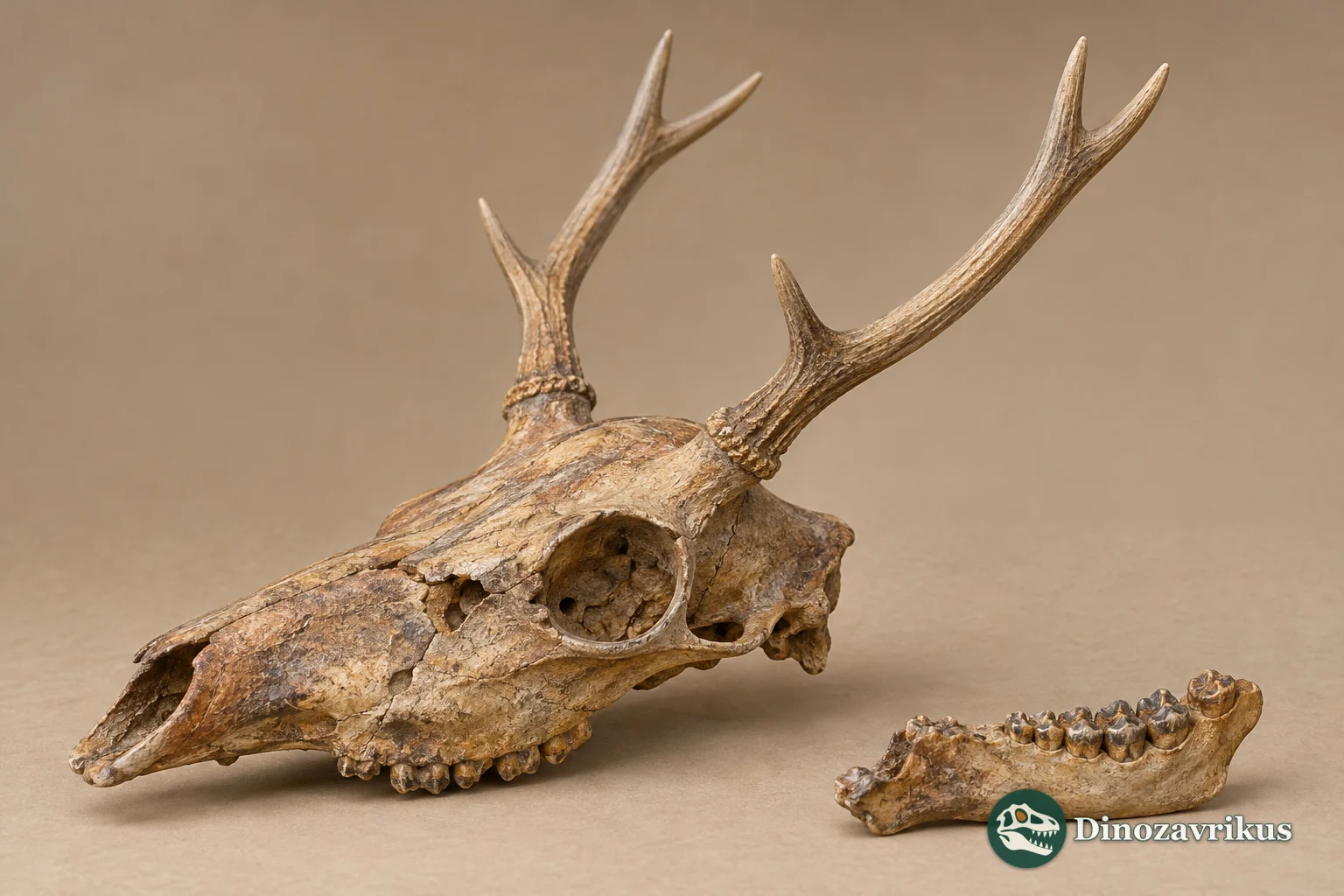
The Tegelen left antler and more complete skulls show a high first tine and a distal fork. Antler form varies among populations and cannot make every isolated antler a secure species identification.
Cranial proportions, pedicles and cheek-tooth details supplement the antlers. A broad anatomical analysis did not confirm every historical synonym proposed for M. rhenanus.
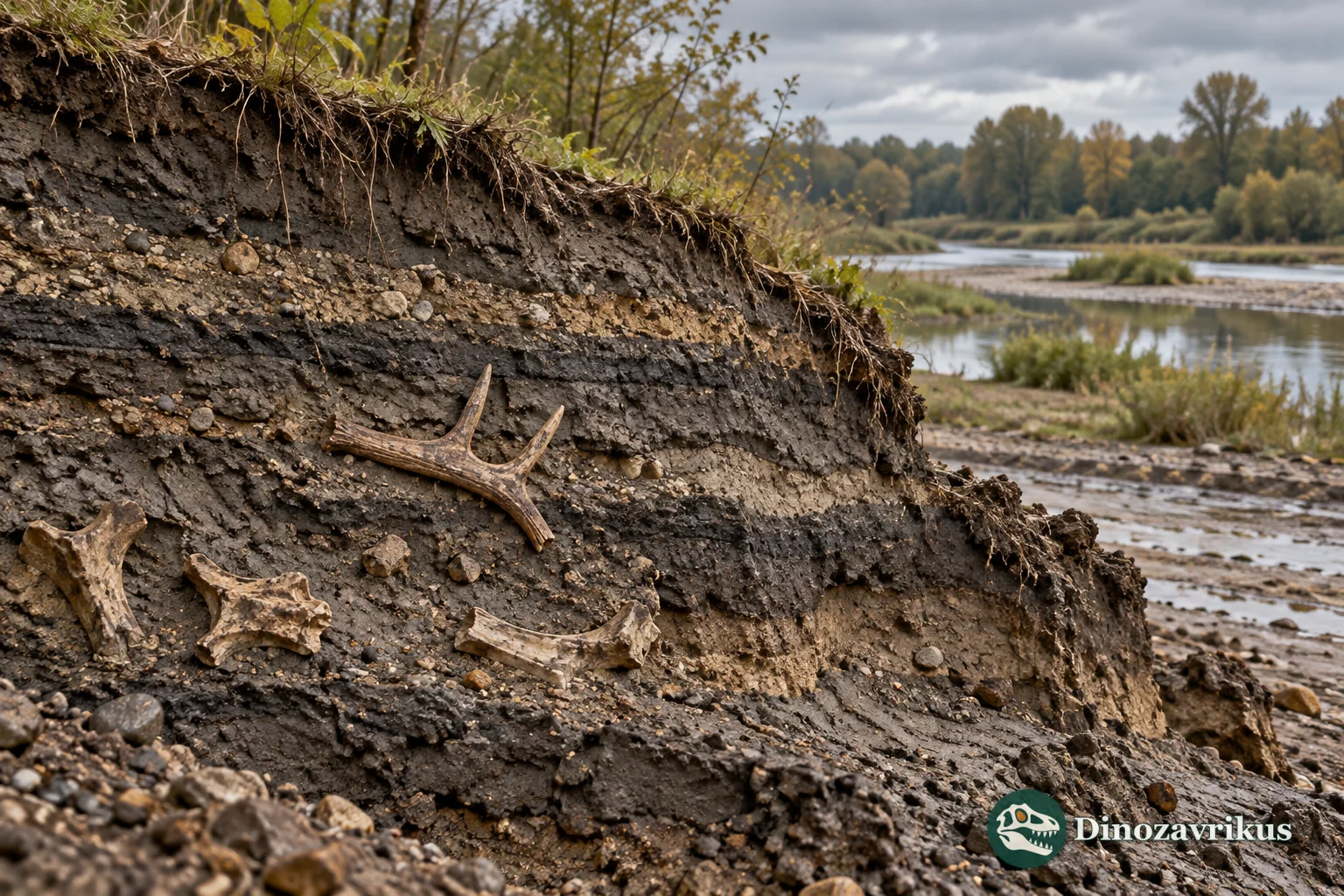
Many Tegelen large-mammal fossils were chance finds during clay extraction and lack exact layer positions. New Slovenian fossils add a southern locality but do not show that all European finds belonged to one contemporaneous population.
The Tegelen antler
The holotype of M. rhenanus is a left antler illustrated by Dubois in 1904. Paul Spaan later revised Tegelen deer using antlers, skulls and teeth. The fossils came from clay workings in Limburg, where workers recovered large mammal bones during commercial extraction. Precise stratigraphic positions are missing for many old finds, which limits any attempt to assign an exact calendar date to one antler.
Long pedicles slope somewhat backwards. The first branch begins well above the burr, while a distal fork completes the light three-pointed form. More complete skulls allow comparison of the braincase, eye sockets and tooth rows. Superficial resemblance to a living axis deer or fallow deer does not demonstrate direct ancestry.
Names that have moved between genera
Related fossils have been assigned to Cervus, Dama, Rusa and Pseudodama in different taxonomic treatments. Spaan associated the French name Cervus philisi with rhenanus on dental and antler characters. A later total-evidence analysis did not confirm that philisi, perolensis and rhenanus must be one species; their positions changed among analyses. Unequal preservation of comparable characters is one reason to remain cautious.
M. pardinensis is primarily Pliocene, while M. rhenanus is associated with the Early Pleistocene. Some studies place these deer near early cervine lineages, but a straight line to the living fallow deer has not been demonstrated. A diagnosis needs shared skull, antler and dental features, not a familiar silhouette.
Beyond the type locality
French skulls and antlers from Senèze reveal much more of M. rhenanus anatomy than the lone Tegelen type antler. Other European finds have sometimes been named local subspecies, and some identifications remain tentative. A study of Early Pleistocene Romanian ruminants used M. rhenanus ssp. for an incompletely known deer rather than claiming a securely diagnosable new subspecies.
Teeth and limb bones described from the Črnotiče quarry in Slovenia in 2026 were referred to M. rhenanus. They extend the documented southern European record, but the Slovenian material and the Dutch type come from different geological contexts. Sharing a name does not make them one population or precisely contemporaneous.
What the skeleton does and does not show
Skulls, teeth and limb fragments constrain the animal's head and general proportions. Body-mass estimates in particular populations rely on selected bones and scaling methods; one exact weight for the entire genus would imply more precision than the fossils support. The teeth establish plant processing but do not identify every food plant eaten by one animal.
The cover depicts a cautious rhenanus-like outline. Coat colour, seasonal behaviour and herd structure are not directly preserved. Eucladoceros offers a contrast in antler complexity, while Praemegaceros represents a separate larger deer lineage. Such comparisons clarify shape without replacing phylogenetic analysis.
Frequently asked questions
Did all Metacervocerus deer live at Tegelen?
No. Tegelen is the type locality of M. rhenanus; material assigned to the genus or close forms has been found elsewhere in Europe and Asia.
Is M. rhenanus the type species of the genus?
No. M. pardinensis is the genus' type species. Dubois' left Tegelen antler is the holotype of the species rhenanus.
Was this deer a proven ancestor of the modern fallow deer?
No. Resemblances led to that hypothesis, but anatomical analyses do not establish a direct ancestor-descendant sequence.
Why are older species names disputed?
Antlers, skulls and teeth from different sites are preserved unevenly. Later comparisons did not support every proposed synonym of M. rhenanus.