

Microposaurus was a Triassic temnospondyl amphibian. Two species are known from incomplete skulls found in South Africa and eastern Australia. One of their clearest shared features is the shape of the front edge of the nostril, where a notch made room for an enlarged tooth of the lower jaw.
Quick facts
| Group | Temnospondyls, trematosaurids (Trematosauridae) |
|---|---|
| Age | Triassic |
| Region | Africa and Australia (South Africa and the Sydney Basin) |
| Type species | Microposaurus casei |
| Scientific name | Microposaurus |
| Diet | Exact prey is unknown |
What can the fossils tell us?
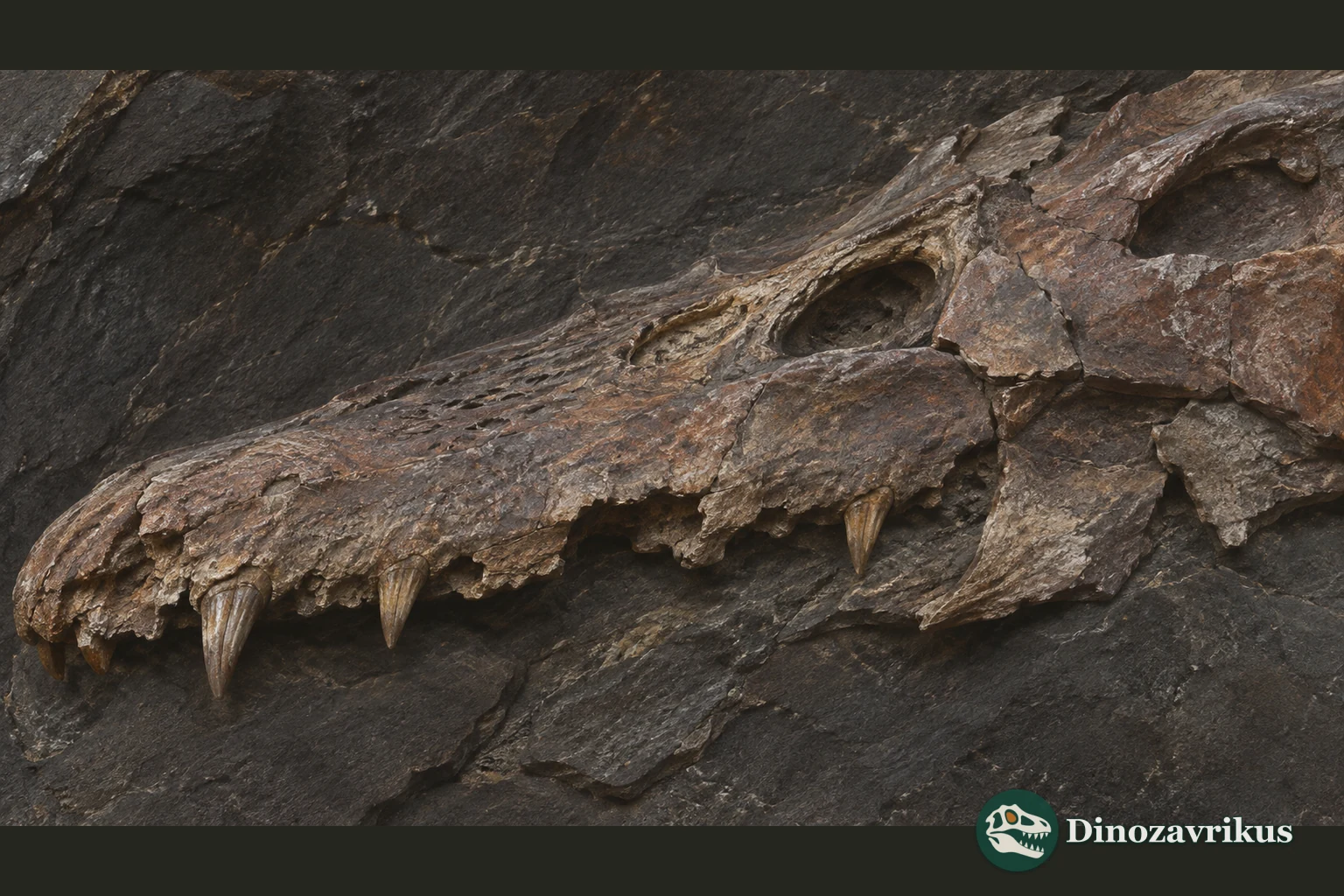
The type species is based on a skull from the Karoo. The Australian specimen AM F135895 preserves the front of the skull with the lower jaw attached.
The notch at the front of the nostril aligns with an enlarged tooth of the lower jaw. The opening is more pronounced in the Australian species.
The teeth and corresponding notches reveal features of the jaws. The available skull material leaves the exact prey uncertain.
Two incomplete skulls
Sidney Haughton described Microposaurus casei in 1925 from a fragmentary skull from the Burghersdorp area of the Karoo Basin. Ross Damiani redescribed the holotype in 2004 after further preparation. In 2012 Anne Warren named the Australian species Microposaurus averyi from the front part of a skull with its lower jaw still articulated. The specimen, AM F135895, came from Middle Triassic beds southeast of Picton in the Sydney Basin.
How the jaws fitted together
In both species the front edge of the external nostril has a notch that made space for an enlarged lower tooth. The Australian species has the larger opening. This feature shows part of the relationship between the upper and lower jaws when the mouth closed. In another Triassic temnospondyl, Edingerella, researchers can follow tooth rows in skulls of different ages. Microposaurus is known from a much smaller set of specimens.
Frequently asked questions
Where was Microposaurus first described from?
The type species, Microposaurus casei, was named from a partial skull from the Karoo Basin of South Africa.
What does the Australian specimen preserve?
AM F135895 preserves the front of the skull with the lower jaw articulated.
What were the notches in front of the nostrils for?
They made room for enlarged teeth of the lower jaw when the mouth closed.
How long was Microposaurus?
The incomplete skulls do not give a reliable full body length.