

Moganopterus zhuiana is represented by a long, narrow skull and four neck vertebrae, without wings or the rest of the body. This unusually large toothed skull prompted early claims of an enormous wingspan. A 2022 restudy separated direct measurements from estimates based on other species, and changed both its family assignment and the geological unit attributed to the fossil.
Quick facts
| Scientific name | Moganopterus zhuiana, Lü and colleagues, 2012 |
|---|---|
| Holotype | HGM 41HIII-0419, skull and four cervical vertebrae |
| Locality | Near Xiaosanjiazi, Jianchang County, Liaoning, China |
| Rock unit | Initially Yixian Formation; later reassigned to Jiufotang |
| Skull length | About 74 cm in the 2022 remeasurement |
| Wingspan | About 3.5 m from a model; no wing is preserved |
What can the fossils tell us?
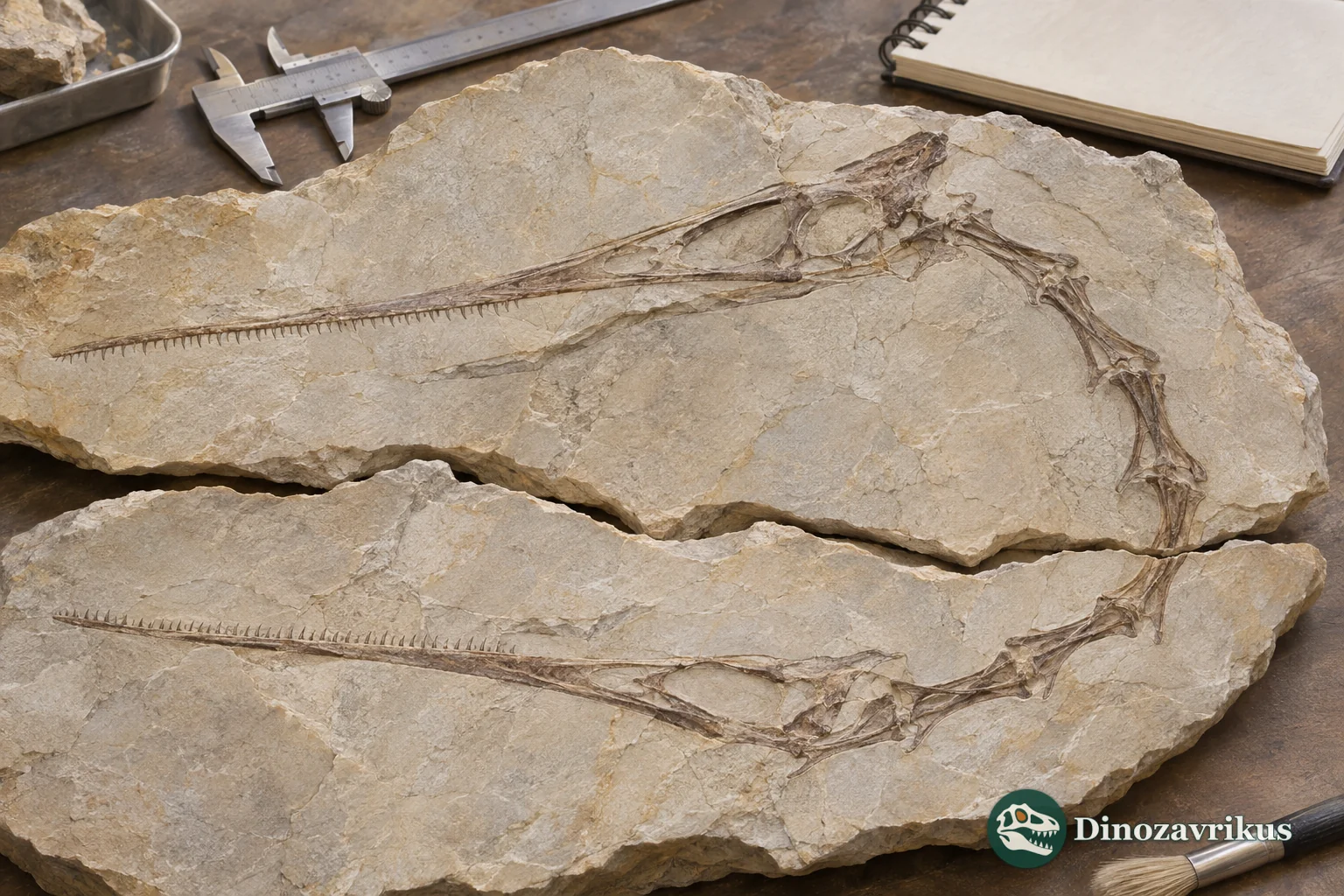
The holotype has nearly complete upper and lower jaws and four cervical vertebrae on two slabs, but no wings.
The dental arrangement is preserved, while prey choice and feeding behaviour are not.
A regression across ctenochasmatids produced about 3.46 m. It assumes comparable proportions and does not measure a Moganopterus wing.
Later work reassigned the locality from Yixian to Jiufotang and the taxon from boreopterids to ctenochasmatids.
A fossil from western Liaoning
Holotype HGM 41HIII-0419 is held by the Henan Natural History Museum, formerly the Henan Geological Museum. It was collected near Xiaosanjiazi village in Jianchang County. Upper and lower jaws and four neck vertebrae are distributed across a slab and counterslab. No articulated wing or trunk accompanies them.
The 2012 description assigned the horizon to the Yixian Formation. Later studies reassigned it to the Jiufotang Formation. The fossil did not move: its geological interpretation changed. Both assignments refer to the Early Cretaceous, and the old formation name should not be used to attach a falsely exact date to the skull.
What the restudy measured
Gao and colleagues redescribed the specimen in 2022. They measured roughly 740 millimetres from the anterior premaxilla to the squamosal, with the rostrum occupying about two thirds of skull length. The jaws bear about one hundred slender teeth. A low crest sits near the front of the skull, while a long rod-like parietal crest projects backwards and upwards. Soft tissues on either crest are not preserved.
The team also reinterpreted openings in the crushed skull. A shape previously taken for the orbit was reassessed, and deformation explained the unusual outline of a neighbouring opening. Boreopterus helps explain the original family comparison, but similarly long jaws are not enough to settle relationship.
From boreopterids to ctenochasmatids
The original publication placed the genus in Boreopteridae. Later phylogenetic comparisons questioned that arrangement, and the 2022 restudy described Moganopterus as a large ctenochasmatid. Forfexopterus is another ctenochasmatid reported from the Jiufotang Formation, although shared broad provenance does not prove identical ecology.
Many slender teeth allow hypotheses about taking small prey. No stomach contents, associated prey or feeding trace identifies a particular food item. Their number alone does not prove filter feeding.

Why wingspan estimates changed
The first estimate exceeded seven metres, and a later comparison suggested about 4.2 metres. The 2022 authors regressed skull length against known wingspan in other ctenochasmatids, yielding about 3.46 metres for the holotype. This model depends on proportional similarity between taxa. It is not a centimetre-precise measurement of an actual Moganopterus wing.
Artwork can show the preserved long jaw outline, but its wing proportions, skin, colour and movement above a lake remain interpretive. A securely associated wing would provide the direct test of the current estimate.
Frequently asked questions
How many Moganopterus fossils are described?
The 2022 restudy treats HGM 41HIII-0419 as the known holotype: a skull with jaws and four cervical vertebrae.
Why do sources name two formations?
The 2012 description assigned the locality to the Yixian Formation; later work reassigned it to the Jiufotang Formation.
Did it have a seven-metre wingspan?
That was an early estimate without preserved wings. A 2022 comparison based on skull length suggested about 3.5 metres, still a model rather than a direct measurement.
What did Moganopterus eat?
Its jaws carried around one hundred slender teeth. They suggest possible capture of small prey but do not establish a specific diet.