

Mollisonia symmetrica was a small Middle Cambrian arthropod with a rounded head shield, seven similar trunk tergites and a posterior shield ending in three projections. Its type fossil preserves mainly the dorsal exoskeleton. Reports of an unusually organised nervous system come from other slabs and depend on interpreting faint carbonaceous traces, making the animal a case study in both exceptional preservation and scientific disagreement.
Charles Doolittle Walcott named M. symmetrica in 1912. Its fossils and changing classifications are included in the ancient arthropod catalogue, alongside other Cambrian forms whose relationships are tested with incomplete anatomical evidence.
Quick facts
| Scientific name | Mollisonia symmetrica Walcott, 1912 |
|---|---|
| Group | Arthropod; the genus is placed among early chelicerates in recent analyses |
| Age | Middle Cambrian, about 505 million years ago |
| Localities | Burgess Shale, British Columbia; related records from Utah |
| Type specimen | Holotype USNM 57659, Smithsonian National Museum of Natural History |
| Measured fossils | Holotype 48 mm; USNM 189155 about 79 mm |
| Notable evidence | Neural traces on separate slabs have competing interpretations |
What can the fossils tell us?
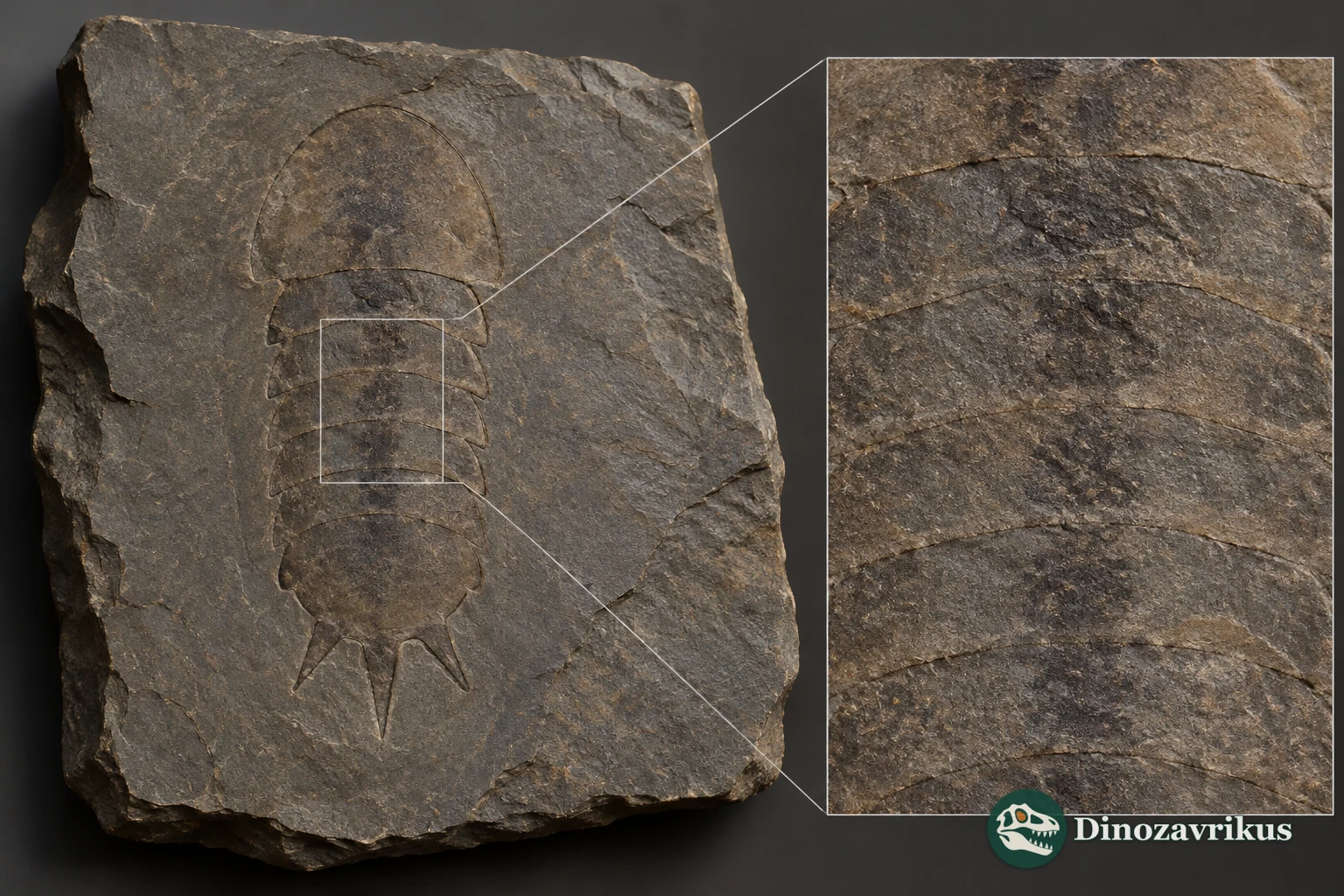
Holotype USNM 57659 is 48 mm long and preserves a dorsal exoskeleton. A different specimen, USNM 189155, measures about 79 mm. Soft limbs and internal anatomy are described from other fossils and cannot be assumed visible on every slab.
M. symmetrica has a rounded head shield, seven trunk segments of similar width and a rounded posterior shield with three projections. The identity and number of some appendage-bearing segments remain debated in comparative reconstructions.
Studies published in 2022 and 2025 proposed optic nerves, ganglia and a ventral nerve cord on compressed specimens. A 2026 commentary challenged the stronger arachnid interpretation; fine carbon films and flattening limit what can be identified directly.
Morphological studies place Mollisonia among early chelicerates, while a 2025 analysis of neural characters proposed a position on the arachnid stem. A 2026 critique rejected that stronger conclusion. The fossils do not show that Mollisonia was a spider or a direct ancestor of spiders.
Walcott's type and a history of shifting names
Walcott described Mollisonia symmetrica and M. gracilis in 1912, each initially from a single specimen. The holotype of M. symmetrica, USNM 57659, is held at the Smithsonian National Museum of Natural History and measures 48 mm. A different specimen, USNM 189155, preserves a longer outline of about 79 mm. Dozens of additional fossils are known from the Walcott Quarry, with rarer material from nearby localities and other Cambrian deposits.
The genus-level record includes several names that should not be casually combined. Simonetta and Delle Cave synonymised Mollisonia? rara with M. symmetrica in 1975. A later soft-tissue specimen once assigned to M. gracilis was removed to the separate genus Houghtonites. M. sinica was described from China's Kaili Formation, not the Burgess Shale. Each species may preserve a different subset of the anatomy.
A compact outline with seven tergites
The dorsal outline of M. symmetrica is elongated and approximately symmetrical. Its rounded head shield bears anterior projections and oval structures on some specimens. Seven thoracic segments of similar width connect it to a rounded posterior shield with three projections. Fossil lengths of 48 and 79 mm refer to separate slabs; neither gives body mass.
The holotype does not show a full set of limbs. Later discoveries and study of other Mollisonia species have contributed chelicerate-like appendages and lamellate outer branches to the genus-level reconstruction. The best-known chelicera-like structures belong especially to M. plenovenatrix, a different species. They cannot be transferred without qualification to M. symmetrica. A 2026 comparative reconstruction also treated some front appendage details and the segmentation of the rear shield more cautiously than earlier diagrams.
Fossilised nerves and competing interpretations
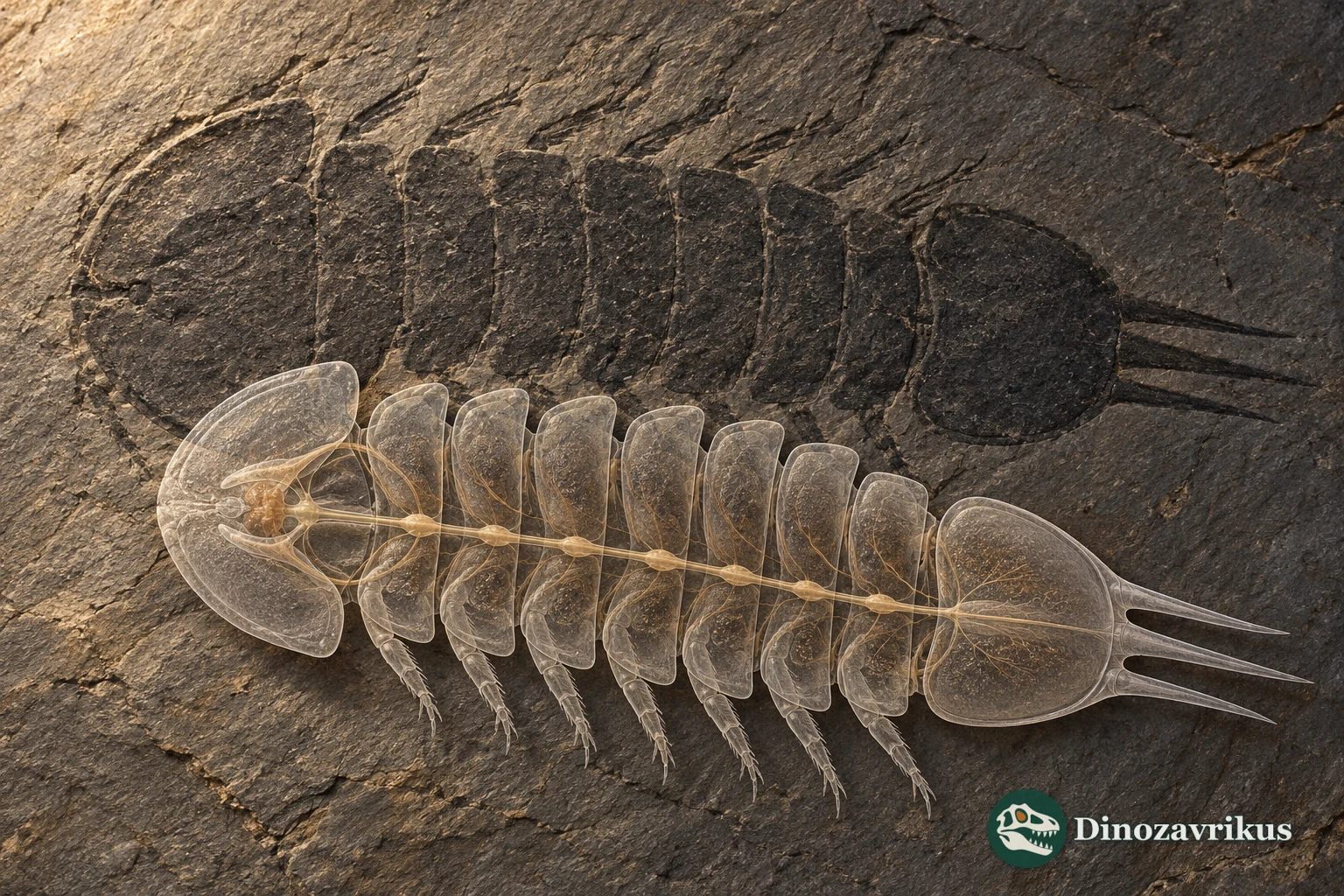
In 2022, researchers described traces they interpreted as parts of the central nervous system in M. symmetrica: optic nerves, a cephalic neural mass and a segmented ventral nerve cord. They proposed that the reflective carbonaceous films lay beneath phosphatised digestive structures. This is an interpretation of contrasting marks in a compressed fossil, not an isolated three-dimensional brain. Their analysis placed the animal on the chelicerate stem and treated the nervous anatomy as evidence for an ancestral organisation.
A 2025 study proposed a different emphasis: it interpreted the arrangement as a recurved, unsegmented brain and argued that this pattern linked Mollisonia more closely with arachnids such as spiders and scorpions. The authors used neural characters to recover the fossil near the arachnid stem. The claim was stronger than simply identifying Mollisonia as an early chelicerate, and it prompted a formal exchange in 2026.
Why the arachnid claim is disputed
In February 2026, Samuel Bolton, Markus Friedrich and Prashant Sharma argued that the proposed arachnid placement rests heavily on the interpretation of the neural marks. They noted that the wider body plan does not clearly resemble arachnids and that the published analysis failed to recover some well-supported groups of living chelicerates. The authors of the 2025 study replied that their analysis specifically tested neural evidence against comparisons with living arthropods. This exchange does not erase the fossil traces; it shows that their identification and phylogenetic weight are contested.
A 2026 Nature study of the separate fossil Megachelicerax cousteaui supports a broader Cambrian history for chelicerates and recognises mollisoniids among the total-group chelicerates. That wider placement does not independently establish Mollisonia as an arachnid. It is useful to keep the claims separate: early chelicerate affinity is broader and better supported than a specific position near modern spiders.
Comparisons with Habelia and Leanchoilia can clarify how early arthropod head shields and appendages differ. They do not make the genera interchangeable or resolve the neural debate by resemblance alone.
Habitat and uncertain ecology
The principal Burgess Shale material comes from the Walcott Quarry on Fossil Ridge, with a few specimens from the Trilobite Beds on Mount Stephen and other nearby sites. M. symmetrica is uncommon in the quarry census. The museum account describes the species as mobile and likely nektobenthic, moving near the bottom or just above it; feeding strategy remains unknown.
No gut contents identify prey, and a proposed chelicera in another species does not establish a specific diet for M. symmetrica. The reconstruction below is therefore a plausible seafloor setting, not a scene documented by the fossil. These animals lived in the marine ecosystems of the Cambrian Period, where rapid burial could preserve carbon films otherwise lost to decay.
Evidence, inference and reconstruction
| Direct evidence | Dorsal shield, seven trunk tergites, posterior projections and contrasting internal traces on separate slabs |
| Research inference | Early chelicerate affinity and possible nervous-system structures |
| Disputed | Whether the neural organisation supports a position close to Arachnida |
| Artistic reconstruction | Colour, soft tissues, exact feeding behaviour and neural overlays |
Frequently asked questions
When did Mollisonia symmetrica live?
It lived in the Middle Cambrian, about 505 million years ago. The best-known fossils come from the Burgess Shale of British Columbia.
How large was Mollisonia?
The holotype USNM 57659 measures about 48 mm; another specimen, USNM 189155, is about 79 mm long. These are fossil-outline measurements, not mass estimates.
Was a brain found in Mollisonia?
Researchers have interpreted carbonaceous marks on separate slabs as neural tissues, including a ventral nerve cord and head structures. Their exact identity and arrangement are debated.
Was Mollisonia an early spider?
That is a disputed hypothesis, not an established fact. Some authors proposed an arachnid-stem position from neural characters; a 2026 critique challenged that result, while broader placement among early chelicerates has stronger support.