

Two species of Monocheilus from Oklahoma have strikingly different eye-lobe proportions. The difference persists when specimens of similar size are compared. Set alongside other features of the head and tail, the new material also supplies evidence for merging genera that had long been kept apart.
Quick facts
| Group | Trilobites |
|---|---|
| Age | Late Cambrian, Furongian |
| Region | North America |
| Diet | Unknown |
| Type species | Monocheilus anatinus |
| Genus named by | Charles Resser, 1937 |
What can the fossils tell us?
Small cranidia of Monocheilus reginae have longer eye lobes relative to the glabella than similarly sized M. richardi. In both species, the ratio decreases in larger specimens.
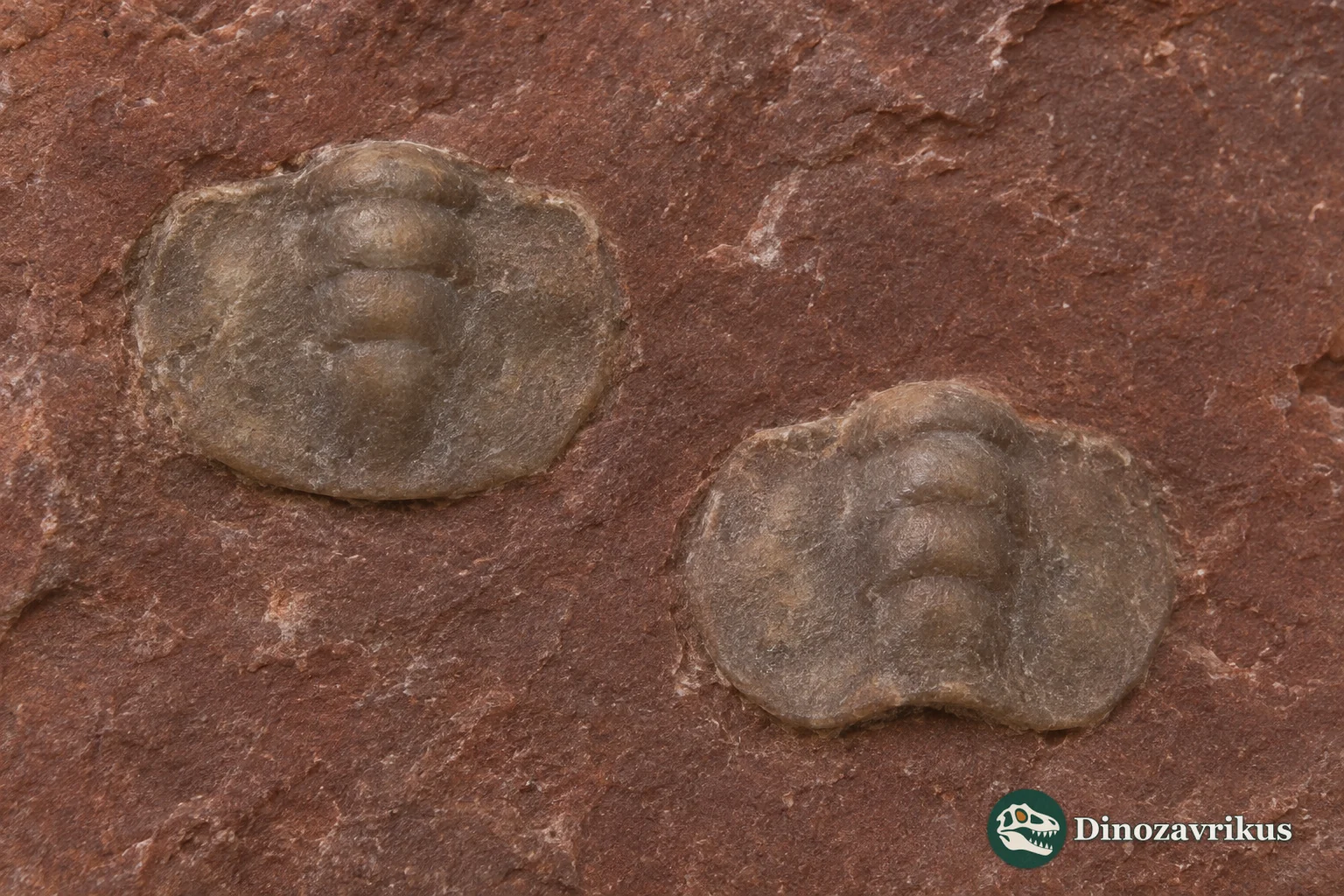
Detached pygidia preserve different profiles and textures. Most cannot be paired with a head shield from the same individual.
Both Oklahoma species occur near the top of the Honey Creek Formation. The surrounding fossils make this interval useful for regional correlation.
The Bally Mountain specimens
Charles Resser established Monocheilus in 1937. The type species was originally described as Conocephalites anatinus by James Hall from material from Wisconsin. Sean Blackwell and Stephen Westrop reported two more species in 2023 from the upper Honey Creek Formation at Bally Mountain, Kiowa County, Oklahoma.
The holotype of M. reginae, OU 238158, is a cranidium, the central portion of the head shield. Cranidia of M. richardi occur in the same collection, BM 79.4T. Both have fine pits on the surface of the shield. Other species of the genus, such as M. micros, may be comparatively smooth.
The assemblage is dominated by Monocheilus and occurs with Ptychaspis. The authors noted parallels in Alberta and the Upper Mississippi Valley and interpreted it as part of a change from a low-diversity fauna after a late Cambrian extinction to more diverse assemblages.
What the eye lobes reveal
Blackwell and Westrop measured the palpebral lobe relative to the length of the glabella in front of the occipital ring. In small specimens of M. reginae the ratio is 56–64%, compared with 42–50% in similarly sized M. richardi. The proportion decreases with size in both species. Values around 42% in large individuals of M. reginae approach values recorded in much smaller M. richardi.
An eye lobe is an external feature of the shell. Its size contributes to identification without measuring visual acuity. The fossils also include outer cheeks, trunk segments and tail shields that are not articulated. The separate finds do not establish which species bore every pygidium.
A revision of two genus names
Earlier studies distinguished Stigmacephalus from Monocheilus. The shorter lobes of M. richardi are comparable to those of the type species of Stigmacephalus, S. oweni. The longer lobes of M. reginae resemble those of species previously placed in Monocheilus. The similarities in the head, free cheeks and pygidia led the authors to treat Monocheilus as the senior synonym.
Known pygidia have a short convex axis with one ring ahead of the terminal portion and almost flat areas to either side. These features help compare isolated trilobite shields. The material gives little basis for estimating whole-body length in the Oklahoma species and no direct record of diet.
Frequently asked questions
Why was Stigmacephalus put in Monocheilus?
The Oklahoma species link morphologies previously assigned to separate genera. The revision also found similarities in free cheeks and tail shields.
Where were the two Oklahoma species found?
They come from the uppermost Honey Creek Formation at Bally Mountain in Kiowa County.
Which species has the longer eye lobes?
In specimens of similar size, Monocheilus reginae has longer lobes relative to the glabella than M. richardi. Lobes become proportionally shorter in larger individuals of both species.
What is known of the tail shields?
Several isolated pygidia were attributed to the genus. Their association with either Oklahoma species remains uncertain.