

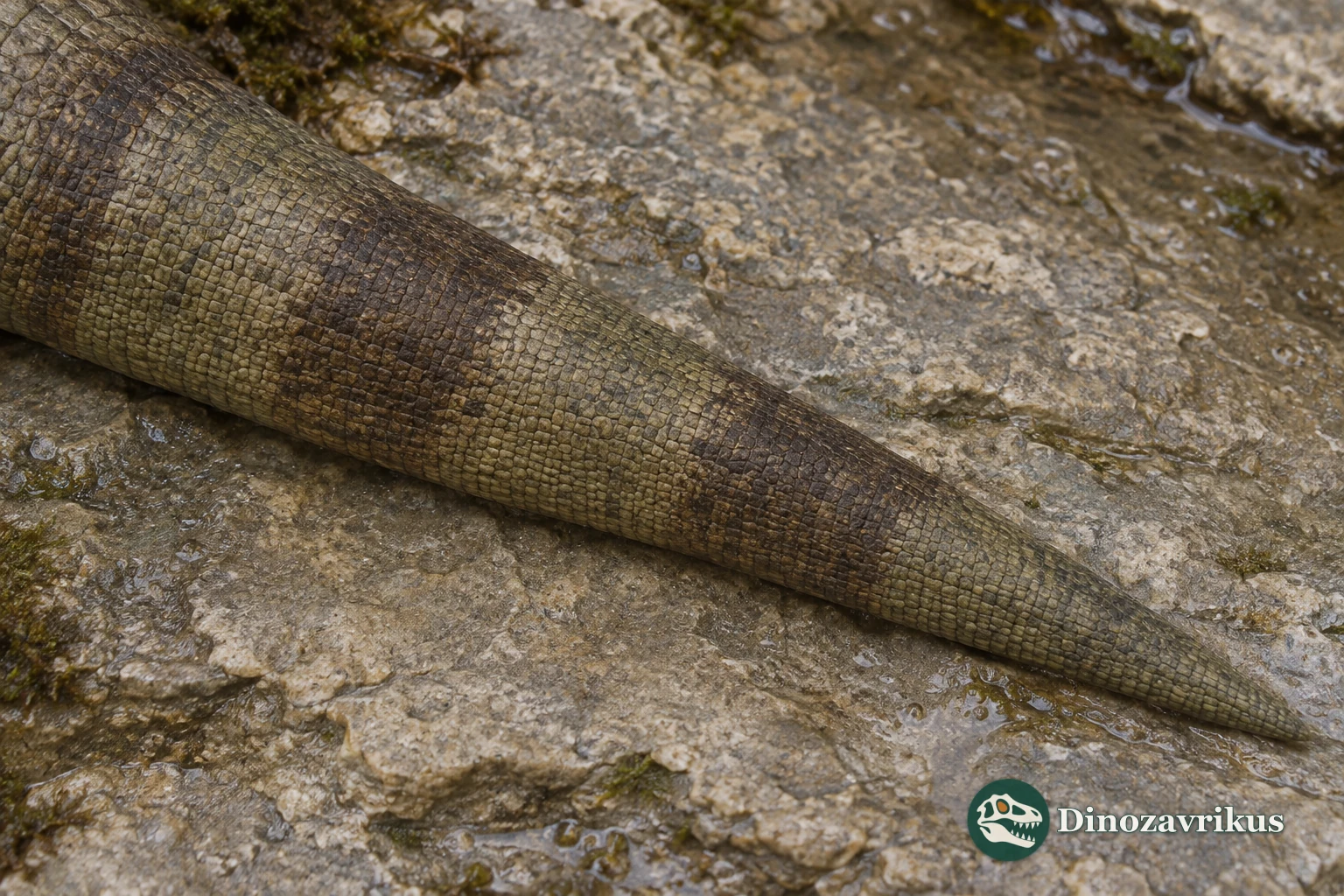
Montsecosuchus depereti was a small crocodyliform from Early Cretaceous limestone in Catalonia. Parts of its skin and cartilage survived beside the skeleton. Under ultraviolet light the tail shows alternating light and dark bands that researchers interpreted as traces of the original pattern.
Quick facts
| Species | Montsecosuchus depereti |
|---|---|
| Group | Neosuchian, possible atoposaurid |
| Age | Early Cretaceous, Barremian in the 2026 study |
| Locality | Rúbies quarry, Montsec, Catalonia |
| Type specimen | Near-complete skeleton, MGB-512 |
| Museum specimen length | 57 cm |
What can the fossils tell us?
The bones allow comparison of head and limb proportions. The museum records a specimen length of 57 cm.
Scale shape varies by region. The contrast between bands helps reconstruct the tail pattern, but the original hues are unknown.
Researchers described cartilaginous ribs and hooked processes. They give clues to chest mechanics and do not record the movement itself.
A skeleton from a Catalan quarry
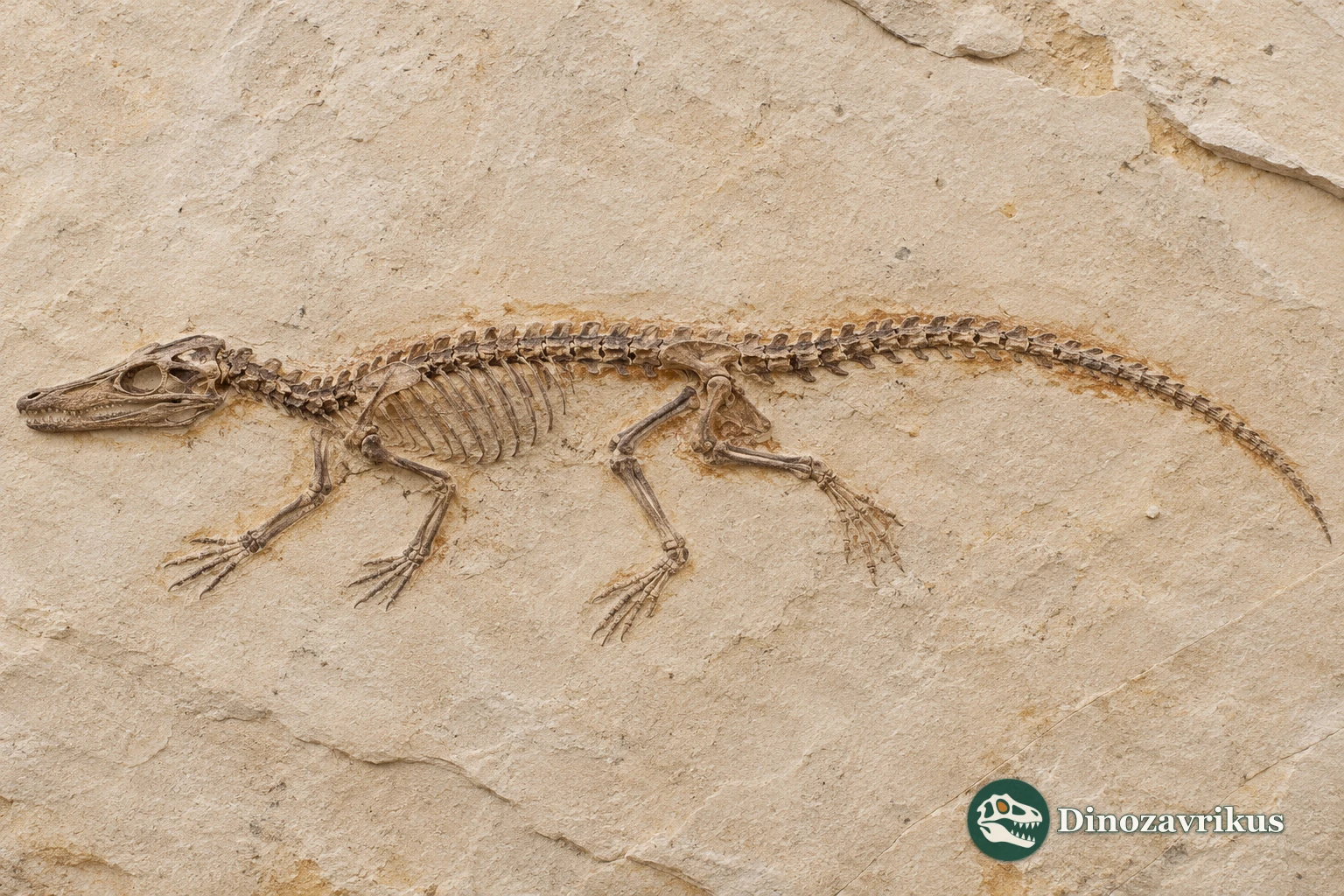
Lluís Marià Vidal found the fossil at the Rúbies quarry in the Montsec massif in 1902. The Natural Science Museum of Barcelona holds the near-complete skeleton and skull as MGB-512 and lists its length as 57 cm. The fine bedding of the lake limestone preserves small details around the bones.
The 2026 soft-tissue study uses a Barremian age for the locality. Earlier work used broader or older Early Cretaceous intervals.
Why the skeleton was given its own genus
Vidal described Alligatorium depereti in 1915. Ángela Buscalioni and José Luis Sanz transferred it to Montsecosuchus and redescribed the skeleton after it had been further prepared. The skull is less than half as long as the presacral region. The back of the skull is domed, and the forelimbs are comparatively short and robust relative to the hindlimbs.
The genus has traditionally been grouped with Atoposaurus and other small atoposaurids. A 2016 study recovered it outside that family in most analyses but within it under a different weighting of the characters. Its placement among neosuchians is better supported than the tentative family assignment.
Scales and a banded tail
In 2026 Oscar Castillo-Visa and colleagues described soft tissues that are particularly clear under ultraviolet light. Scale forms vary across the body. The authors reported that the tail lacked a deep crest and that the limb scales lacked the strong keels seen in living crocodilians.
Transverse light and dark regions on the tail were interpreted as remains of a colour pattern. Their original hues cannot be determined. Small structures on scales near the body margin may represent sensory organs, but their function remains uncertain.
Traces of the breathing apparatus
The chest preserves cartilaginous ribs and hooked structures called uncinate processes. The authors proposed a role in improving the efficiency of chest movements during breathing. Their preserved positions establish the anatomy, and the exact contribution to ventilation is inferred from comparison.
Frequently asked questions
Where was Montsecosuchus found?
The type came from the Rúbies quarry in the Montsec massif of Catalonia. It is held by the Natural Science Museum of Barcelona.
How long was it?
The museum records a length of 57 cm for its specimen. This is the length of one individual.
How was the tail pattern detected?
Ultraviolet light revealed alternating transverse bands. Their arrangement is visible, but their original colours are unknown.
Was Montsecosuchus an atoposaurid?
It has traditionally been assigned to Atoposauridae. Analyses have recovered it both within and outside that family, while supporting neosuchian affinities.