

Morrinhosuchus luziae was a small Late Cretaceous notosuchian from Brazil’s Bauru Basin. The type specimen preserved the front of the skull and lower jaw. A nearly complete skull described later clarified the outline of its short snout, the shape of the rear teeth and how the species differed from its relatives.
Quick facts
| Species | Morrinhosuchus luziae |
|---|---|
| Group | Notosuchia |
| Age | Late Cretaceous |
| Horizon | Adamantina Formation, Bauru Basin |
| Holotype | MPMA 07-0009/01, front of the skull and jaw |
| Length estimate | About 60 cm from skull length |
What can the fossils tell us?
The snout of MPMA 12-0050/07 occupies about one-third of skull length. A notch initially identified in the type resulted from slight displacement of two bones.
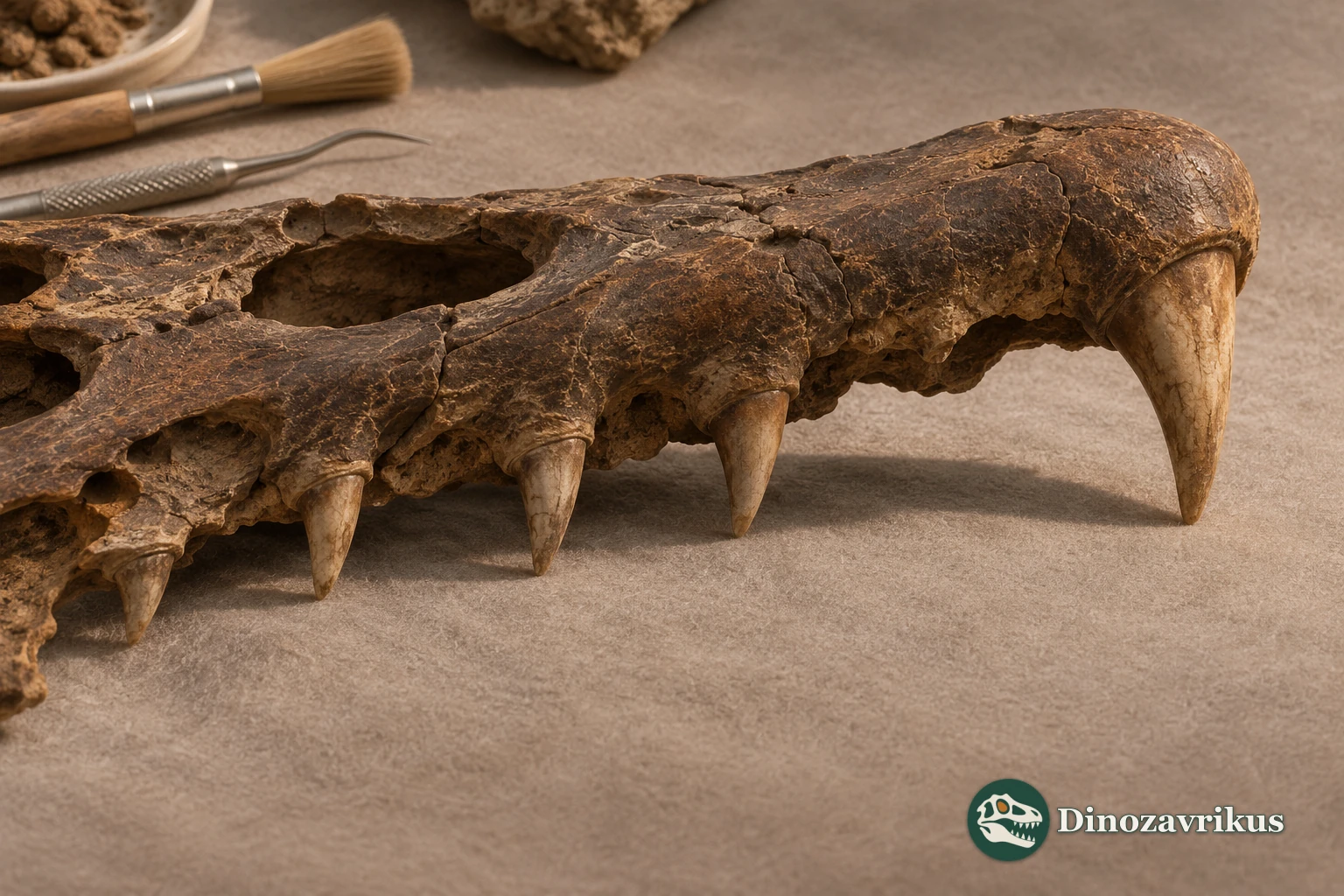
The third premaxillary tooth is enlarged. Rear crowns have a raised band at the base. The shapes suggest several ways of handling food without identifying specific prey.
A 109.9 mm skull measurement yielded an estimate of about 60 cm in a comparative model. It was not measured from a complete skeleton.
From a broken snout to a nearly complete skull
Fabiano Iori and Ismar de Souza Carvalho named the species in 2009. The genus name refers to the Morrinho de Santa Luzia hill near Monte Alto, where the type was found. The species name honours Saint Lucy, to whom a chapel on the hill is dedicated. The type is held in the palaeontology museum at Monte Alto.
The near-complete skull and mandible MPMA 12-0050/07 came from Cândido Rodrigues in São Paulo state. Iori and colleagues described it in 2018 together with another specimen from Monte Alto. All are from the Late Cretaceous Adamantina Formation.
A short snout with an enlarged front tooth
Viewed from above, the skull is roughly triangular. The snout takes up about a third of its length and has nearly straight sides. Mariliasuchus from the same basin has a more bulbous snout. Morrinhosuchus has six maxillary sockets and an enlarged third tooth in the premaxilla at the front of the upper jaw.
The original description treated the rear crowns as globular. The fuller material showed they are conical with a raised band at the base. It also revealed that an apparent notch between two upper jaw bones was caused by slight disarticulation in the type.
How much can be inferred about size and food?
Pointed teeth could have held prey. The 2018 study proposed a generalised diet with animal food and possibly some plant matter. No food remains were identified in the specimens described. Different analyses recover it among advanced notosuchians, with changes in its closest relatives as more characters are included.
A 2026 study used skull length in a model that accounted for relationships among the animals being compared. Its estimate for Morrinhosuchus was 59.5 cm, with a 75% interval of 45.7–77.5 cm. This is a range of inferred values from a skull measurement, without a corresponding femur measurement.
The site near Monte Alto exposes fine sandstone with carbonate inclusions. It belongs to continental deposits of the Bauru Basin. These sediments provide a local setting without showing how often Morrinhosuchus entered water.

Frequently asked questions
What is Morrinhosuchus named after?
The Morrinho de Santa Luzia hill near Monte Alto, close to the discovery site.
Which fossil best shows the skull shape?
MPMA 12-0050/07 from Cândido Rodrigues preserves a nearly complete skull and lower jaw.
How was its length estimated?
Researchers used a skull measurement in a comparative model. The result was about 60 centimetres.
What might it have eaten?
Pointed crowns could have held prey. The exact contribution of animal and plant foods remains uncertain.