

Nanocorax is an extinct lamniform shark genus known from small isolated teeth. Its name records a taxonomic correction: the type species was first described as Microcorax crassus, but that genus name was already occupied by a bird. A second species was first described in Squalicorax and later transferred. Neither species is known from a complete body skeleton.
Quick facts
| Group | Lamniform shark assigned to the family Anacoracidae |
|---|---|
| Type species | Nanocorax crassus, first named Microcorax crassus |
| Other named species | N. microserratodon, first described in Squalicorax |
| Age and localities | Cenomanian teeth from Texas; Coniacian material from Kansas |
| Known material | Isolated teeth; calcified-cartilage fragments are reported with the Kansas type |
| Tooth size | The type material of N. microserratodon includes teeth up to about 4 mm |
| Body length and diet | Unknown; tooth size alone does not establish body size or prey |
What can the fossils tell us?
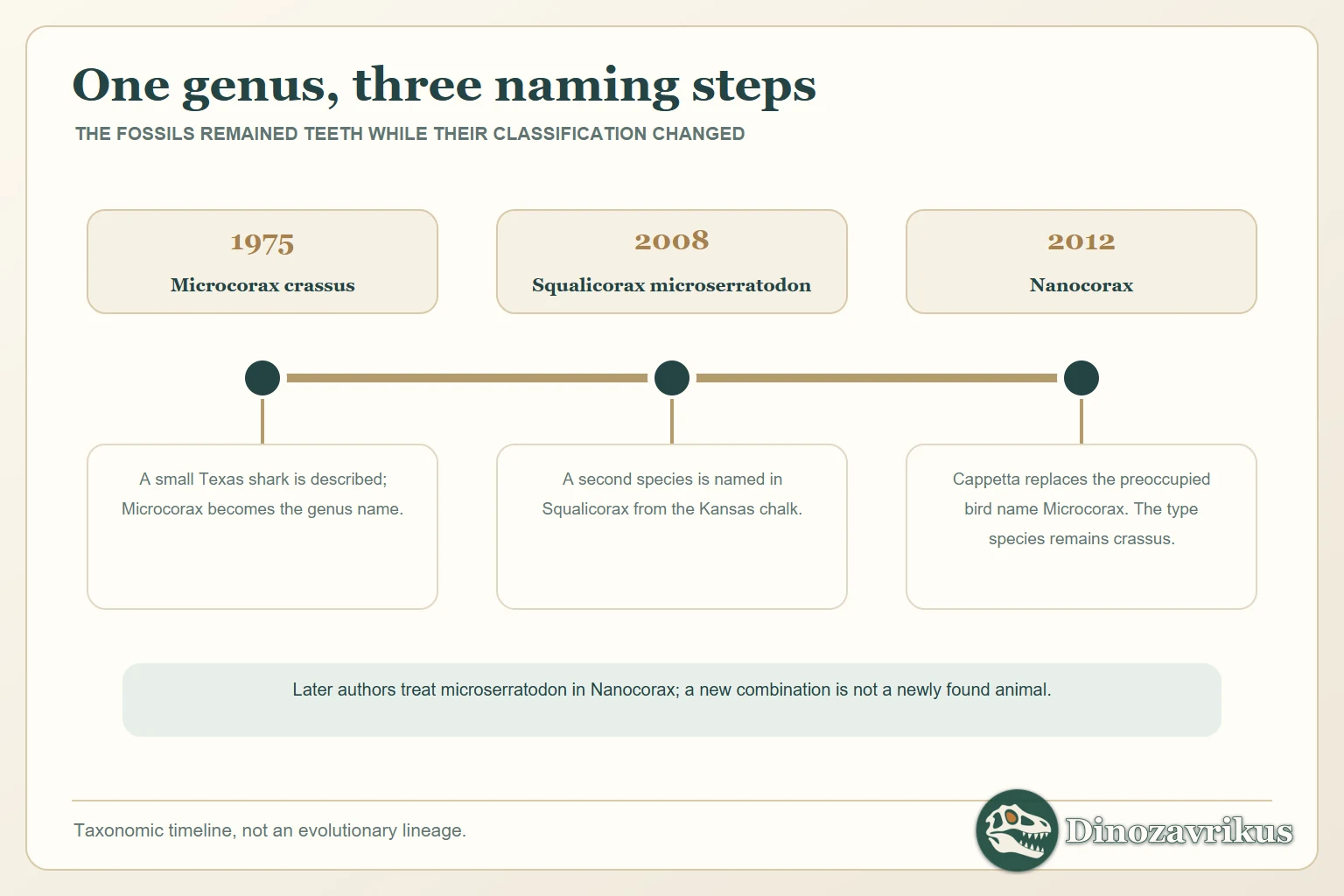
Cappetta and Case described Microcorax crassus in 1975. Because Microcorax was preoccupied by a bird genus, Cappetta introduced Nanocorax as a replacement name in 2012. Shimada had described the second species as Squalicorax microserratodon in 2008; it was later recombined in Nanocorax.
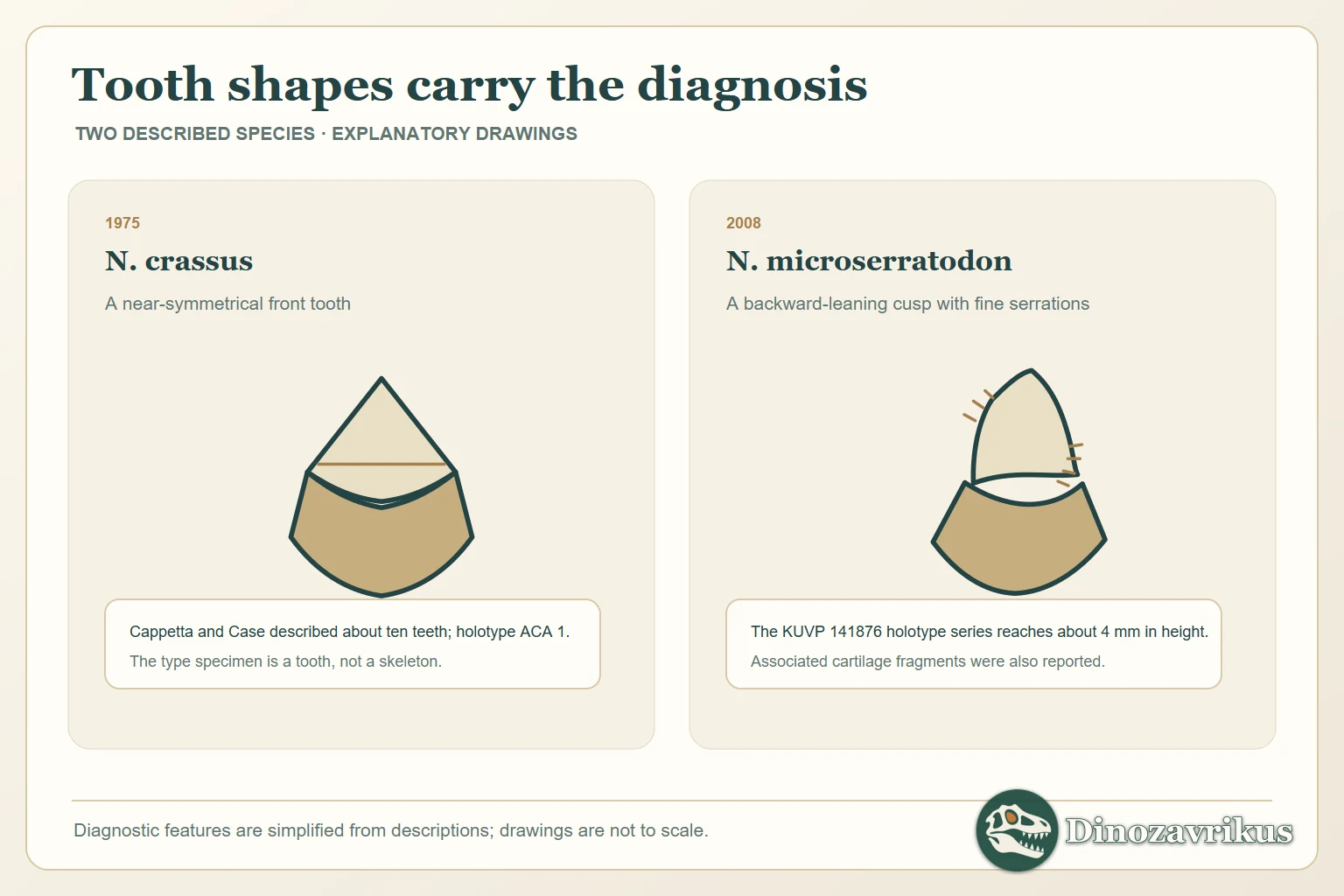
The original Texas series includes nearly symmetrical anterior teeth and broader, more asymmetric lateral teeth. The Kansas type series of N. microserratodon contains tiny teeth with a distally inclined cusp, fine serrations and a bilobed root. Such differences describe teeth, not total body proportions.
The type of N. microserratodon also includes calcified-cartilage fragments, but no complete skeleton or measured tooth row is known. Later bonebed counts refer to teeth and specimens, not necessarily to the same number of individual sharks.
The original species and its replacement name
Henri Cappetta and Grant Case described Microcorax crassus in 1975 from about ten teeth collected at the Amon Carter Airfield site in Tarrant County, Texas. The deposit belongs to the Lower Arlington Sandstone Member of the Woodbine Formation and is Cenomanian in age. The designated holotype is ACA 1. The authors listed the type material in the palaeontology laboratory at Université de Montpellier II.
The genus name Microcorax could not remain in use because it had already been established for a bird. Cappetta introduced Nanocorax in 2012 as a replacement name, retaining the same type species, crassus. This was a nomenclatural replacement, not a new species based on new bones. The history shows why a fossil name can change even when its defining specimen and species stay the same.
What the Texas teeth show
Cappetta and Case described the anterior teeth as nearly symmetrical, with a straight central cusp and cutting edges limited to the lower part of the crown. More lateral teeth are asymmetric and transversely broad, with the cusp leaning toward the corner of the mouth. Their roots are massive and lack a deep groove. In the specimens they examined, the cutting edges were not serrated.
These differences are expected within a jaw: a front tooth and a lateral tooth need not share the same outline. A loose tooth therefore has to be compared with its likely position as well as with other diagnostic details. The type series is useful for recognizing N. crassus, but it does not preserve an entire jaw, a full tooth row or the body to which those teeth belonged.
A second species with a different naming history
Kenshu Shimada described Squalicorax microserratodon in 2008 from the Smoky Hill Chalk Member of the Niobrara Chalk in western Kansas. Its holotype, KUVP 141876, includes 18 small teeth and fragments of calcified cartilage. Shimada suggested that the material probably represented one individual. The type horizon lies in the Coniacian part of the member.
The teeth reach about four millimetres in height. The crown is small and triangular, the cusp leans distally, the cutting edges bear fine serrations, and the root has two lobes. Later systematic work transferred the species to Nanocorax. Its current combination is Nanocorax microserratodon; the earlier name remains part of its taxonomic history rather than a separate animal.
More Kansas teeth, not a head count
Allen and Shimada reported ten teeth assigned to N. microserratodon from a Kansas bonebed in 2022. They are catalogued as FHSM VP-19648, FHSM VP-19649 and FHSM VP-19650, with eight teeth in the last lot. The teeth are up to about three millimetres high. The sample supports the presence of the species in the Smoky Hill Chalk, but ten teeth do not mean ten sharks. Several teeth can come from one individual, and collecting or cataloguing lots can group specimens in different ways.
The available named records are associated with Cenomanian material from Texas and Coniacian material from Kansas. They do not show every interval between those ages, nor do they establish a continuous geographic range. A comparison with another tooth-known shark, Cretalamna, illustrates why small fossil teeth are described by their crown and root characters rather than by a complete body outline.
Classification and the limits of reconstruction
Published classifications place Nanocorax among lamniform sharks in Anacoracidae. The directly described evidence is chiefly dental. Calcified-cartilage fragments accompany the type material of N. microserratodon, but the available reports do not provide an associated, articulated skeleton that would establish the shark’s body shape or total length.
A tooth only a few millimetres high cannot by itself show whether its owner was small-bodied. Tooth size depends on jaw position, species and growth, and a reliable body-length estimate requires a validated relationship or associated anatomy. Specific prey, colour and swimming behaviour are also unknown. The cover artwork uses a generalized lamniform silhouette and should not be read as a species-level reconstruction. As with Johnlongia, most of the evidence concerns teeth rather than the animal’s full anatomy.
Frequently asked questions
Why was Microcorax renamed Nanocorax?
The name Microcorax was already occupied by an earlier bird genus. Cappetta introduced Nanocorax in 2012 as a replacement name and retained Microcorax crassus as its type species under the new combination.
Where were the type teeth of Nanocorax crassus found?
They came from the Amon Carter Airfield site in Tarrant County, Texas, in the Cenomanian Lower Arlington Sandstone Member of the Woodbine Formation. ACA 1 is the designated holotype.
Why was the Kansas species first called Squalicorax microserratodon?
Shimada used that combination when he described its type material in 2008. Later systematic work transferred the species to Nanocorax, giving it the current name N. microserratodon.
Can a four-millimetre tooth reveal the shark’s body length?
No reliable total length follows from tooth height alone. The genus is not known from a complete skeleton or a full tooth row that would provide a validated size relationship.