

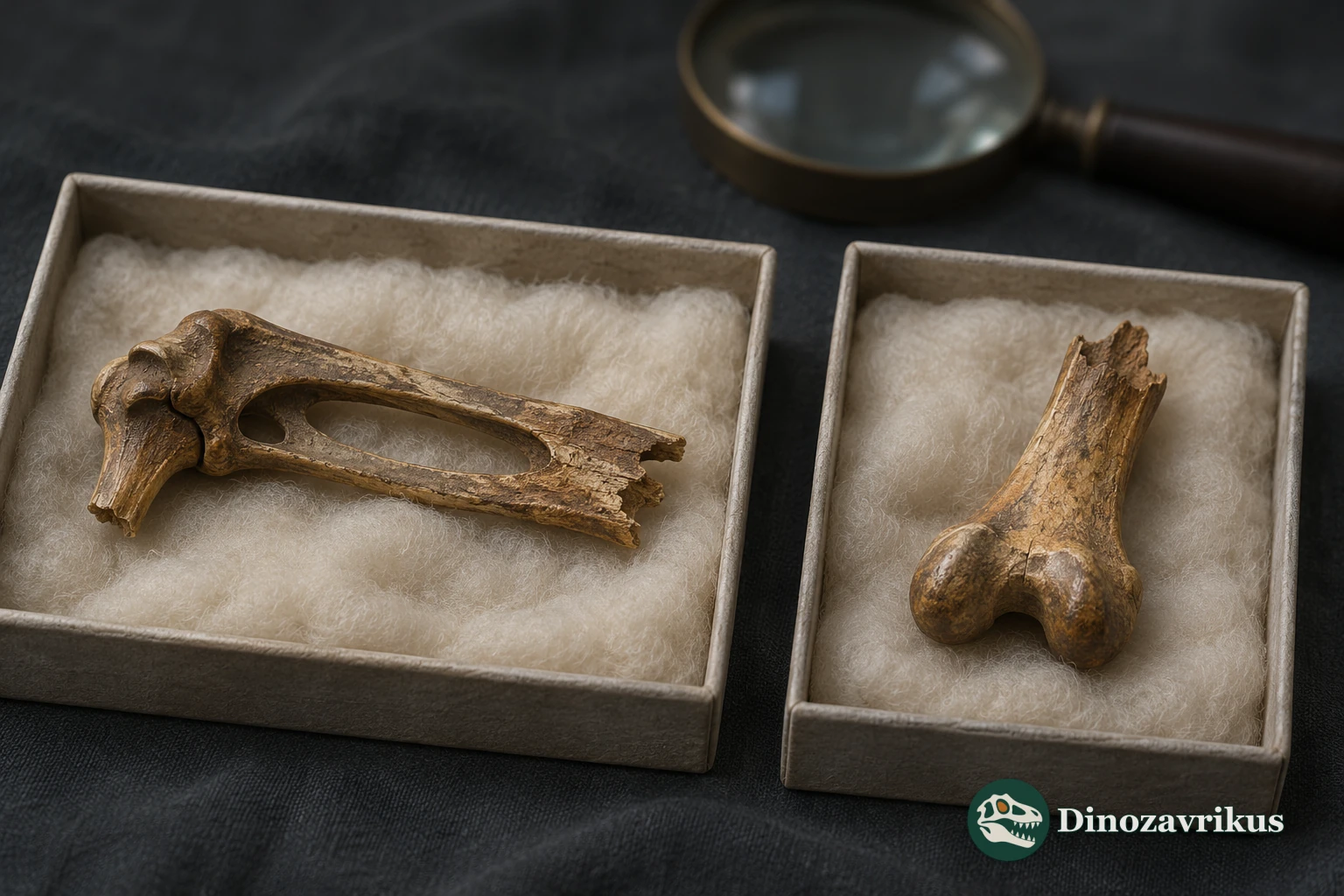
Naranbulagornis is known from two fragments in southern Mongolia. The wing bone helped identify it as a large anseriform, and the end of the thigh bone suggested a bird adapted for swimming. Its bones are comparable in size to those of a swan. Its place among early waterfowl is less clear.
Quick facts
| Order | Anseriformes |
|---|---|
| Age | Late Paleocene |
| Localities | Naran-Bulag and Tsagaan-Khushuu, Mongolia |
| Fossils | Parts of a right carpometacarpus and a left femur |
| Relative size | Swan-sized by comparison of the bones |
What can the fossils tell us?
Features near the joint could be compared with those in other waterfowl. The fossil does not preserve the length of the whole wing.
The distal end resembles the corresponding part in swimming anseriforms. It supports an aquatic interpretation without revealing the details of propulsion.
Both fossils came from sandy or gravelly river deposits. Comparison supports assigning them to the same species, while their separate find sites rule out treating them as an articulated skeleton.
Two finds from Mongolia
The joint Soviet–Mongolian palaeontological expedition collected the fragments in 1970–1971. The right carpometacarpus, part of the hand skeleton of the wing, is from Naran-Bulag. The lower end of a left femur came from Tsagaan-Khushuu, about six kilometres away.
Nikita Zelenkov named Naranbulagornis khun in a description published in 2019. The genus name refers to Naran-Bulag, Mongolian for a sunny spring. The epithet khun means swan and refers to the animal’s estimated size.
What the bones tell us
Zelenkov compared the wing element with those of a swan and a screamer, and the femur with those of a swan and a magpie goose. The shape at the lower end of the femur suggests that the bird swam. The comparisons indicate a large animal, while a precise body mass, height or wingspan would require more of the skeleton.
The two fossils combine traits that are distributed among several living families of Anseriformes. Some resemble those of screamers and magpie geese. The species may represent a separate early branch. Size and ecology alone do not establish swan affinities, a similar problem in the interpretation of the much younger Megalodytes.
Late Paleocene river deposits
Both remains were recovered from river sands and gravels assigned to the Late Paleocene in the description. The sites also preserve fish, reptiles and mammals. These finds provide context for the anatomy of a swimming bird. They do not identify its diet.
Frequently asked questions
Which bones are known?
Part of the right carpometacarpus from the wing and the lower end of a left femur. They came from different sites.
Was Naranbulagornis a swan?
Swan-sized is a comparison of scale. The available material places it in Anseriformes without resolving its precise relationships.
What suggests it swam?
The shape around the knee end of the femur resembles that of swimming waterfowl. Both specimens were also recovered from river deposits.
What does khun mean?
The species epithet is Mongolian for swan. The genus name comes from the fossil locality Naran-Bulag.