

Navajosuchus mooki was an early relative of alligators from the Paleocene of New Mexico. Two skulls from different levels of the San Juan Basin were originally named as different species. Later comparisons brought them together under one species name.
Quick facts
| Species | Navajosuchus mooki |
|---|---|
| Group | Early alligatorine |
| Age | Early Paleocene |
| Localities | San Juan Basin, New Mexico, United States |
| Type specimen of the species | Skull and skeleton, AMNH 6780 |
| Rock unit | Puercan and Torrejonian beds of the Nacimiento Formation |
What can the fossils tell us?
Specimen AMNH 6780 preserves the skull and bones from the rest of the body. In 1930 it became the type of the species now called Navajosuchus mooki.
The partial skull AMNH 5186 supplied the genus name. Later comparisons referred it to the species established from the Puerco beds.
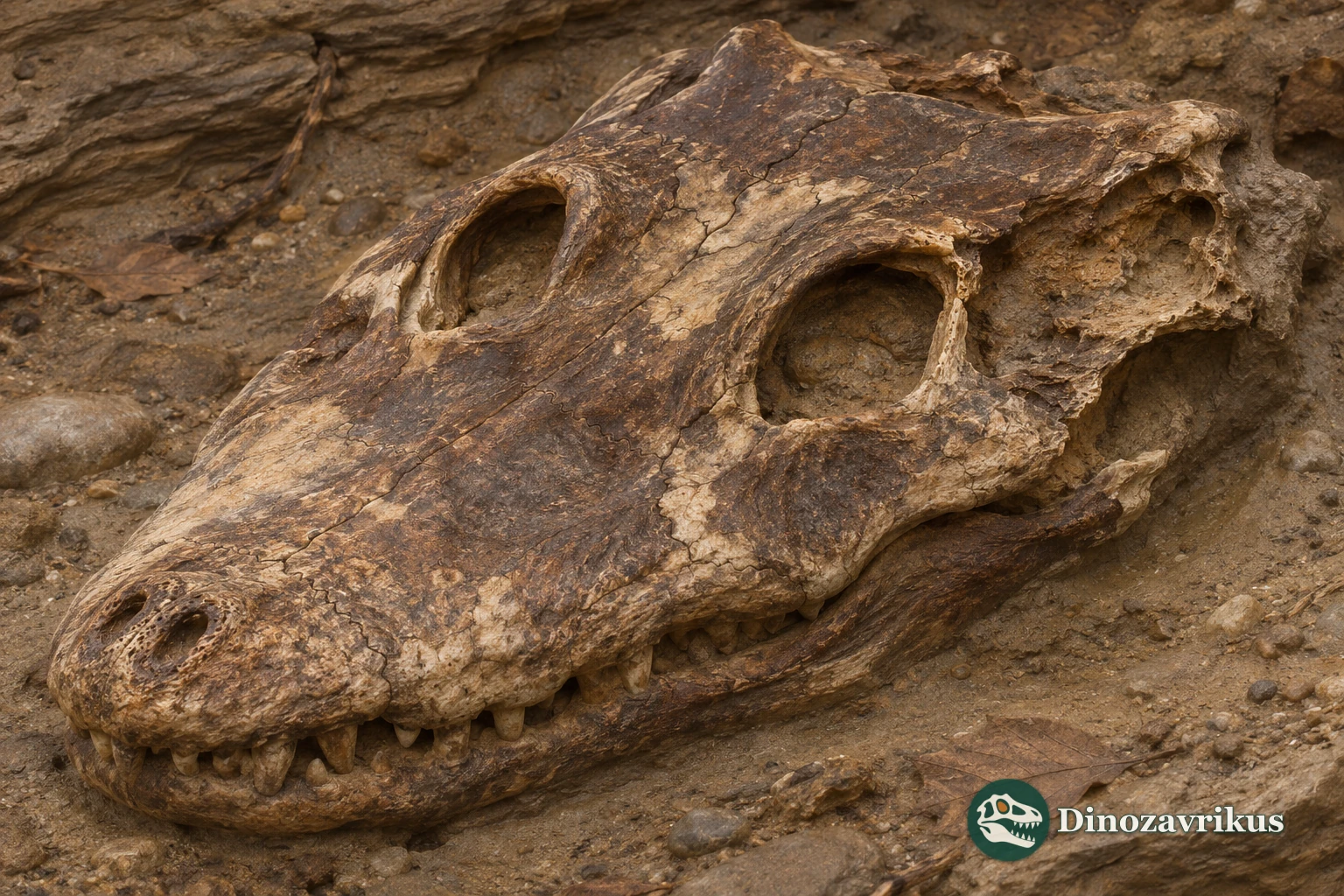
Contacts near the orbit and a modest ridge in front of the eyes help compare these fossils. Damage makes some features easier to see on one skull than another.
Two specimens in one museum
George Gaylord Simpson described a nearly complete skeleton with skull, AMNH 6780, as Allognathosuchus mooki in 1930. It came from the Paleocene Puerco beds of the San Juan Basin and is held by the American Museum of Natural History.
The second skull, AMNH 5186, was found in 1913 near the West Fork of Kimbetoh Wash. It came from Torrejon beds above the Puerco succession. In 1942 Charles Mook named it Navajosuchus novomexicanus.
Teeth and the bones in front of the eyes
A low bony ridge in front of the orbits is apparent on some specimens. It is difficult to see on the damaged AMNH 6780 skull and clearer on MCZ 8381. As described in comparative work, the lacrimal bone extends farther forward than the prefrontal.
The partial lower jaw UNM B-1121 has an enlarged fourth tooth socket and preserves a rounded tooth with fine striations. Such finds show how size and shape vary within the tooth row, but do not identify its usual prey.
From Allognathosuchus to Navajosuchus
Later comparisons supported referring the Puerco and Torrejon skulls to one species. Christopher Brochu in 2004 recommended retaining the older epithet mooki in the genus Navajosuchus. The earlier placement reflects genuine similarities with Allognathosuchus, whose own classification has been revised.
A 2021 analysis placed Navajosuchus among early alligatorines close to the type species of Allognathosuchus and to the lineage of living alligators. It gives one example of how early members of the family were already diversifying in Paleocene North America.
Frequently asked questions
Where did Navajosuchus live?
The main fossils came from Puercan and Torrejonian deposits of the San Juan Basin in New Mexico.
Why did it have two species names?
Two skulls were named independently. Later authors referred them to one species and retained the older epithet mooki.
How much of its skeleton is known?
Specimen AMNH 6780 preserves a skull and a nearly complete skeleton. Other specimens include incomplete skulls and parts of the jaws.
Was Navajosuchus an alligator?
It belonged to the alligator family. A 2021 analysis placed it in an early branch of Alligatorinae close to the lineage of genus Alligator.