

Nemicolopterus crypticus was named for a tiny articulated pterosaur skeleton from Early Cretaceous China. Its original authors estimated a wingspan of about 25 centimetres and proposed that curved foot bones suited life among branches. Later research found the animal much younger than first appreciated and questioned whether the features used to name it separate a species at all. The measurement belongs to one juvenile, not an adult of a known tiny species.
Quick facts
| Original name | Nemicolopterus crypticus, Wang and colleagues, 2008 |
|---|---|
| Holotype | IVPP V14377, small articulated but incomplete skeleton |
| Locality | Western Liaoning, China |
| Rock unit | Jiufotang Formation, Early Cretaceous |
| Juvenile span | About 25 cm estimated in the original description |
| Later placement | Indeterminate Sinopterinae in a 2023 revision |
What can the fossils tell us?
IVPP V14377 holds articulated skull, trunk and limb bones. Incomplete wing elements make total span an estimate.
Large orbit and unfused bones show immaturity. Later work interpreted the fossil as near-hatchling rather than a small mature animal.
The 2023 revision identified an indeterminate sinopterine. It could not show that the fossil belonged to a named Sinopterus species or to a separate one.
Curved toes inspired an arboreal interpretation, but related Jiufotang pterosaurs share relevant traits and the fossil records no behaviour.
An articulated fossil from Liaoning
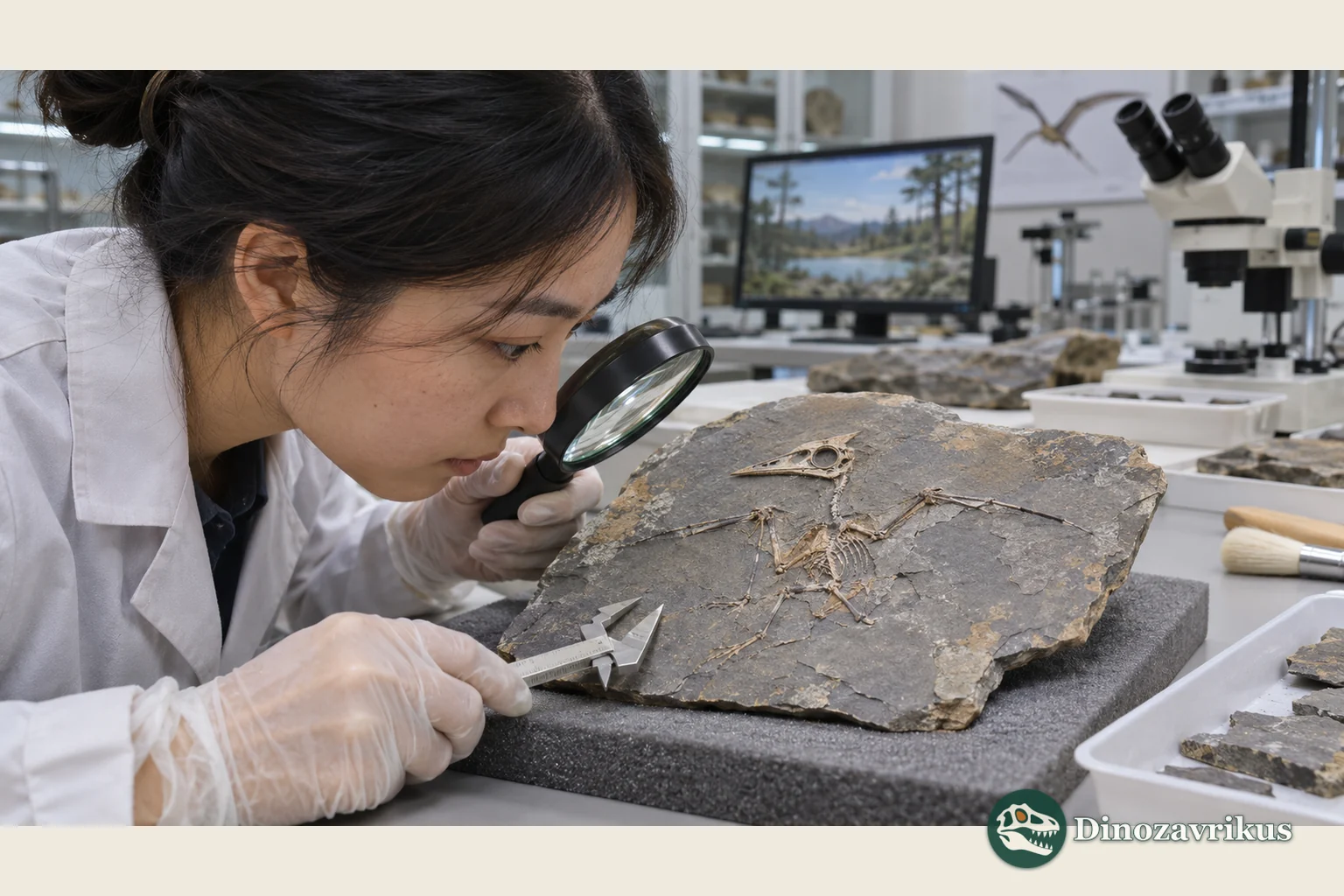
Xiaolin Wang, Alexander Kellner, Zhonghe Zhou and Diogenes Campos described Nemicolopterus crypticus in 2008. Its holotype IVPP V14377 came from lacustrine sediments of the Jiufotang Formation in western Liaoning and is held by the Institute of Vertebrate Paleontology and Paleoanthropology in Beijing. Many bones remain in anatomical association on a slab, though parts of the wings are missing.
The skull is about four centimetres long and has a conspicuously large orbit. It is toothless, with a slightly downturned front. Trunk, limb and wing-finger bones are preserved. The original estimate of roughly 25 centimetres across the wings extrapolated from this incomplete juvenile skeleton; it did not measure a complete adult wing.
How growth changed the identification
The original paper already considered the individual immature, but argued that it was not a newborn. A 2021 analysis pointed to its large orbit, unfused shoulder, pelvic and limb bones and other early-growth features, interpreting it as closer to a hatchling stage. That distinction matters because diagnostic-looking features can alter during rapid growth.
A 2023 revision of the Sinopterus complex compared the fossil with other toothless Jiufotang pterosaurs. Some traits originally thought unique occur elsewhere or may reflect juvenile ossification. The authors classified IVPP V14377 as an indeterminate sinopterine. They could neither confidently assign it to a known Sinopterus species nor establish a separate species. The historical name remains useful for locating the fossil, but its independent taxonomic status is unsettled.
A forest life proposed from the feet
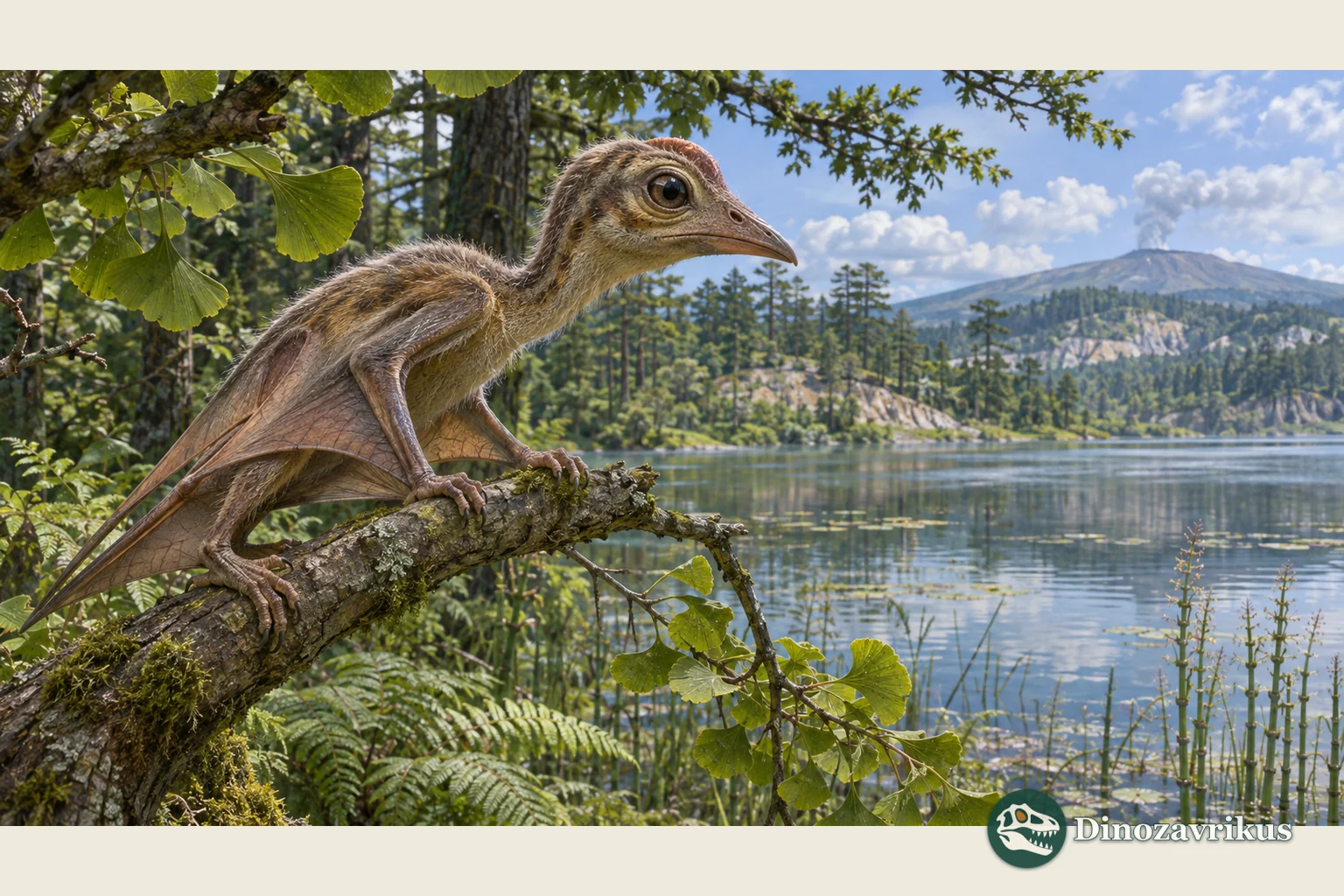
The penultimate foot phalanges and claws are curved. The 2008 authors interpreted these as adaptations to grasp branches and proposed an arboreal lifestyle. Later comparison found similar pedal proportions among other Jiufotang tapejarids. A slab of bones does not record the tree, perch or prey of its owner.
Jiufotang rocks record lake and shore environments with several pterosaur forms. Jeholopterus is known from separate material and should not be treated as a stand-in for this juvenile. No preserved stomach content identifies its food. Even if it could climb or fly at this age, those abilities cannot alone establish a lifelong tree-dwelling habit.
The limits of a living reconstruction
The cover shows a young toothless pterosaur in flight, while another scene places it on a branch. Both are possible interpretations of its anatomy and environment, not photographs of observed behaviour. Soft-tissue colour, adult crest and adult size remain unknown.
Further growth-series specimens could test whether the unusual features of IVPP V14377 are simply juvenile stages of an already named species. Until then, calling it the smallest adult pterosaur would confuse the size of a fossil individual with the size of a species.
Frequently asked questions
Was Nemicolopterus a sparrow-sized adult?
No. The roughly 25 cm span was estimated for a very young fossil individual. The adult size of that animal is unknown.
Is its skeleton complete?
Many bones are articulated, but some elements, including parts of the wings, are absent.
Did it definitely live in trees?
Curved foot bones led to an arboreal hypothesis, but comparable traits occur in other pterosaurs and the fossil preserves no behaviour.
Is it a synonym of Sinopterus?
A 2023 revision regarded the fossil as an indeterminate sinopterine. It could not securely assign it to Sinopterus dongi or demonstrate a distinct species.