

Neochelys was a genus of freshwater side-necked turtles in Eocene Europe. Living side-necked turtles bend the neck sideways to draw the head beneath the shell edge. That motion is inferred for Neochelys from its relationships. Fossil skulls and shells preserve more direct details of its anatomy.
Quick facts
| Group | Turtles, side-necked podocnemidids (Podocnemididae) |
|---|---|
| Age | Eocene |
| Region | Europe |
| Type species | Neochelys capellinii |
| Scientific name | Neochelys |
| Diet | No direct dietary evidence |
What can the fossils tell us?
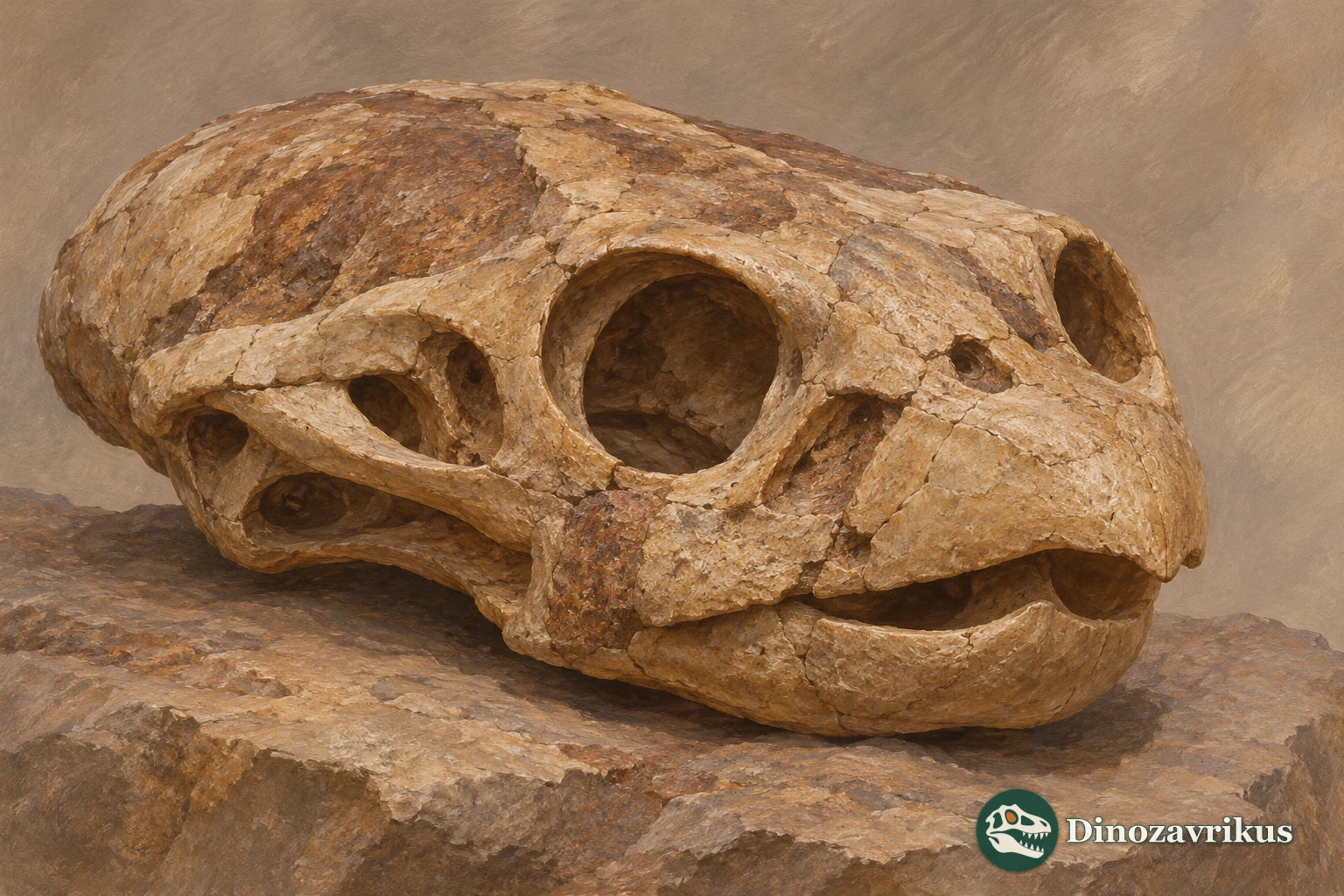
The early Eocene skulls of Neochelys arenarum, MNHN.F.RI 6 and MNHN.F.RI 7, are held at the National Museum of Natural History in Paris.
CT scans show cavities and canals in the skull bones, including paths for vessels and part of the inner ear. A digital endocast records the shape around the tissue.
The abnormal margin of Spanish specimen STUS 14024 was once attributed to a bite. Reexamination made that explanation unlikely and left the cause unresolved.
The type species from Italy
Frédéric Bergounioux erected the genus Neochelys in 1954. The type species, N. capellinii, was originally described as Emys capellinii from a nearly complete upper shell found at Purga di Bolca in northern Italy. The earlier type was also included in the material used to establish the genus. Later studies treated N. bolcensis as a synonym of N. capellinii.
From Rians to Messel and the Duero Basin
One of the earliest members, N. arenarum, occurs in Ypresian deposits at Rians in southern France. Middle Eocene Messel in Germany yielded N. franzeni, including specimens with skull and shell together. Spanish Duero Basin shells come from middle and late Eocene strata. A number of fragments can only be identified to genus.
Inside the skull
Marcos Martín-Jiménez and Adán Pérez-García used CT scans of two French N. arenarum skulls to model the brain cavity, nasal cavity and inner ear. The rear part of the carotid artery's course lacked a bony enclosure. Farther forward, one carotid canal passed through the basisphenoid. Some cavities had been distorted during burial, making comparison between the two specimens useful.
Relationships and freshwater habits
Neochelys belongs to Podocnemididae. The Paleocene turtle Carbonemys from Colombia belonged to the same family. Together they illustrate a distribution much wider than that of living podocnemidids. For Neochelys itself, the deposits and skeletal anatomy are consistent with a freshwater life. Direct evidence of diet is lacking.
The damaged shell from Zamora
Part of the shell margin of specimen STUS 14024 is missing. An earlier explanation invoked a predator. On reexamining the shell and its CT scans, researchers found that the pattern of damage and bone structure did not fit that interpretation well. The evidence did not establish a single cause.
Frequently asked questions
What kind of turtle was Neochelys?
It was a podocnemidid, one of the side-necked turtles. Living members of the group bend the neck sideways to draw in the head.
Where has it been found?
Neochelys is known from Eocene localities in Europe, including France, Italy, Germany and Spain.
Did scans show the brain itself?
The scans show the bony cavity occupied by the brain and surrounding tissues. Researchers used its shape to create a digital endocast.
Was the damage to the Spanish shell a bite?
A later study found the bite interpretation unlikely. The exact cause of the abnormality remains unknown.