

Neosclerocalyptus was a South American glyptodont with a rigid bony carapace and a protected tail. Its skull also developed an unusual ossification around the nose. That structure has often been linked to cold, dry Pleistocene conditions, but recent imaging shows that its origin requires a more careful explanation.
The genus belongs in the ice-age animal catalogue, even though its oldest recognized species predates the Pleistocene. The earlier Eosclerocalyptus helps frame the lineage, while Glyptodon provides a different glyptodont comparison.
Quick facts
| Group | Glyptodonts, Cingulata |
|---|---|
| Type species | N. ornatus (Owen, 1845) |
| Range of named species | Late Pliocene to late Pleistocene |
| Key region | Pampas and north-central Argentina |
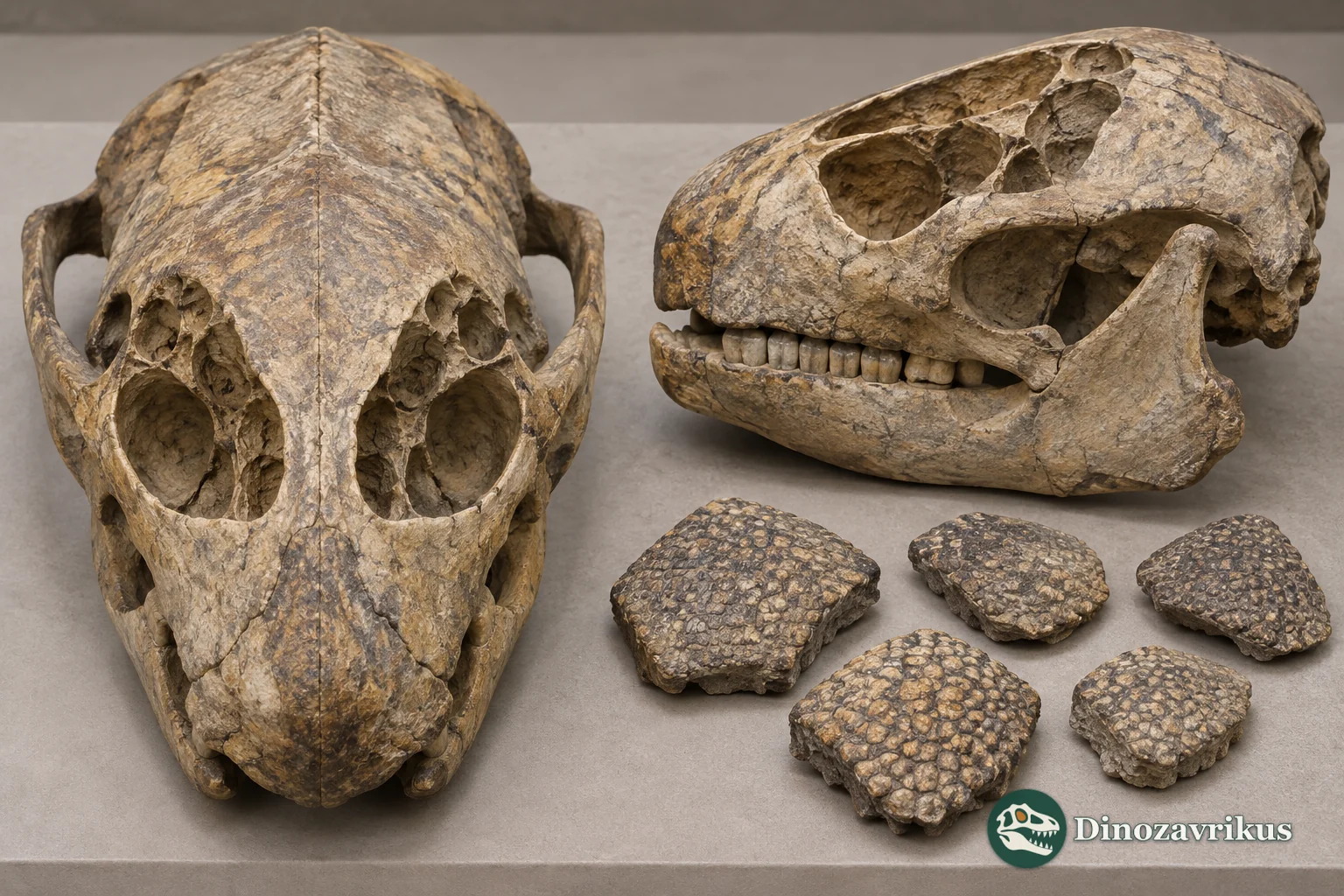
| Informative specimen | Associated skull, jaw and head shield of N. gouldi |
| Distinctive feature | An ossified expansion around the nasal opening |
What can the fossils tell us?
The associated skull, jaw and head shield of N. gouldi allow direct anatomical comparison. The expansion's shape helps identify species but does not itself demonstrate its respiratory function.
CT imaging of N. pseudornatus found that cavities in its nasal ossification were not open to the nasal airway. A primary air-warming function is therefore doubtful for that early form.
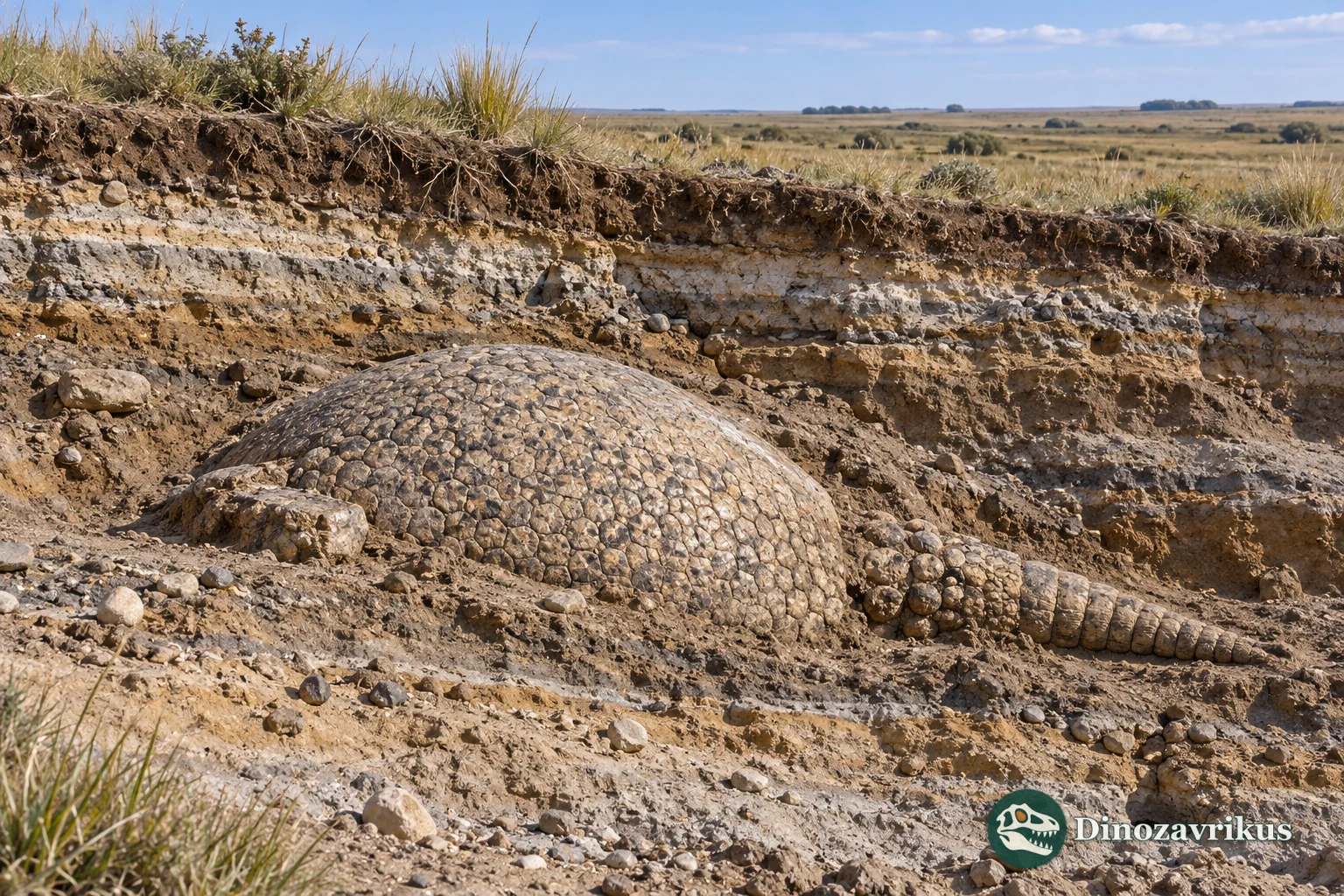
A complete back shell and a tail-tube fragment from Chaco document armor construction. Detached plates without a skull and a secure layer are less useful for species identification or dating.
Old names and a five-species sequence
Richard Owen described the animal now called N. ornatus as Glyptodon ornatus in 1845. Later authors used Sclerocalyptus for related material before Neosclerocalyptus became established. A revision of early Pleistocene Pampas fossils retained N. pseudornatus and N. ornatus among a longer list of historical names.
In 2008, Alfredo Zurita and colleagues named N. gouldi from San Andrés de Giles, Argentina. Its type includes an associated skull, mandible and cephalic shield. Their comparative characters included the frontal and nasal cavities, cheekbone processes and occipital region; they treated the older name N. migoyanus as inadequately diagnostic. The later description of late Pliocene N. castellanosi near Mar del Plata pushed the known history back. N. paskoensis represents a younger part of the sequence.
What the nasal bone actually did
The extra ossified structure near the nasal opening grows more pronounced in some later species. An earlier explanation proposed that it helped warm and humidify inhaled air as environments cooled and dried. Geography and its changing shape made that plausible, but a functional claim needs evidence of how the cavities connect to airflow.
A 2025 CT study examined a well-preserved early Pleistocene N. pseudornatus skull from the Santiago Roth collection. Cavities in the new ossification were not openly connected to the nasal passage. The authors therefore favored a structural role related to skull organization and the expanded head shield at the origin of the feature. Later air-conditioning benefits remain possible as a secondary function, not a directly observed fact about the first species.
Carapace, tail and locality
Like other glyptodonts, the animal carried many bony osteoderms joined into a rigid dorsal shell. A complete back carapace from Avia Terai and a distal tail-tube piece from Charata, both in Argentina's Chaco Province, document this armor. They do not each provide the same anatomical information as an associated skull and should not be assigned to species by superficial resemblance alone.
Early Pleistocene N. pseudornatus and N. ornatus, middle Pleistocene N. gouldi and later N. paskoensis belong to different deposits. Their sequence does not date a detached plate by itself. A particular fossil needs its own layer and dating context. Records are concentrated in the Pampas and north-central Argentina; preservation and research effort may also shape that pattern.
The living animal and its reconstruction
Shell and skull fossils establish a large armored terrestrial mammal. Relatedness and chewing anatomy support herbivory, but no cited stomach contents identify a species' particular plants. Speed, daily activity and skin color cannot be read from these bones.
The cover reconstructs a plausible glyptodont in a Pampas landscape. Surface color and soft nasal tissue are artistic choices. The inner fossil and field scenes are illustrations rather than images of the named type or an actual excavation.
Frequently asked questions
Was Neosclerocalyptus the same genus as Glyptodon?
No. Both were glyptodonts, but Neosclerocalyptus had a distinctive ossified expansion around the nasal opening.
How many Neosclerocalyptus species are discussed in recent work?
Five commonly discussed species are N. castellanosi, N. pseudornatus, N. ornatus, N. gouldi and N. paskoensis.
Did its nasal bone definitely warm cold air?
No. CT imaging of early N. pseudornatus found no open connection from the bony cavities to the airway, weakening that original explanation.
Do fossils preserve the original armor color?
No. Osteoderms preserve bony shape and texture, but the color shown in life reconstructions is artistic.