

Nesodon was a large South American notoungulate in the toxodontid subfamily Nesodontinae. Its best-known species, N. imbricatus, is represented by abundant skulls and skeletal remains from Miocene Patagonia. A body mass of about 550 kilograms has been estimated from anatomy, not measured directly.
Nesodon belongs in the ancient mammal catalogue alongside its smaller relative Adinotherium. Their skull proportions and tooth patterns help distinguish two related members of the South American native ungulate fauna.
Quick facts
| Scientific name | Nesodon Owen, 1846 |
|---|---|
| Type species | Nesodon imbricatus Owen, 1846 |
| Group | Mammalia, Notoungulata, Toxodontidae, Nesodontinae |
| Age | Early Miocene; chiefly Santacrucian, with a record from the Aisol Formation |
| Range | Patagonia and Mendoza Province, Argentina |
| Main evidence | Skulls, jaws, teeth, limb bones and near-complete skeletons |
| Estimated mass | About 550 kg for N. imbricatus; model-based estimate |
| Species caveat | N. cornutus requires additional taxonomic review |
What can the fossils tell us?
Traditional and geometric morphometrics document variation in Santacrucian toxodontids. Growth and individual variation mean one outline cannot represent every animal or diagnose a species by itself.
Researchers compare crown height, occlusal relief and jaw mechanics. These features support a plant-eating interpretation but do not preserve a menu or direct feeding event.
The species was described from the Aisol Formation and compared with Patagonian N. imbricatus. A U–Pb date of about 19.48 Ma constrains a tuff layer; some associated bones were referred tentatively.
Limb proportions and comparative equations provide a scale estimate, not the directly measured weight of a complete fossil animal.
Name and fossil collections
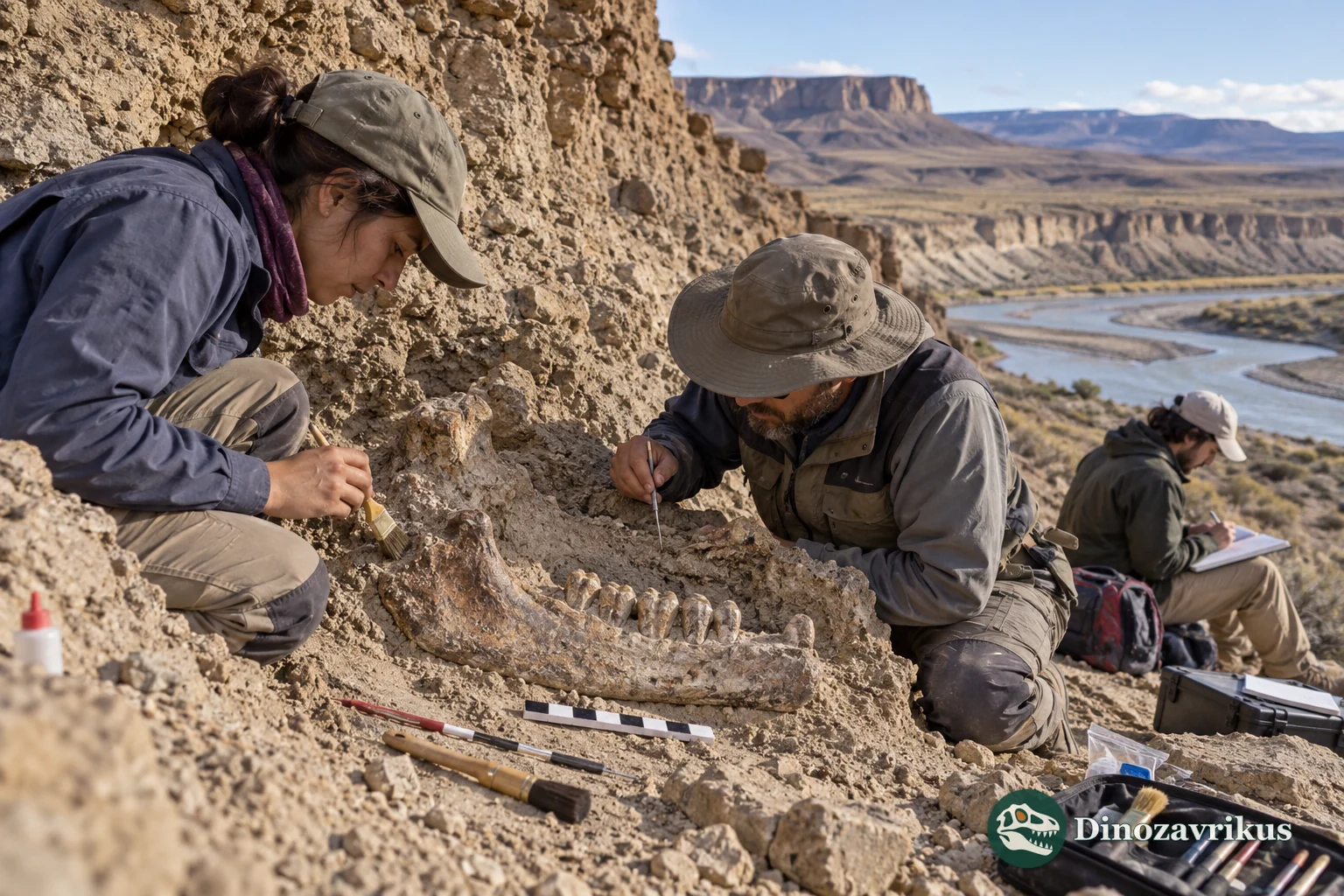
Richard Owen established Nesodon in 1846 from South American fossil teeth. Later collecting in Patagonia supplied many more specimens. Carlos and Florentino Ameghino helped expand the late nineteenth-century collections; John Bell Hatcher and subsequent field teams recovered additional skulls and skeletons from the Santa Cruz Formation. Specimens are now distributed among museums in Argentina, the United Kingdom and the United States.
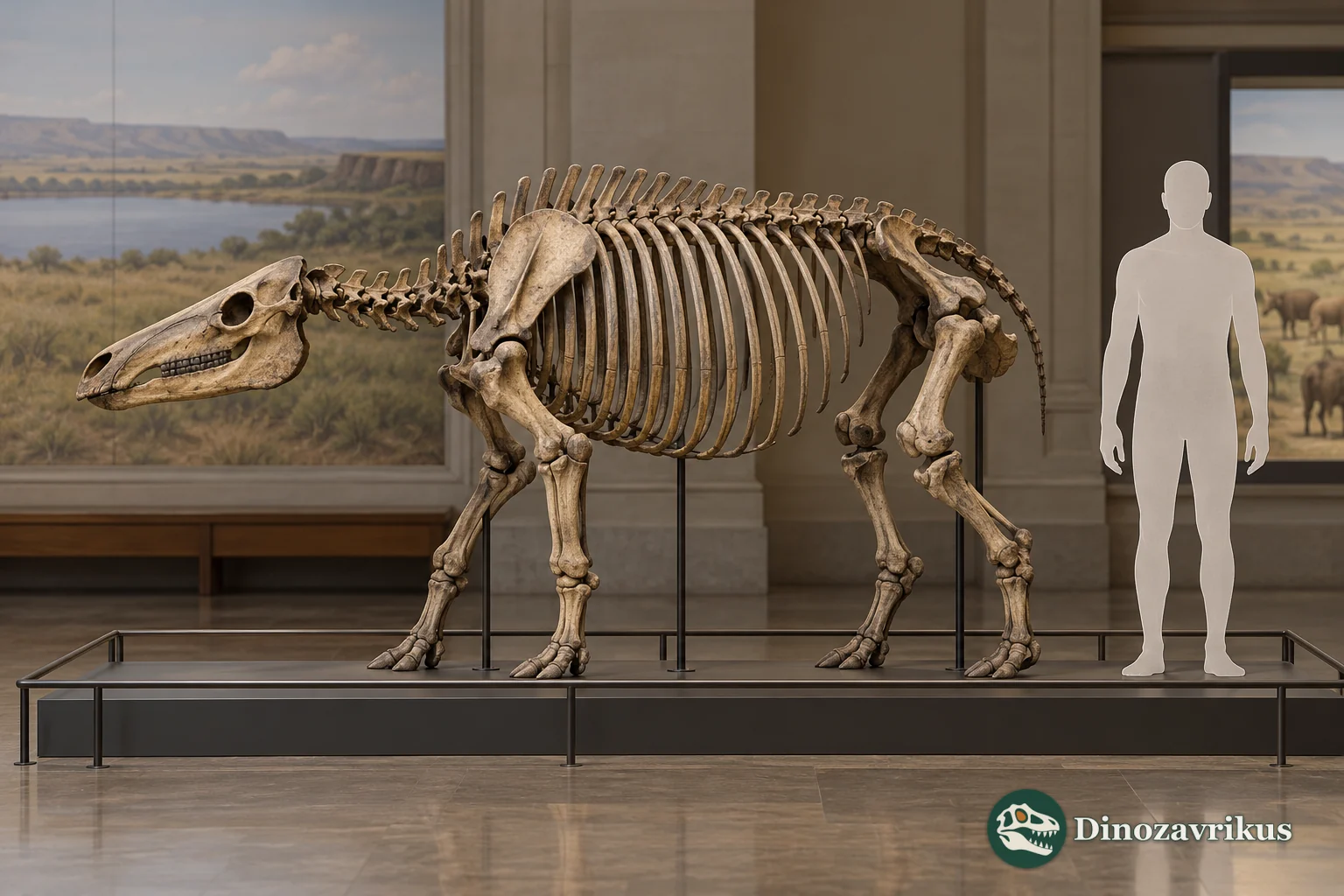
The Santacrucian record is unusually informative. Published material includes skulls, jaws, teeth, limb bones and near-complete skeletons, rather than isolated teeth alone. These fossils come from distinct individuals and localities. A composite reconstruction can be useful, but should not be confused with one fully articulated, catalogued specimen.
Species and changing classifications
The most widely recognized species are Nesodon imbricatus from the Santa Cruz Formation and N. taweretus, described in 2014 from the Aisol Formation in Mendoza Province. The latter is based on a skull with several mandibular fragments and postcranial bones referred tentatively. Its diagnosis rests on a combination of cranial and dental features.
A 2018 revision of the Santa Cruz toxodontids reassessed more than seventy historical names and reduced the well-supported Santacrucian nesodontines to Adinotherium ovinum and Nesodon imbricatus. Earlier names such as N. conspurcatus have subsequently been treated as junior synonyms of N. imbricatus. N. cornutus, reported from Lago Posadas, remains a case where further revision is needed: its morphology may fall within the variation of other species. These are different taxonomic judgments, not simple spelling variants.
Skull, teeth and body size
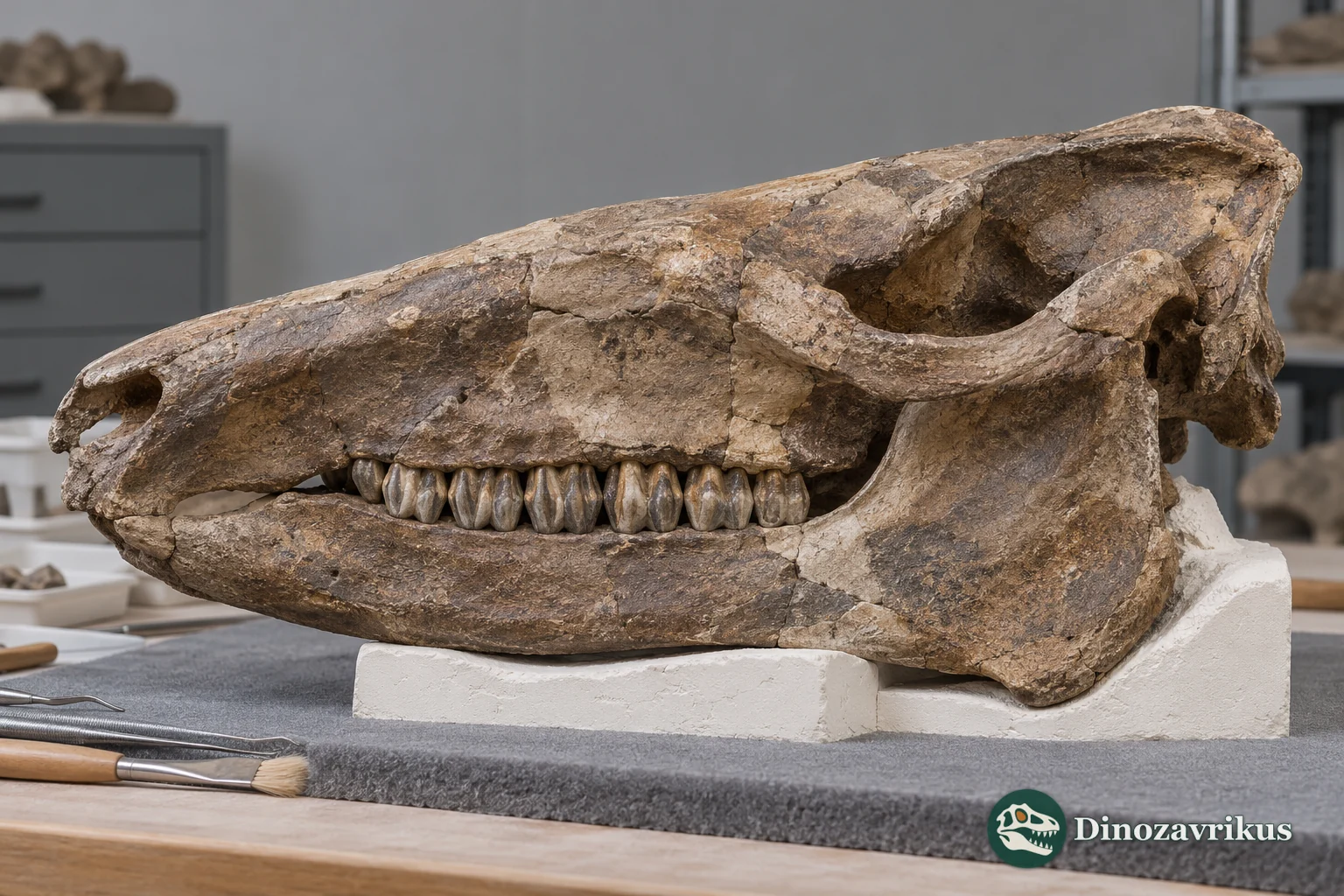
The skull is long and relatively low. Nesodontines have complex cheek teeth, contrasting with the shorter, higher skull and simpler occlusal pattern typical of toxodontines. A study of 110 skulls and mandibles used 27 traditional measurements alongside geometric morphometrics to separate size and shape variation, including changes associated with growth. This large sample makes the diagnosis more robust than a comparison based on a single striking specimen.
Published estimates place N. imbricatus at roughly 550 kg. A similar estimate was given for N. taweretus, whose remains are comparable in size. Such values are calculated from skeletal proportions and comparative models; they express an approximate body scale, not an exact weight for every adult.
Feeding and locomotion
Tooth crowns and jaw mechanics support a herbivorous interpretation. Crown relief and wear help researchers consider how food was processed, but no securely attributed stomach contents or feeding traces identify particular plants. Diet is therefore an anatomical inference rather than a direct observation.
Limb bones provide evidence about weight support and possible movement, although the best-studied features remain cranial and dental. A heavy, large-bodied animal was terrestrial, but speed, gait and daily behaviour cannot be read directly from the fossil record.
Age, localities and environment
Most N. imbricatus material comes from the Santa Cruz Formation of southern Argentina. The formation spans multiple measured levels, so its broad age should not be assigned as one precise date to every specimen. N. taweretus comes from the Aisol Formation in Mendoza. A U–Pb zircon date of 19.480 ± 0.025 million years constrains a tuff near the fossil-bearing section to the Burdigalian, Early Miocene.
Geographic separation between Mendoza and Patagonia has been proposed as one possible factor behind species differences. It is a biogeographic hypothesis based on the available fossil samples, not proof that all populations of the genus were isolated throughout its history.
What is known and what is inferred
Skulls, teeth and postcranial bones confirm a large toxodontid with a distinctive chewing apparatus and allow comparisons between species. The estimate near 550 kg is model-based, herbivory is inferred from anatomy, and the role of geographic separation in diversification remains a testable proposal. Soft tissues, colour and behaviour are not preserved.
Frequently asked questions
When did Nesodon live?
The best-known species, N. imbricatus, lived during the Early Miocene. N. taweretus is known from a tuff-dated Aisol Formation section at about 19.48 million years ago.
How much did Nesodon weigh?
A body mass near 550 kg has been estimated for N. imbricatus. It comes from skeletal proportions and comparative models, not a direct weighing.
Which species are recognized?
The 2018 revision supports N. imbricatus in the Santa Cruz fauna, and N. taweretus was described from Mendoza in 2014. N. cornutus needs further taxonomic review.
What did Nesodon eat?
Its teeth and jaw support a herbivorous interpretation, but the exact plants in its diet are not directly preserved.