

Nigerpeton ricqlesi is a temnospondyl from the Upper Permian Moradi Formation of northern Niger. Two partial skulls preserve an unusually long snout and a distinctive arrangement of large fangs, but do not provide a complete skeleton.
The species belongs in the ancient amphibian catalogue. Its position among edopoid temnospondyls helps connect the isolated Moradi fauna with broader early tetrapod history, while the missing postcranial skeleton limits estimates of body size and ecology.
Quick facts
| Species | Nigerpeton ricqlesi |
|---|---|
| Group | Edopoid temnospondyl; usually associated with Cochleosauridae |
| Age | Upper Permian |
| Region | Northern Niger, West Africa |
| Rock unit | Moradi Formation |
| Holotype | MNN MOR69, partial skull and atlas |
| Larger skull | MNN MOR70, partial skull and lower jaw |
| Total body length | Not reliably established |
What can the fossils tell us?
The holotype MNN MOR69 preserves part of the skull and the atlas. The larger referred specimen MNN MOR70 preserves much of the left palate, skull roof and lower jaw. Together they document cranial anatomy, not a complete articulated body.
A maxillary swelling accommodates two or three large fangs inside the marginal tooth row; mandibular fangs entered openings in the front of the skull. This anatomy supports a powerful grasp, but does not identify a specific prey animal.
The original description placed Nigerpeton in Edopoidea, and later work treated it within or close to Cochleosauridae. This is a phylogenetic result from cranial characters, not evidence of direct ancestry.
The formation preserves a distinct continental vertebrate fauna in northern Niger. Stratigraphy gives the regional age and setting, but does not reconstruct the exact water depth or behaviour of an individual.
Two skulls from the Moradi Formation
The genus and species were named in 2005 from fossils collected in the Upper Permian Moradi Formation of northern Niger. The holotype, MNN MOR69, is a partial skull associated with an atlas, the first neck vertebra. A second, larger specimen, MNN MOR70, preserves much of the skull roof, palate and lower jaw. Both are curated at the National Museum of Niger in Niamey.
The referred specimen adds information that the holotype cannot provide by itself. It is still incomplete, however, and the two skulls should not be combined into an imagined articulated skeleton.
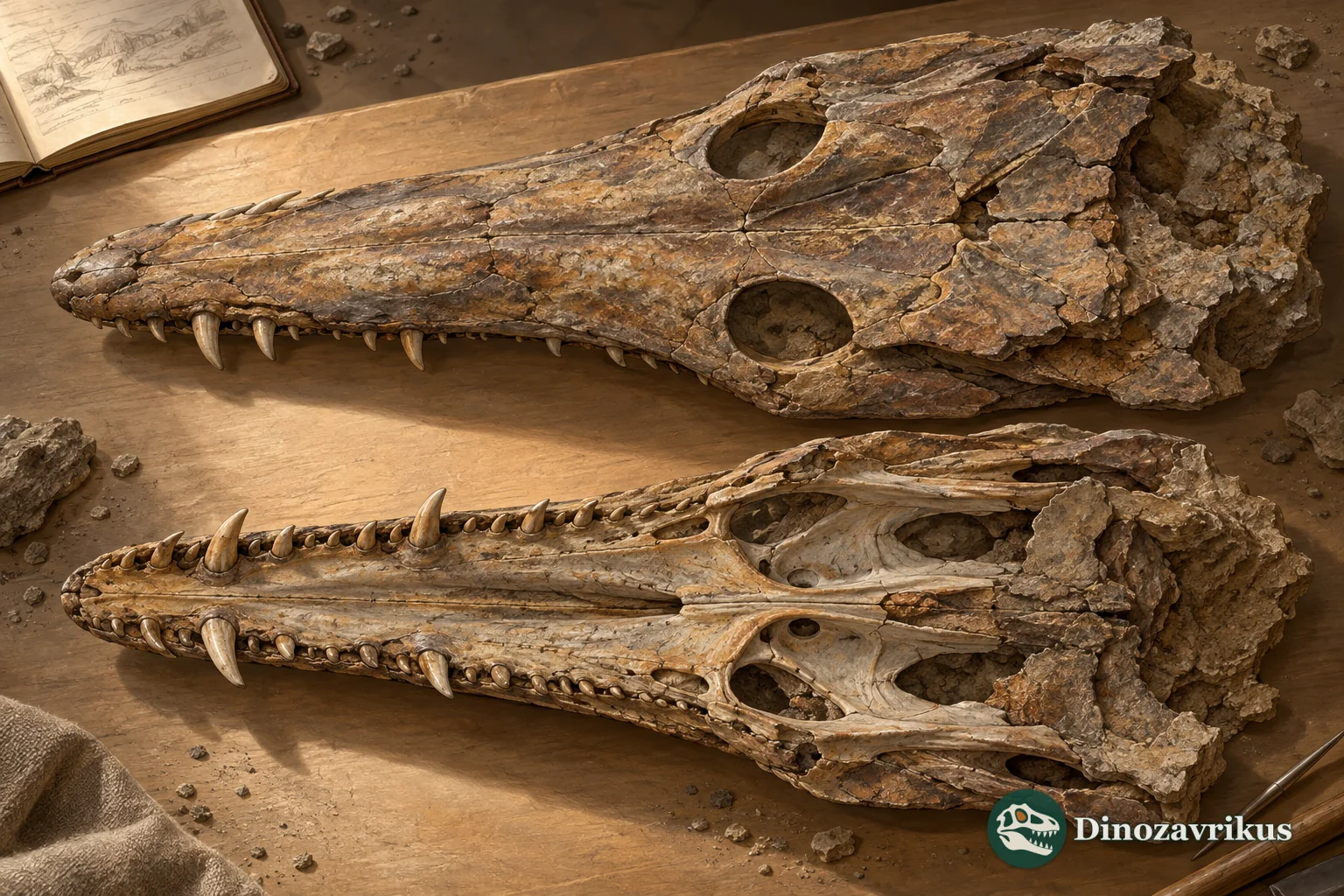
A long snout with an unusual set of fangs
The preorbital region occupies about 70 percent of the skull’s total length in the original diagnosis. The maxilla expands laterally to accommodate two or three large fangs inside the marginal tooth row. Large mandibular fangs sat farther toward the midline and entered paired openings in the front of the skull. Some positions in the tooth rows also show a doubled pattern.
These features make the dentition more complex than a single line of similar teeth. A strong grasping bite is a reasonable functional interpretation, but teeth alone do not reveal the exact prey, hunting method or frequency of feeding.
What can be said about its size?
The larger skull is roughly half a metre long in published accounts. That measurement belongs to the skull, not the whole animal. The vertebral column, limbs and tail are not preserved as a complete articulated skeleton, so a precise body length or mass cannot be calculated from the available material.
Several isolated postcranial elements have been tentatively referred to the genus, including a femur and sacral material. Their association is less secure than the skull specimens and should not be used to create a precise full-body reconstruction.
Edopoid affinities and their limits
The original description placed Nigerpeton within Edopoidea. A later detailed study compared the skull with cochleosaurids and discussed its place within that early temnospondyl branch. The unusually long snout, palatal anatomy and tooth arrangement all contribute to the comparison.
Phylogenetic placement is a hypothesis based on a coded set of anatomical features. It can change as taxa and character interpretations are revised. Nigerpeton is not known to be a direct ancestor of Cochleosaurus or any living amphibian.
A distinct late Permian community
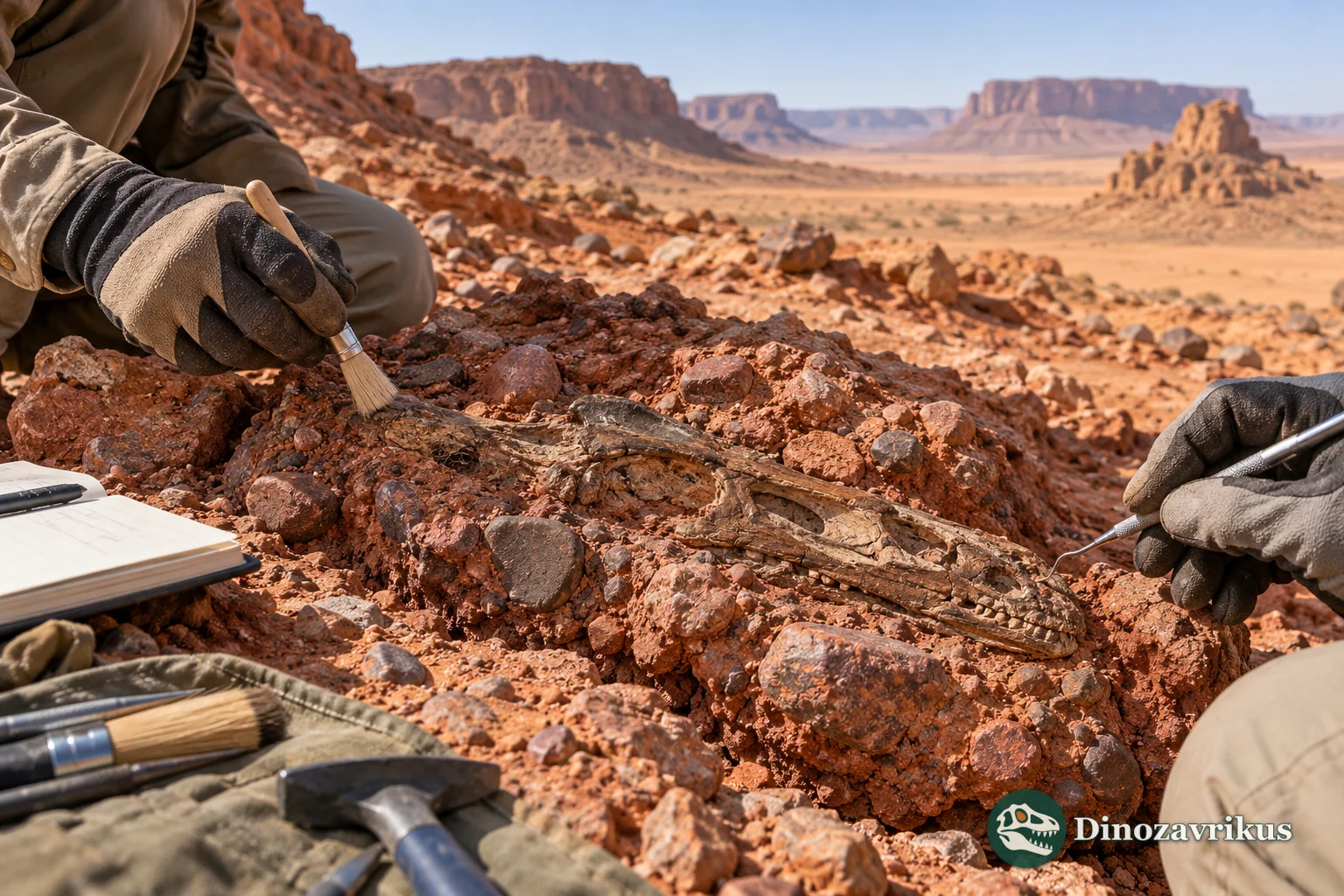
The Moradi Formation preserves a continental vertebrate fauna from northern Pangaea. Its mix of tetrapods differs from better-sampled southern Permian assemblages, and researchers have used it to study how climate and geography shaped faunal distribution. Local water bodies in a generally dry region can explain why aquatic temnospondyls appear there without requiring a permanently wet landscape.
That geological context does not locate the exact microhabitat of either skull. The image below is a conceptual reconstruction of fieldwork in fossil-bearing conglomerate, not a record of the expedition that collected the type specimens.
What the fossil record leaves open
The skulls establish a long preorbital region, distinctive fang positions and several useful taxonomic characters. They do not establish exact body proportions, skin colour, reproductive biology or a specific prey species. A low-bodied aquatic reconstruction is plausible, but its outline remains artistic rather than measured from a complete skeleton.
Frequently asked questions
When did Nigerpeton live?
It is known from Upper Permian deposits of the Moradi Formation in northern Niger.
How many skulls are known?
The main description is based on the partial holotype MNN MOR69 and the larger referred skull MNN MOR70.
What is unusual about its teeth?
Large fangs occupy specialized positions in the upper and lower jaws, and mandibular fangs entered paired openings at the front of the skull.
How long was the whole animal?
A reliable total body length is not established. The roughly half-metre measurement applies to the larger partial skull, not a complete skeleton.