

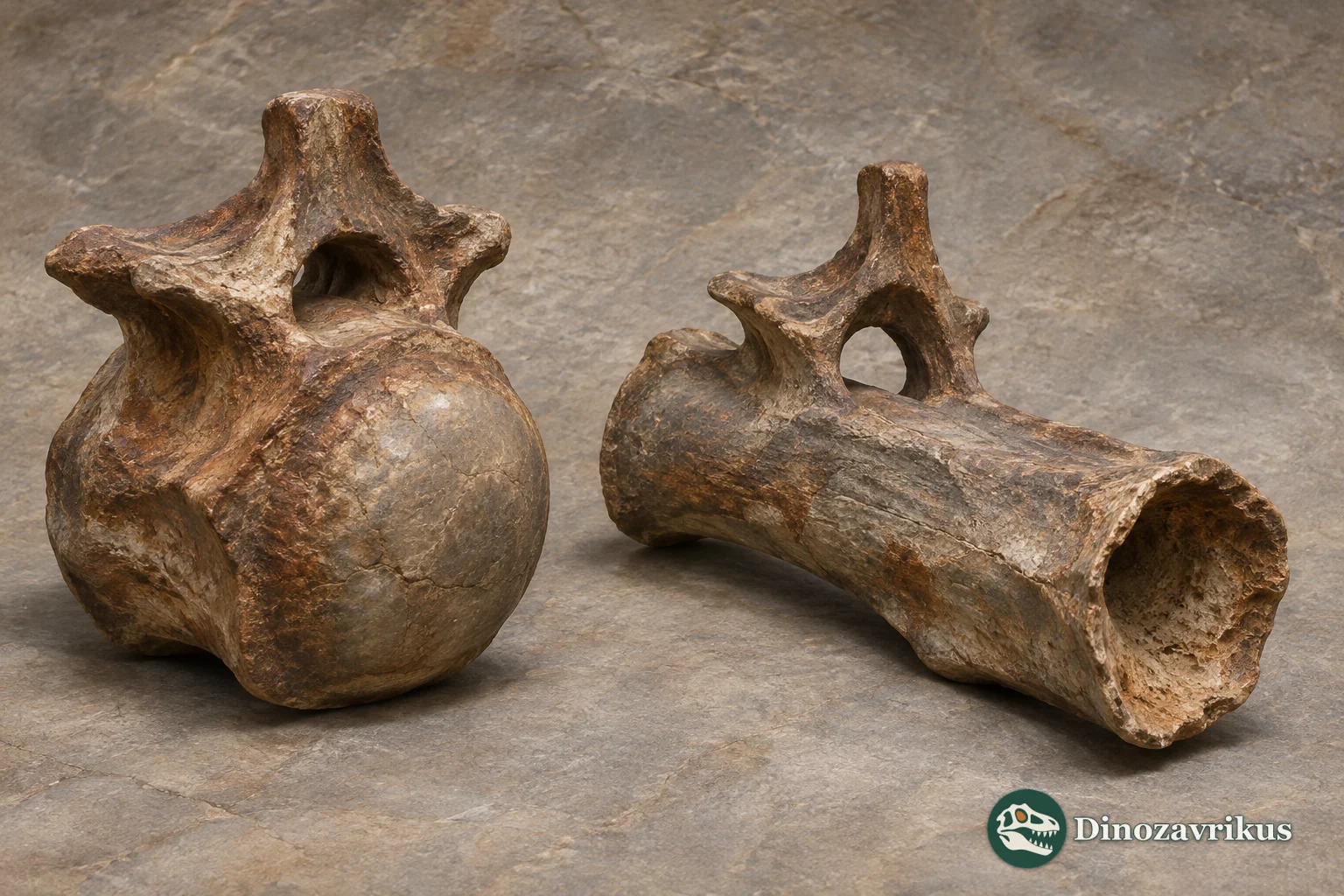
Normanniasaurus genceyi was a sauropod from what is now Normandy. Its scattered bones were recovered from fallen rock blocks on the coast near Le Havre. The front tail vertebra has a convex rear joint surface, while a vertebra from farther along the tail is concave at both ends.
Quick facts
| Group | Sauropods (Titanosauria) |
|---|---|
| Age | Early Cretaceous (early to middle Albian) |
| Region | Europe (Normandy, France) |
| Diet | Herbivore |
| Type species | Normanniasaurus genceyi |
| Holotype | MHNH-2013.2.1.1–12, an incomplete skeleton |
| Locality | Bléville, Le Havre, north side of Cap de la Hève |
| Geological unit | Poudingue Ferrugineux Formation |
What can the fossils tell us?
A front vertebra has a deep front socket and a rear projection. A middle vertebra has a hollow at both ends and the arch sits closer to the front of the centrum.
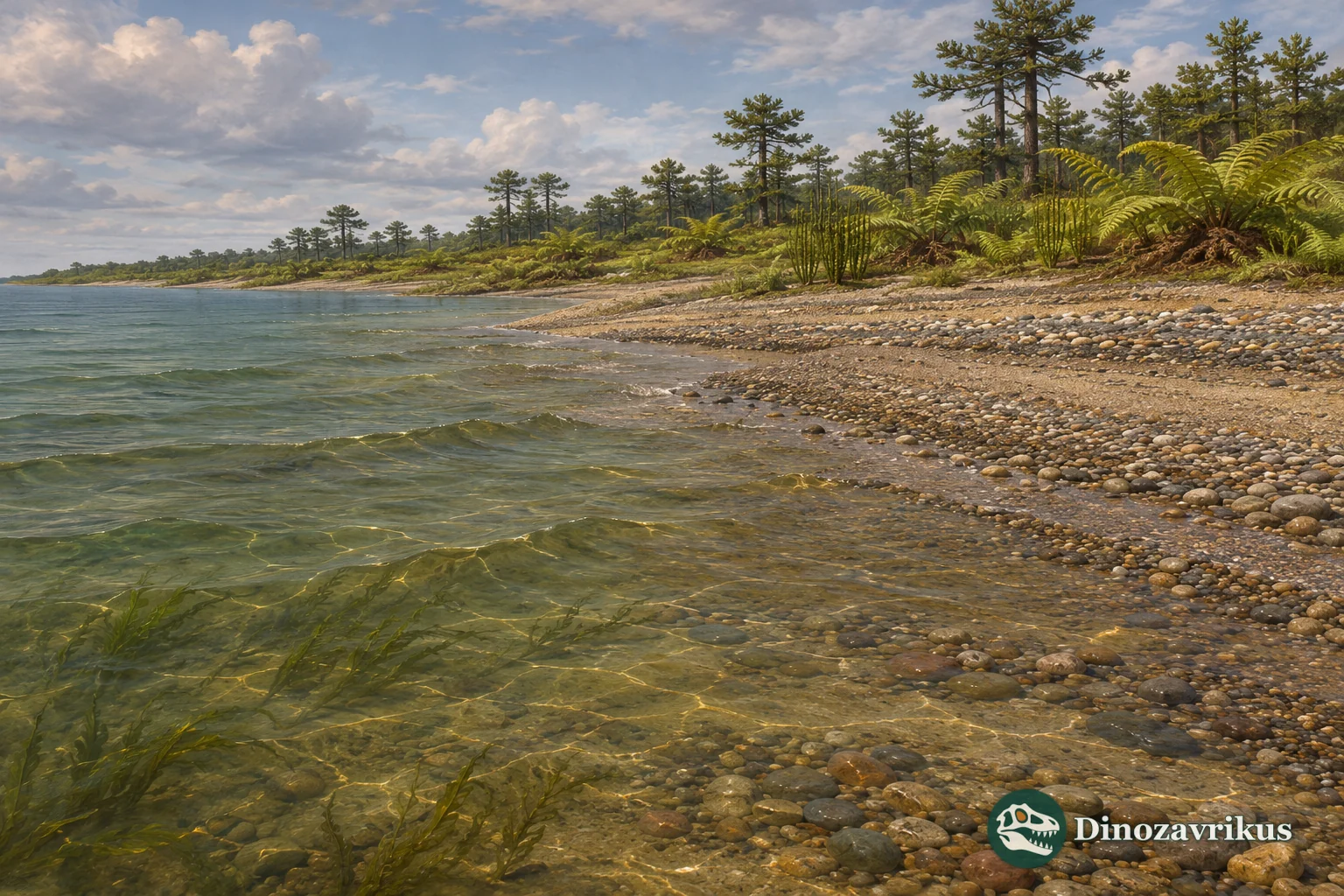
The type material was found at the foot of a cliff. The nature of the pebbles and their cement allowed the original layer to be identified. The deposit records a shallow coastal setting.
Matrix on the vertebra in the Bucaille collection suggests a younger bed. Its shape is consistent with a referral to Normanniasaurus, although the identification rests on one bone.
Pierre Gencey’s finds at Bléville
Pierre Gencey collected the bones in 1990 from blocks that had fallen from the cliff at Bléville, now a district of Le Havre. Jean Le Loeuff, Suravech Suteethorn and Eric Buffetaut named Normanniasaurus in 2013. Its name incorporates the Latin name for Normandy, and the species honours Gencey.
The Le Havre Natural History Museum holds the type material. It includes vertebral fragments from ahead of the hips, part of the sacrum, two tail vertebrae, a right shoulder blade, parts of both sides of the pelvis and the upper ends of a femur and a fibula. The authors treated this set as the remains of one individual.
Joints and internal structure
The front tail vertebra has an opening between processes on the arch. Its centrum is 141 mm long including the rear projection. The centrum of the middle vertebra measures 101 mm. A break through the arch of a vertebra from ahead of the hips exposes large internal cells.
The original description compared the combination of tail joints with early branches of Titanosauria and discussed Epachthosaurus. The front and middle parts of the tail preserve different surfaces in Normanniasaurus. Comparing bones from the same position makes these differences useful for assessing relationships.
From dry land into a coastal deposit
The iron-rich conglomerate accumulated in shallow water. Strong currents carried coarse sediment from the west, and the beds preserve both ammonites and plant remains. The authors suggested that the animal lived on land around the Armorican Massif. Its place of death is unknown.
An isolated tail vertebra from the same district is held in the Bucaille collection at Rouen. Glauconitic matrix on that bone suggests a younger Albian horizon. The 2013 team provisionally referred it to Normanniasaurus, along with some comparable vertebrae from the Moru quarry. The type skeleton remains the strongest basis for identifying the genus.
Frequently asked questions
Why is the genus spelled with a double n?
It was named after Normannia, the Latin name for Normandy.
Has its full length been measured?
Measurements are available for individual bones. The fragmentary spine and limbs leave the total length uncertain.
Did the type skeleton include teeth?
There are no teeth in the known type material. Plant feeding follows from sauropod affinities, and the particular plants eaten are unknown.
When did Normanniasaurus live?
The conglomerate that yielded the type skeleton dates to the early to middle part of the Albian, the final stage of the Early Cretaceous.