

Nothrotherium was a comparatively small South American ground sloth. Its fossils are particularly informative because Brazilian caves preserved a nearly complete skeleton, skulls and a remarkable fetal skeleton. These specimens clarify anatomy and development while leaving coat color and exact behavior unknown.
The genus belongs to the ice-age animal catalogue. The heavier Scelidotherium and Glossotherium represent different ground-sloth lines rather than larger examples of the same genus.
Quick facts
| Type species | Nothrotherium maquinense (Lund, 1839) |
|---|---|
| Genus name | Nothrotherium Lydekker, 1889 |
| Family | Nothrotheriidae |
| Key localities | Caves in Minas Gerais and Bahia, Brazil |
| Associated skeleton | Nearly complete specimen from Gruta dos Brejões |
| Dietary signal | Browsing inferred from muzzle form and isotopes |
What can the fossils tell us?
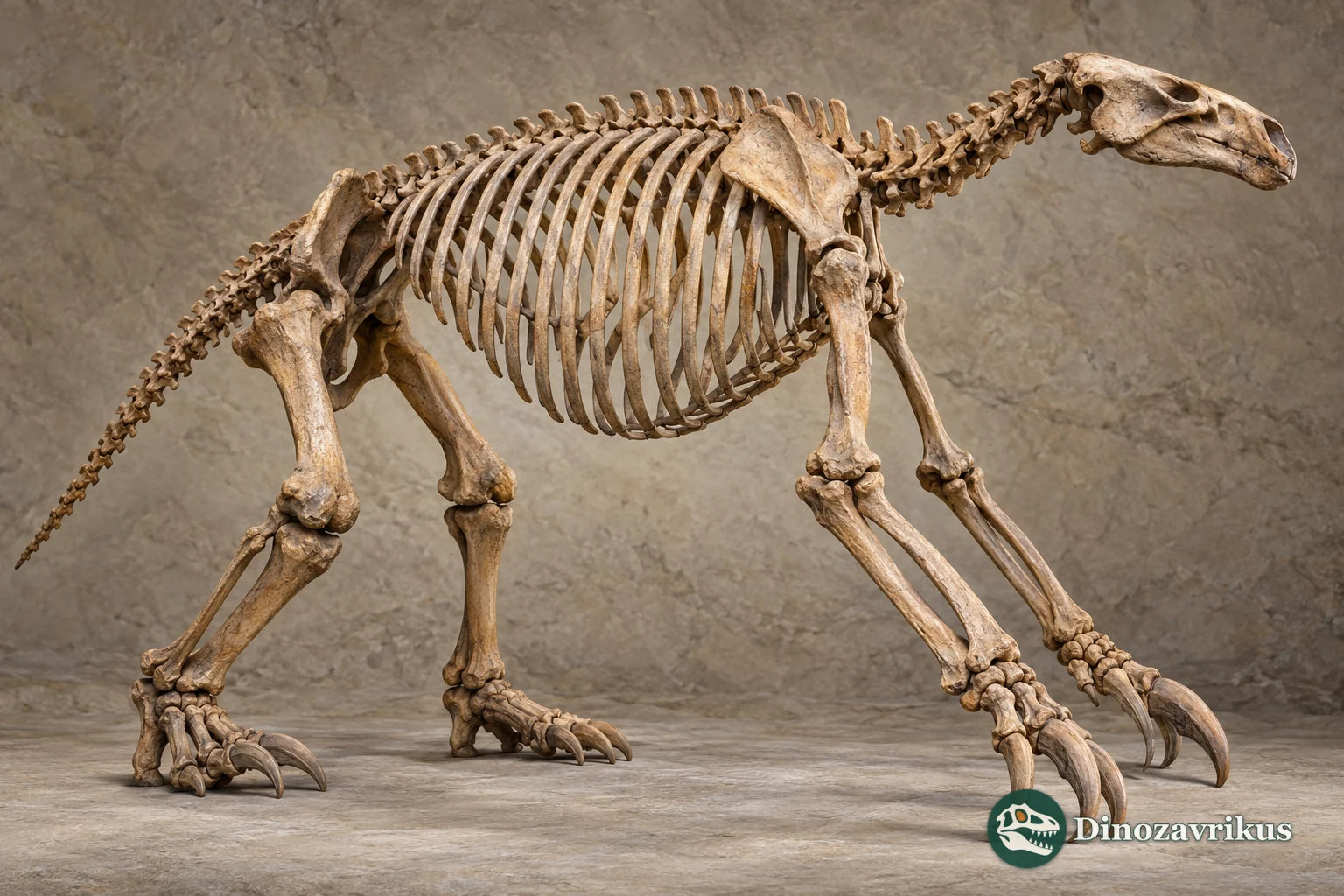
The Gruta dos Brejões skeleton reveals a relatively gracile body, limbs and claws. It cannot preserve fur color or demonstrate that the animal lived permanently inside caves.
A fetal skeleton occurs with maternal remains at Toca da Boa Vista. Its teeth and robust limbs document anatomy; carrying the young on the back remains a comparison-based inference.
CT scans of skull MCL 1021 show a tiny alveolus where an ancestral caniniform would have been. Researchers interpret a rare atavism, not the normal dental condition of the species.
Lund's cave species and a nearly complete skeleton
Peter Wilhelm Lund described the species N. maquinense from Lapa Nova de Maquiné in Minas Gerais. Richard Lydekker established the genus name later, in 1889. Historical names including N. escrivanense are treated differently by later specialists; a list of old names should not be mistaken for a settled count of valid species.
Castor Cartelle and José Sílvio Fonseca described a nearly complete skeleton from Gruta dos Brejões in Bahia in 1982. Associated skull, vertebrae and limb bones allowed a more useful comparison with North American Nothrotheriops than isolated finds could provide. The authors supported keeping those genera separate. A large isolated femur from another Brazilian cave was cautiously assigned only to Nothrotheriidae in a 2024 study; it does not justify inventing an additional Nothrotherium individual or direct date.
Teeth, an atavistic socket and growth
The usual Pleistocene Nothrotherium tooth row lacks the forward caniniform present in older relatives. A 2026 study used X-ray and CT scans on the subadult skull MCL 1021 from Gruta dos Brejões. It found a small alveolus in the ancestral caniniform position and excluded an ordinary crack or pathology. The authors interpret partial re-expression of an ancestral feature in this individual. No caniniform tooth was preserved, and the exceptional socket does not redefine the normal tooth formula.
At Toca da Boa Vista, many fetal bones were found associated with remains of an adult female. A 2023 anatomical study described the skull, permanent teeth and comparatively robust young limb bones. Their stage of ossification supports a fetus close to birth. Large claws may have helped a newborn cling to its mother, by analogy with living anteaters, but that behavior is not directly recorded. One fetal individual also cannot establish an invariant litter size for an entire species.
Browsing and the limits of cave evidence
Relative muzzle width and chewing-surface area were used in a 2022 study to infer that N. maquinense preferentially browsed foliage. Carbon isotope results from one Bahia cave also support heavy use of C3 plants. Both lines describe a feeding niche, not a precise list of plant species. A comparative mass estimate near 210 kg is a model result for a representative adult, not a direct measurement of all individuals.
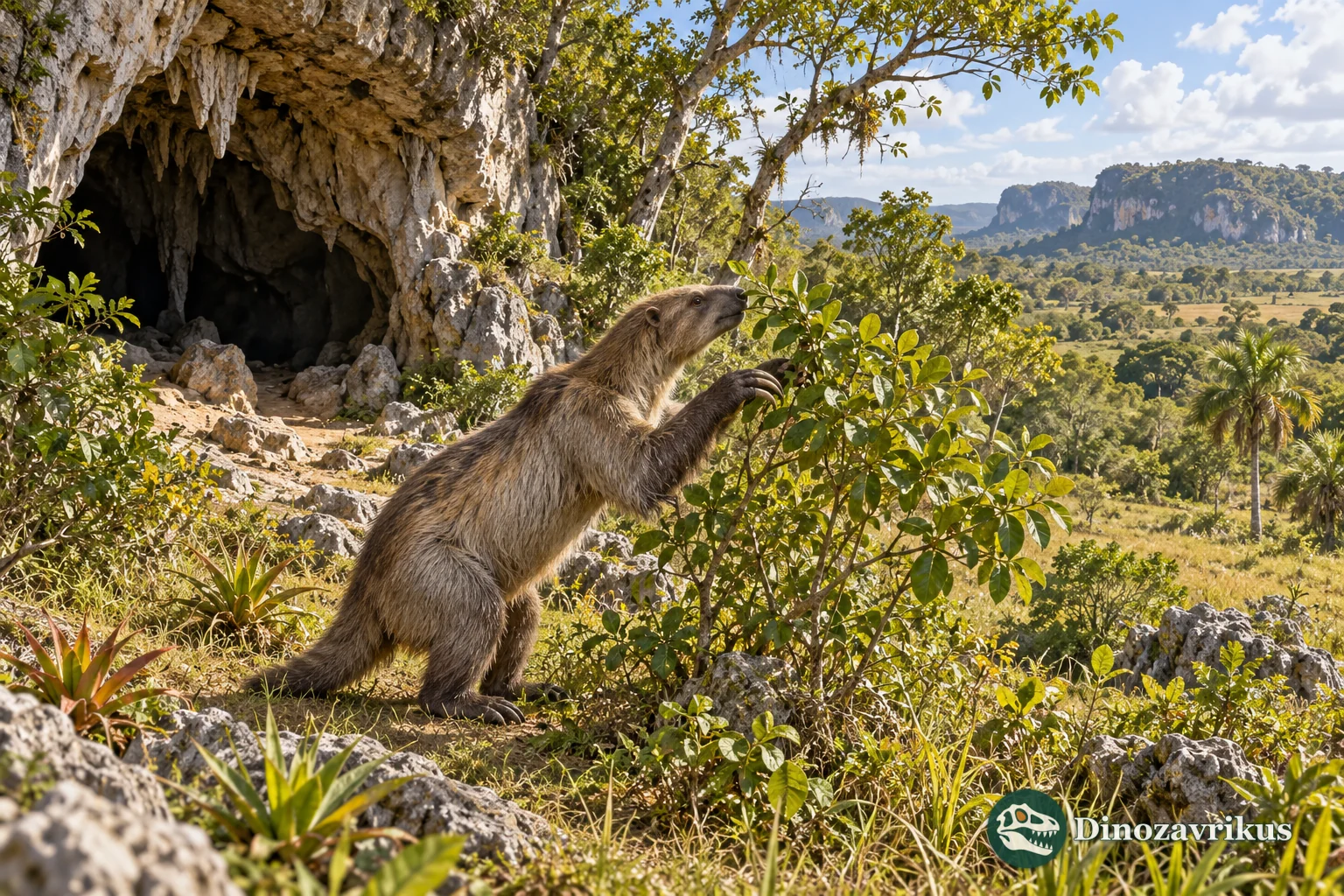
A right mandibular branch referred to Nothrotherium cf. N. maquinense has been described from Uruguay's Sopas Formation. The cf. qualifier records uncertainty about species identification. Skull MCL 1021 itself has not been directly radiocarbon dated; its late Pleistocene placement is inferred from context and associated material. Cave preservation does not establish habitual cave dwelling. The cover's fur, posture and landscape are artistic choices; bone shape and locality are observed evidence.
Frequently asked questions
Why is Nothrotherium called a smaller ground sloth?
Comparative mass estimates near 210 kg are far below those for many giant ground sloths, though individual size varied and the figure is model-based.
Did it live permanently in caves?
There is no proof of habitual cave dwelling. Caves preserved its bones particularly well.
What did skull MCL 1021 reveal?
CT scans found a tiny socket interpreted as a rare atavistic caniniform alveolus in one individual.
What is known about its young?
A late fetal skeleton with maternal remains documents teeth and robust limbs; post-birth behavior is inferred rather than observed.