

Nyctitherium was a small Eocene mammal known chiefly through jaws and teeth. Its record illustrates how much species comparison can achieve with fragmentary fossils, while leaving coat colour, activity schedule and complete body form unresolved. A name evoking night is not evidence that the animal was nocturnal.
The genus appears in the ancient mammal catalogue because its dental record is identifiable and scientifically useful. The illustrations on this page are clearly reconstructions.
Quick facts
| Scientific name | Nyctitherium Marsh, 1872 |
|---|---|
| Type species | N. velox |
| Group | Nyctitheriidae; wider affinities debated |
| Age | Eocene for the fossils discussed here |
| Range | North America, including Wyoming |
| Named specimen | SDSNH 110393, type of N. gunnelli |
| Main evidence | Jaw fragments and teeth |
| Behaviour | No direct evidence of night activity or a specific gait |
What can the fossils tell us?
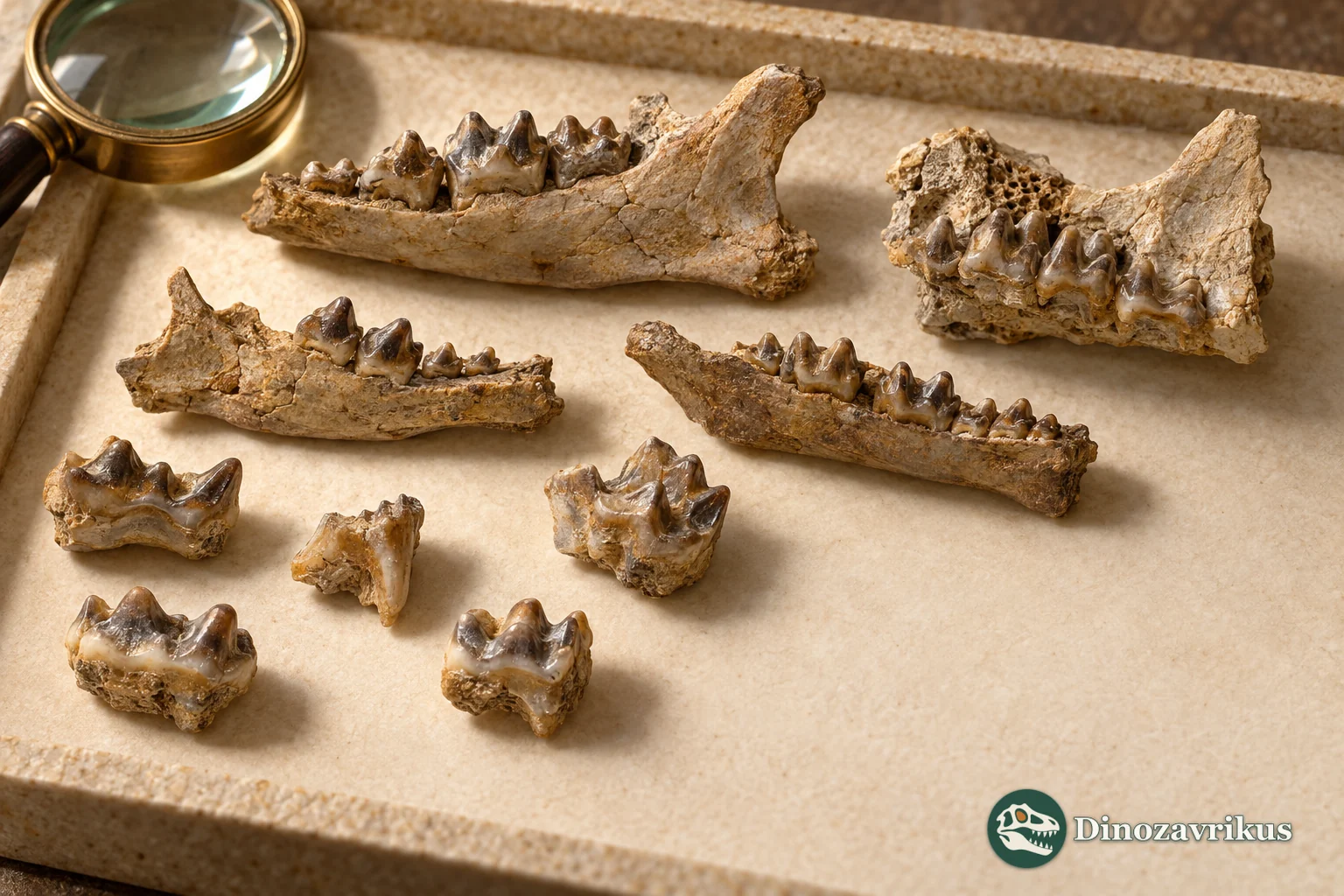
SDSNH 110393 includes an associated lower premolar and two molars. Known tooth positions support comparison but do not reveal full body form.
N. gunnelli was compared with N. velox and N. serotinum using size, ridges and lower-molar structure. Worn isolated crowns may remain uncertain.
Limb studies of European members of Nyctitheriidae inform broader family relationships. Those bones are not a skeleton of North American Nyctitherium.
The jaw supports dental comparisons and cautious dietary discussion. It cannot demonstrate night activity, climbing or an exact prey list.
An old name and a newly described species
Othniel Charles Marsh named Nyctitherium in 1872, with N. velox as its type species. Early researchers compared these tiny teeth with different small-mammal groups, sometimes even bats. Such historical proposals do not show that Nyctitherium could fly. The extinct family Nyctitheriidae has been studied in its own right; an Eocene tooth cannot be assigned to the type species simply because it is small.
A study of the Turtle Bluff Member of Wyoming's Bridger Formation described N. gunnelli. Its type specimen, SDSNH 110393, is a lower jaw fragment preserving the fourth premolar and first two molars in sequence. Their positions make comparison with N. velox and N. serotinum more secure than a collection of unidentified isolated crowns. The authors compared dimensions and the ridges and basins of the chewing surfaces. Heavy wear can still limit an identification.
Why a bed position matters
The Turtle Bluff authors placed the N. gunnelli find about 105 metres above the member's base and assigned that level to the earliest Uintan North American land-mammal age. This is geological context for a specific fossil, not a single birth date for the genus. Comparison with other Bridger beds helps reconstruct changing faunas but cannot record a living animal's actions.
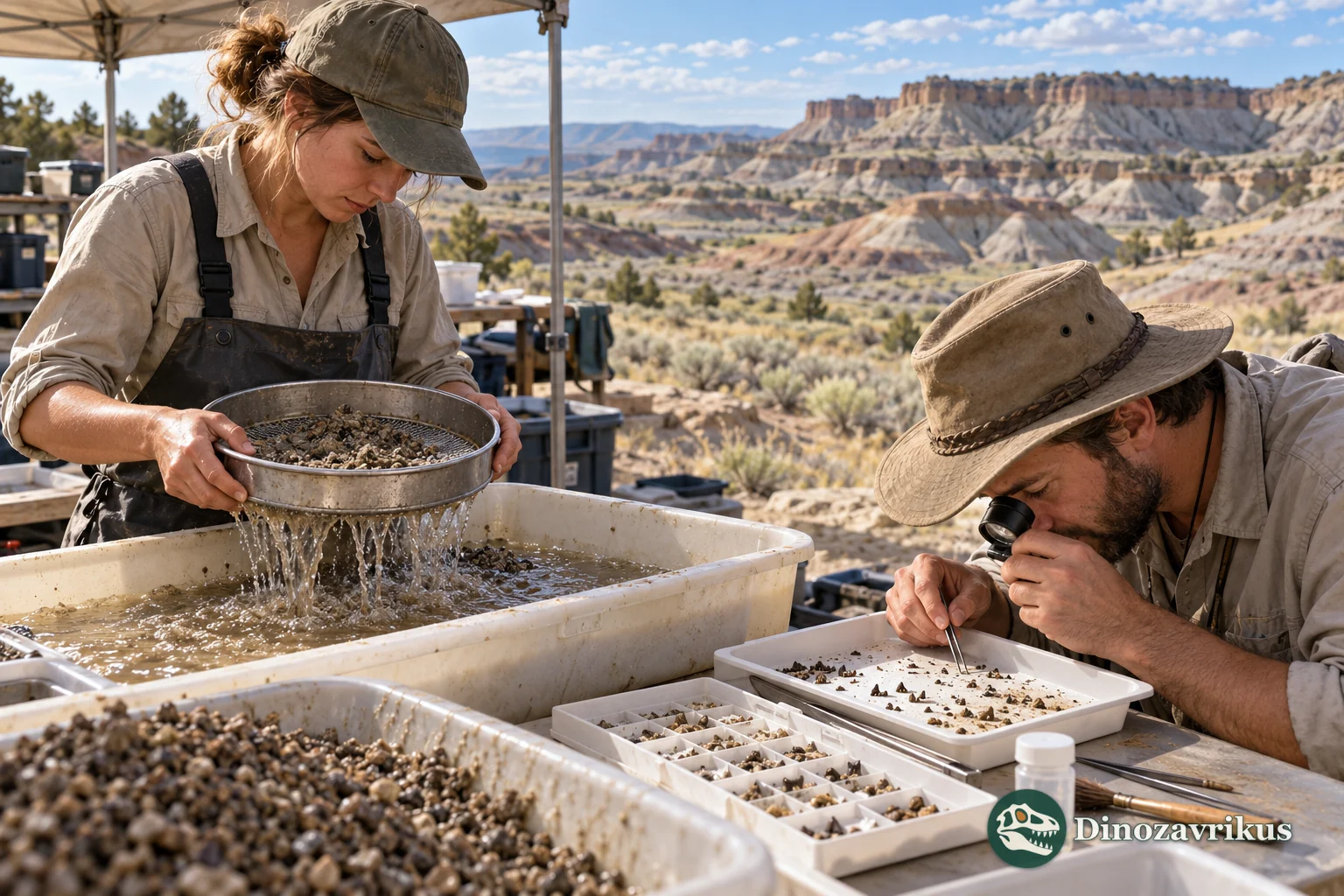
Small teeth can be recovered by careful washing and screening of sediment. An illustrated field scene explains why a tiny mammal may be represented by crowns when a larger animal leaves more conspicuous bones. A reliable museum number and locality preserve the context needed to interpret them.
Kinship and movement remain open questions
A separate study described limb bones of late Eocene and earliest Oligocene European nyctitheriids. Their mobile joints suggest climbing ability in those family members and provide characters for testing wider relationships. Crucially, the European bones do not belong to the North American species N. gunnelli or N. velox. Their movement cannot simply be assigned to Nyctitherium as directly observed fact.
Tooth shape allows limited dietary comparisons with small insect-eating mammals, but the discussed material does not provide an exact prey list. The cover's branch, ear shape and coat remain artistic choices. Nyctitherium lived during the Palaeogene Period. The Apatemys page offers a contrast: its articulated skeleton supports anatomical questions that a few Nyctitherium jaws cannot answer. These animals belong to distinct lineages.
Frequently asked questions
Does the name prove Nyctitherium was nocturnal?
No. The name is not a behavioural observation, and the preserved jaws and teeth do not establish its activity schedule.
Was Nyctitherium a bat?
Flight is not demonstrated. Historical comparisons with several mammal groups do not justify adding wings or identifying it as a direct bat ancestor.
Why is SDSNH 110393 important?
It is the N. gunnelli type, a lower jaw fragment with teeth in known positions, permitting more reliable species comparison than an isolated uncertain crown.
Do we know how it moved?
Not directly for the North American species discussed here. Limbs of other nyctitheriid genera help frame hypotheses for the family, not a definite gait for Nyctitherium.