

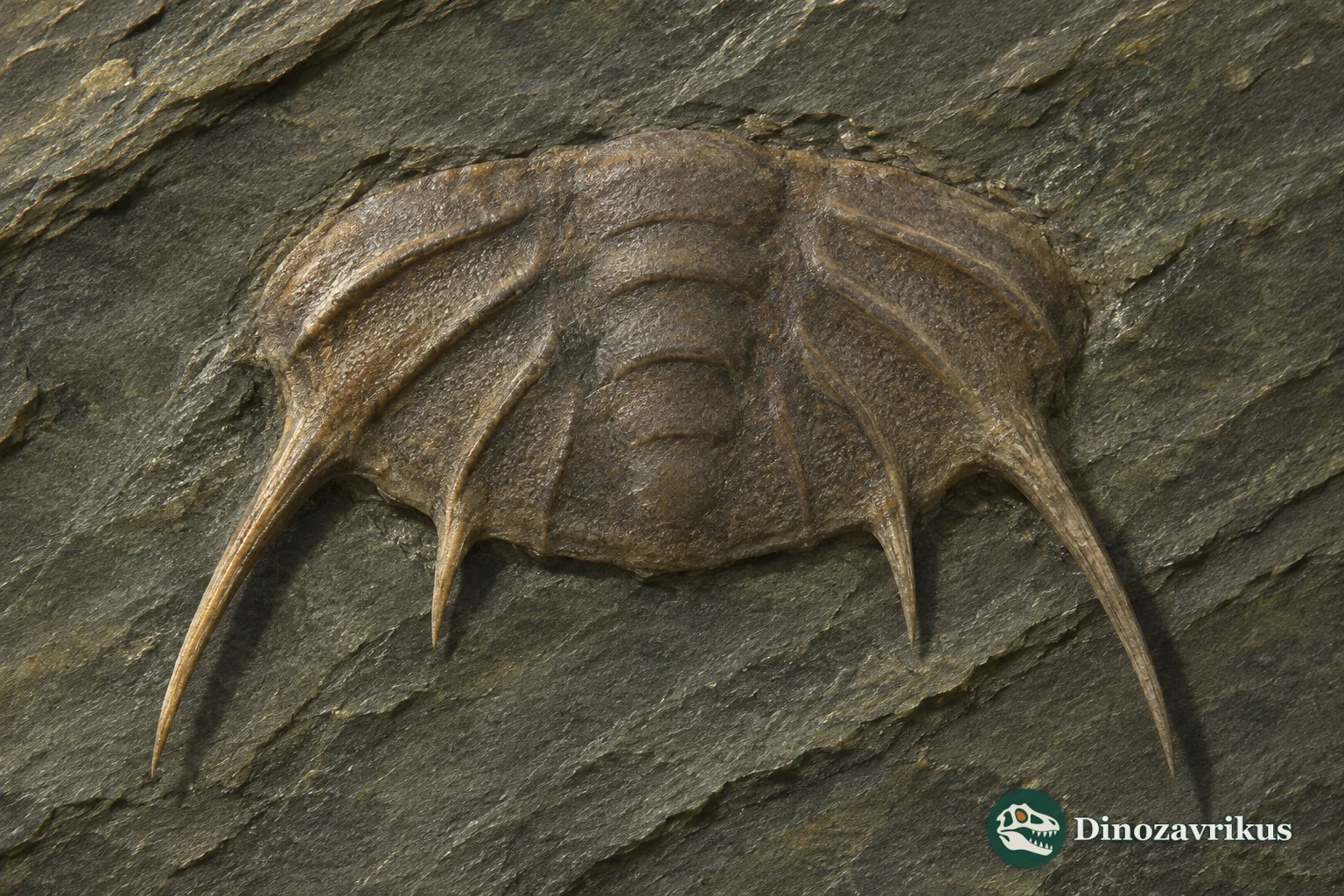
Olenaspella was a Late Cambrian trilobite genus. Its tail shield carried paired marginal spines. Taxonomists examine their number and position as well as how each spine connects to the side of a tail segment.
Quick facts
| Group | Trilobites |
|---|---|
| Age | Late Cambrian, including the Paibian |
| Region | North America (Canada and United States) |
| Diet | Unknown |
| Type species | Olenaspella evansi |
| Genus named by | James Lee Wilson, 1956 |
What can the fossils tell us?
Lectotype GSC 15150 is a tail shield from Kobayashi’s original British Columbian collection.
The outer pair is usually longest. Some specimens also develop a small additional pair just inside the inner spines.
In the type species, the spines continue the lateral ribs. A similar form reassigned to Eugonocare has spines growing out of the posterior border.
A discrepancy between text and illustration
Teiichi Kobayashi described the type species in 1936 from material collected north of Jubilee Mountain, British Columbia. The original illustration shows six spines on the tail shield, although the description lists four. James Lee Wilson established the genus Olenaspella in 1956.
Allison Palmer re-examined the original series and designated the pygidium illustrated by Kobayashi, GSC 15150, as the lectotype. Three pairs of spines are visible on it and on other tail shields in the series. Palmer assigned Nevada material with two more conspicuous pairs to O. regularis. Its spines may point straight back or somewhat inwards, and some specimens have a short third pair.
Where the spines meet the shield
In O. evansi and O. regularis, the spines extend from the lateral ribs of the pygidium. In the species originally named O. separata, the spines arise from the posterior border, beyond the ends of the pleural furrows. Brian Pratt moved this species to Eugonocare. Later work supported the use of spine attachment to distinguish these genera.
Alaskan material identified as O. evansi has fainter furrows on the head and tail shields than the Canadian types. In the Great Basin, other trilobites, including a species of Glaphyraspis, also help identify the upper Aphelaspis Zone where O. regularis occurs.
Frequently asked questions
Which species defines Olenaspella?
O. evansi, from Late Cambrian deposits in British Columbia.
What is lectotype GSC 15150?
The isolated tail shield with three spine pairs illustrated in the original description.
Did all species have the same number of spines?
O. evansi has three pairs. O. regularis typically has two conspicuous pairs, sometimes with a short additional pair.
How do the spine attachments help identify the genus?
Olenaspella spines continue the lateral ribs of the shield. In superficially similar forms, the spines can arise from the border.