

The French species of Oligocorax was first recognised from leg bones. Its joint surfaces helped distinguish it from living cormorants. A somewhat older German bird, known from much more complete material, has also been assigned to the genus provisionally. Its placement depends on how it compares with the original French species.
Quick facts
| Family | Cormorants |
|---|---|
| Type species | Oligocorax littoralis |
| Age of type species | Early Miocene |
| Type locality | Saint-Gérand-le-Puy, France |
| Original material | Proximal right tarsometatarsus, MNHN Av 9434 |
What can the fossils tell us?
Jiří Mlíkovský identified the upper part of a foot bone as the specimen described in 1863. Jacques Cheneval had selected a humerus as lectotype from what he regarded as a larger original series.
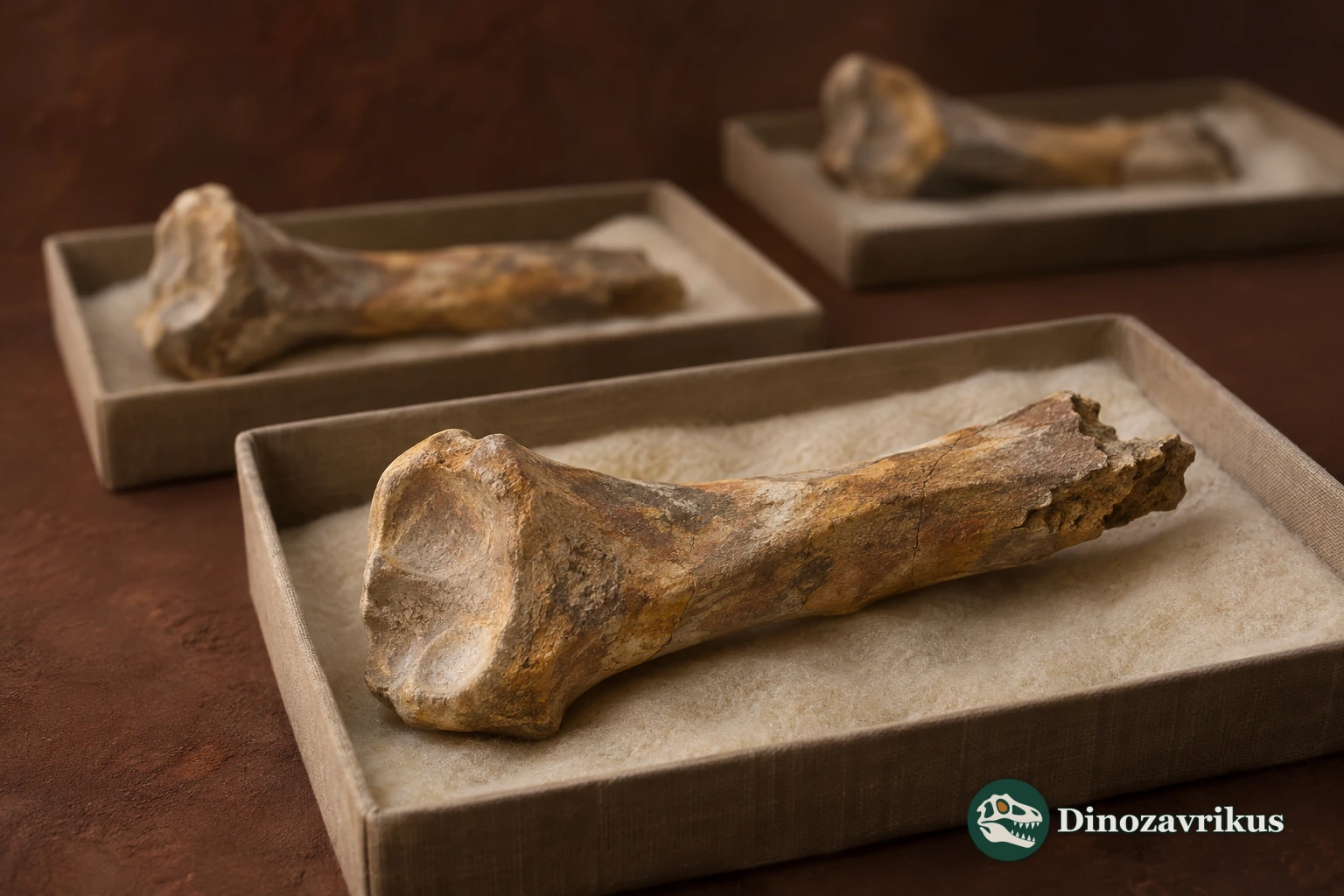
Differences in the shin and foot helped separate the fossil from living cormorants. The shallow inner socket at the upper end of the foot bone is one feature noted for the French species.
A later Enspel skeleton shows the wishbone fused to the tip of the keel. It is a feature of the German bird, whose assignment to Oligocorax is provisional.
From a foot bone to a genus
Alphonse Milne-Edwards named the French species Graculus littoralis in 1863. The upper part of a right tarsometatarsus from Saint-Gérand-le-Puy is catalogued as MNHN Av 9434. The species was later assigned to Phalacrocorax. In 1952 Pierce Brodkorb fixed it as the type species of Oligocorax, a name previously used by Kálmán Lambrecht.
Jacques Cheneval selected the humerus MNHN Av 9421 as lectotype in 1984. Jiří Mlíkovský later argued that the 1863 description was based solely on the foot bone, with the other bones documented later. Under that reading, the foot bone was already the holotype.
The French material
Parts of the humerus, ulna, femur and shin have also been referred to the French species. The upper joint of its tarsometatarsus has a relatively shallow inner socket and a less prominent projection between the two joint surfaces than in living cormorants. Similar comparisons of the shin and foot formed part of Gerald Mayr’s case for recognising Oligocorax as a distinct genus.
Cheneval counted at least two individuals in the French sample. Comparative studies record it from other European deposits as well. An eroded thigh bone from Elisabethfeld in Namibia was assigned to the species in one study. That single bone offers weaker evidence for its range than the French series.
The bird from Enspel
The German fossils come from Late Oligocene lake deposits at Enspel. Mayr initially placed an isolated foot near Oligocorax, then described a skeleton as ?Borvocarbo stoeffelensis. Another specimen preserved more of its shoulder girdle. In a paper published online in 2014, Mayr removed it from Borvocarbo and provisionally returned it to Oligocorax.
The wishbone of the Enspel bird is fused to the front of the sternal keel, a condition absent in living cormorants. The German fossils show that early cormorants combined features in ways that differ from living forms. The fusion has not been established in the French type species.

Frequently asked questions
Where did the original fossil come from?
It came from Early Miocene deposits at Saint-Gérand-le-Puy, in Allier, France.
Why are two different bones discussed as the type?
Cheneval selected a humerus from the material he considered original. Mlíkovský pointed out that only the foot bone was described in 1863, so it already served as the type.
Is a complete skeleton known for the French species?
The French fossils are principally isolated bones. The more complete Enspel specimens are a different species placed in the genus provisionally.
What did the newer Enspel skeleton reveal?
It shows the wishbone fused to the keel of the sternum. The shoulder bones also led to a different interpretation of the bird’s generic affinities.