

Olympidytes was a flightless seabird from what is now western Washington. Its late Eocene type specimen preserves the bones of the legs. Plotopterids such as Olympidytes are best known for swimming with their wings, but the evidence for that behaviour comes from better-preserved forelimbs of other members of the family.
Quick facts
| Type species | Olympidytes thieli |
|---|---|
| Family | Plotopteridae |
| Age of the type | Late Eocene |
| Type locality | Southwestern Washington, USA |
| Formation | Lower Lincoln Creek Formation |
| Holotype | SMF Av 608, hindlimb bones |
| Right tibiotarsus | 177.1 mm long |
What can the fossils tell us?
Both femora measure 111.2 mm. The right tibiotarsus is 177.1 mm long. These are bone lengths and give no direct overall body length.
The upper end of the humerus found with SMF Av 671 is much wider than the upper end of the type femur. The skull belongs to a larger plotopterid.
The lower end of a right tibiotarsus from Kyushu resembles Olympidytes. The provisional referral leaves its species and exact relationship open.
A specimen from Lincoln Creek
Gerald Mayr and James L. Goedert named Olympidytes thieli in 2016. The species honours Bruce Thiel, who found the type specimen and donated it to the Senckenberg museum in Frankfurt. The bones came from a late Eocene section in the lower Lincoln Creek Formation.
The two femora of SMF Av 608 are each 111.2 mm long. Its right tibiotarsus, the main bone of the lower leg, measures 177.1 mm. A right tarsometatarsus about 53 mm long, SMF Av 609, was listed as cf. Olympidytes thieli in a later comparison. It is a separate fossil with a more tentative identification.
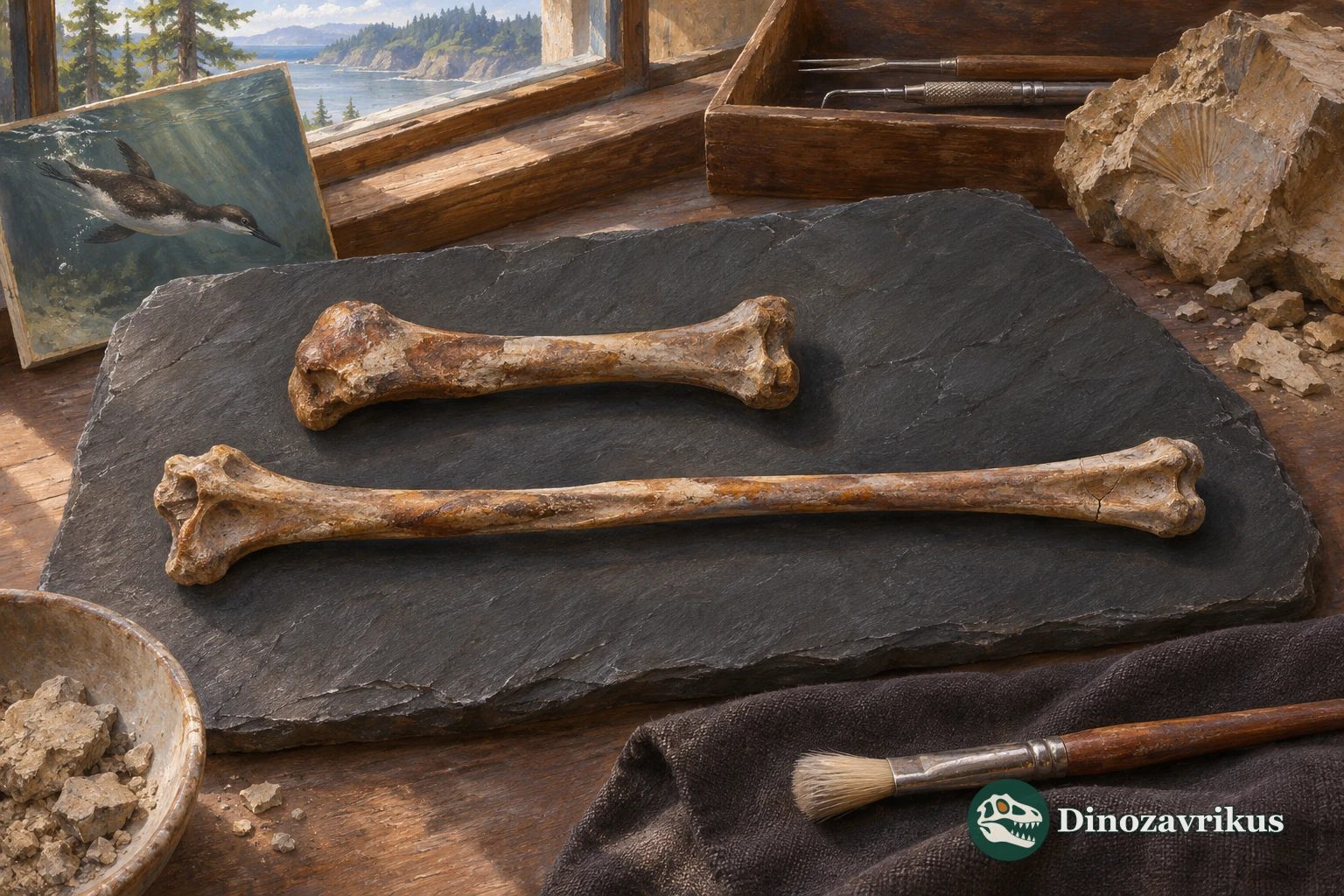
What can be reconstructed
The skull SMF Av 671 was recovered farther north in a different part of the Lincoln Creek Formation, with an associated partial humerus. That humerus measures 46.5 mm across its upper end. The corresponding width of the type femur of Olympidytes is 28.5 mm. Measurements at those two joints are much closer in plotopterids that preserve both bones, so the researchers ruled out attributing the skull to the same species.
In Tonsala, bones of the wing carry direct evidence of the machinery for underwater propulsion. The Olympidytes reconstruction uses that broader family anatomy to fill the gaps left by its hindlimb fossils. Its head, wings and plumage remain approximate.

A comparable ankle in Kyushu
Hirotsugu Mori and Kazunori Miyata described SM–SKT–1153 from the Yanagi Coast, near Saikai in Japan. They traced it to an oyster bed in the lower Kakinoura Formation and used the local calcareous nannofossil record to assign the horizon to the early Oligocene. The preserved end measures 58.8 mm. The authors used cf. Olympidytes sp. because the right tibiotarsus resembles the American genus without showing enough to identify a species.
Frequently asked questions
Was Olympidytes a penguin?
It was a plotopterid. Its resemblance to penguins reflects a similar way of moving underwater.
Who found the type specimen?
Bruce Thiel found the fossils and donated them to the Senckenberg museum. The species name thieli honours him.
Does the Lincoln Creek skull belong to Olympidytes?
The humerus found with it indicates a larger plotopterid. The genus remains without an identified skull.
Is its occurrence in Japan certain?
The early Oligocene leg fragment was provisionally compared with the genus. The assignment could change with better material.