

Omegachelys is known from shells found in the Himalayan foothills. The type specimen comes from Pliocene deposits near Nahan in northern India. It preserves enough of the upper shell to compare with other finds, while the head and limbs remain unknown.
Quick facts
| Group | Turtles, geoemydids (Geoemydidae) |
|---|---|
| Age | Late Pliocene (beds yielding the holotype) |
| Region | Asia (India, Himalayan foothills) |
| Type species | Omegachelys sahnii |
| Holotype | SFP 24, partial carapace |
| Type locality | Pipal Wala near Nahan, Himachal Pradesh |
| Formation | Saketi Formation, Upper Siwaliks |
| Carapace length | 51 cm in the reconstructed holotype |
| Scientific name | Omegachelys |
| Diet | Exact diet unknown |
What can the fossils tell us?
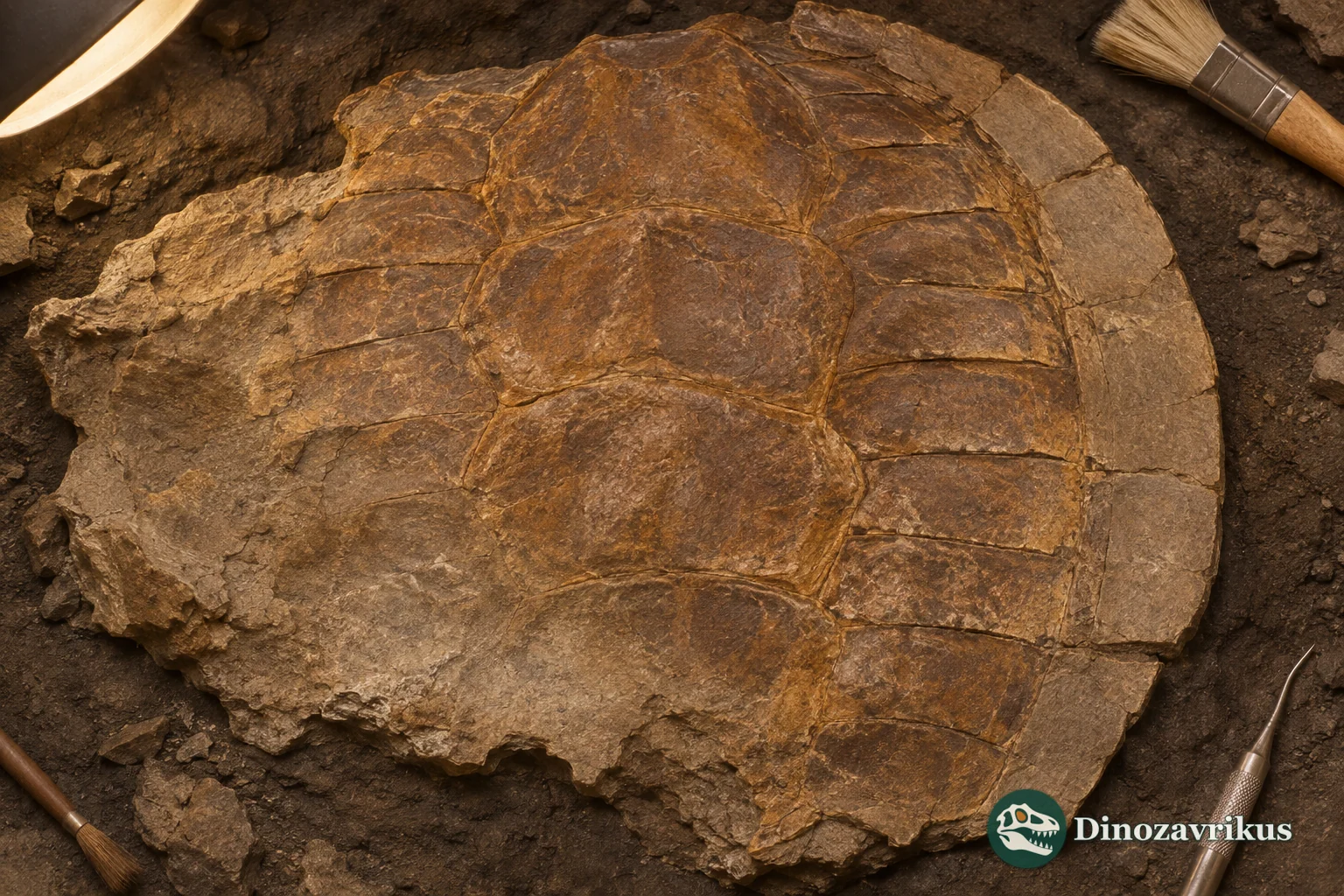
The front of SFP 24 is broken. The specimen is held in the field museum of Saketi Fossil Park.
The vertebral scutes covered much of the upper surface. Shorter scutes occupied the steep slopes on either side.
The referred carapace WIF/A 451 comes from the lower part of the Pinjor Formation. Its published straight length is 94 cm.
The shell near Nahan
Srivastava and Schleich named Omegachelys sahnii in 2018. The holotype, SFP 24, was found at Pipal Wala near Nahan, Himachal Pradesh. It comes from the Saketi Formation in the Upper Siwaliks. The species name honours Indian palaeontologist Ashok Sahni.
The carapace is elongated. A high central dome descends steeply to a nearly horizontal rim around the shell. The authors likened this profile to the Greek letter omega. Parts of the type are deformed or worn, so some scute boundaries cannot be traced clearly.
Putting two shells side by side
The reconstructed holotype was estimated at 51 cm in straight carapace length, 34.5 cm in width and 26.5 cm in height. These figures incorporate the restoration of missing parts of the shell.
A much larger carapace, WIF/A 451, came from near Masumpur outside Ambala in the lower part of the Pinjor Formation. The describers referred it to the species and reported a length of 94 cm. The figures show the range among the referred shells without establishing maximum size or the ages of the individuals.
Relationships and what the shell can show
The authors distinguished Omegachelys among Asian geoemydids by the combination of an elongated high shell, broad vertebral scutes and short scutes along the sides. The Siwaliks also yielded large tortoises such as Megalochelys, which belongs to a different turtle family.
The shell and the beds in which it was found document its anatomy and occurrence. The material described for Omegachelys includes no known skull or jaws, so its precise diet is unresolved.
Frequently asked questions
Why was it named Omegachelys?
The domed shell and its almost horizontal edges resembled the letter omega in cross section.
Where was the type specimen found?
At Pipal Wala near Nahan in the Indian state of Himachal Pradesh.
How long was the type shell?
Its reconstructed straight length was 51 cm. The front of the carapace is incomplete.
Which shell was reported at 94 cm?
WIF/A 451, a referred carapace from the lower part of the Pinjor Formation.