

Onchosaurus was an extinct cartilaginous fish in the sclerorhynchiform group, rays with an elongated rostrum bearing lateral spines. Most fossils assigned to the genus are isolated spines, so they do not show the whole animal. A rare Italian specimen also preserves the rostrum, its spines, cartilage fragments and dozens of vertebrae. That find provided the first substantial basis for estimating its body length.
Quick facts
| Name | Onchosaurus Gervais, 1852 |
|---|---|
| Type species | Onchosaurus radicalis |
| Group | Sclerorhynchiformes, extinct cartilaginous fishes |
| Main fossils | Rostral spines; one partial skeleton of O. pharao from Italy |
| Age | Late Cretaceous; the Italian skeleton is from the middle to Upper Turonian |
| Length | About 4.5 m estimated for one Italian specimen |
| Diet and colour | Not established by the known material |
What can the fossils tell us?
Most Onchosaurus fossils are separate spines attached along the sides of a long rostrum. The Mexican specimen RDCH18M is preserved for 44.3 mm and was assigned to Onchosaurus cf. pharao. It supports anatomical comparison, not a direct measurement of the fish's full length.
One skeletal specimen of O. pharao from Upper Turonian rocks in the Lessini Mountains includes a rostrum, diagnostic spines, cartilage fragments and 87 disarticulated vertebrae. Its roughly 4.5 m estimate combines vertebral number and size with comparative proportions. It is a reconstruction for one individual, not a measurement of every Onchosaurus.
Two species, O. radicalis and O. pharao, are commonly recognised, although their boundaries have been discussed. Isolated spines occur across several regions, while the rare Italian vertebrae and cartilage support an interpretation of a large pelagic form. These conclusions belong to particular fossils rather than describing every individual or population.
A saw-like rostrum and a debated name
Paul Gervais introduced the genus Onchosaurus in 1852. The type species, O. radicalis, was named from material found at Meudon near Paris. A second commonly recognised species, O. pharao, was later described from North African fossils. Researchers have discussed how consistently the two species can be separated; an isolated spine should not be assigned to either one automatically.
Onchosaurus belongs to Sclerorhynchiformes, an extinct branch of cartilaginous fishes with an elongated rostrum and toothed spines along its sides. Its outline may recall modern sawfishes, but that visual resemblance does not mean it was closely related to every fish now called a sawfish. Taxonomic comparisons depend on the shape and structure of the spine and its base, not on a long snout alone.
What isolated spines preserve
Most fossils assigned to the genus are detached rostral spines. A spine can preserve a useful combination of crown and base features even when the rest of the skeleton has disappeared. In Mexico, a partial specimen catalogued as RDCH18M was collected from a shell bed at Potrero del Llano, in the municipality of Aldama, Chihuahua. Its preserved length is 44.3 millimetres. The authors referred it to Onchosaurus cf. pharao, using ‘cf.’ to signal a close comparison while retaining uncertainty.
The rock probably came from the San Carlos Formation and is Campanian in age. The fossil was recovered at an eroded locality and may have weathered out from the formation rather than remaining in its original layer. Its geological provenance is therefore less direct than an in-place specimen. The Mexican find expanded the record of the genus, but one spine cannot demonstrate that a large population lived continuously at the collecting site.
A rare partial skeleton from Italy
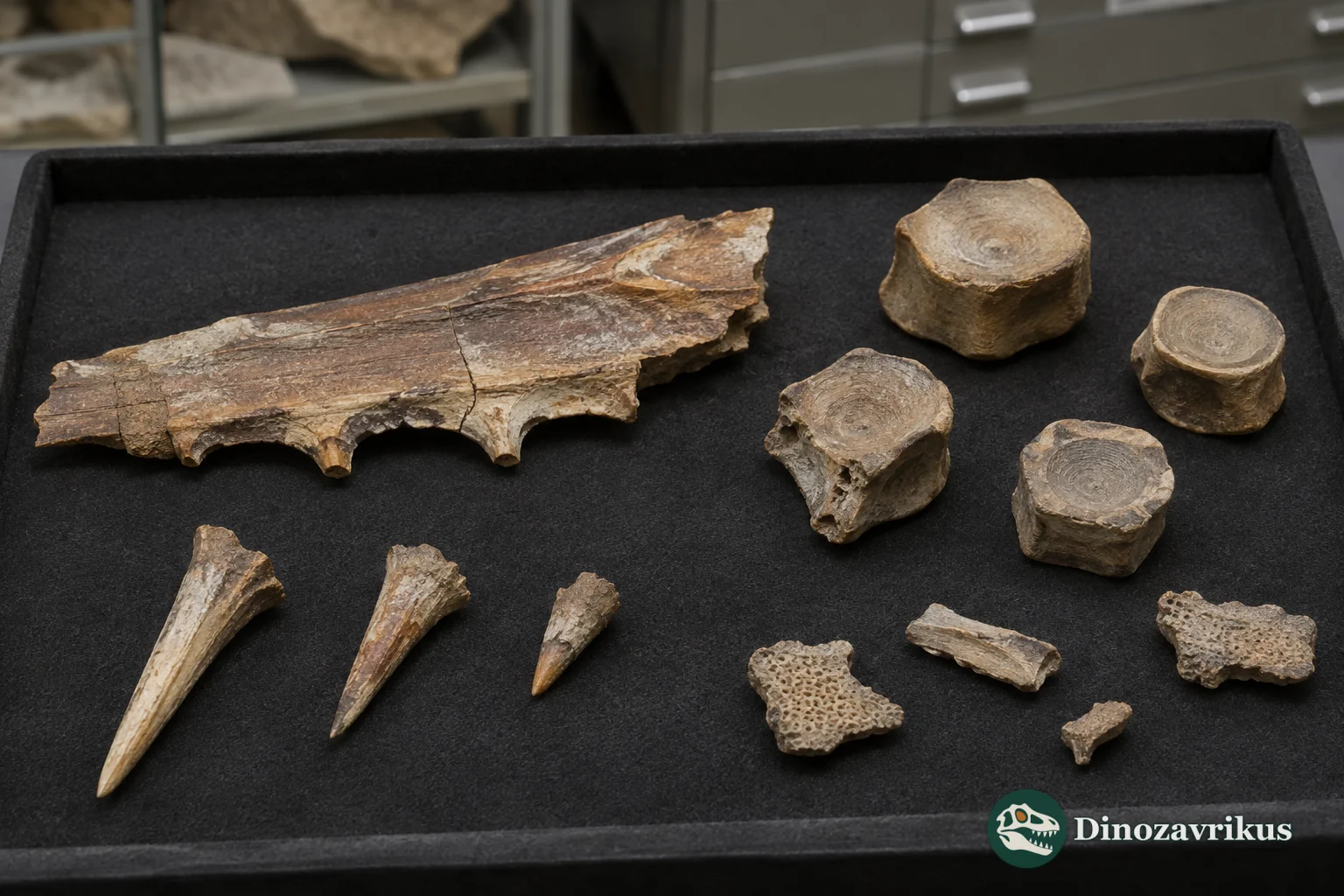
More complete material was described from middle to Upper Turonian rocks in the Lessini Mountains of northeastern Italy. This is a single skeletal specimen of O. pharao. It includes unidentified cranial fragments, several diagnostic rostral spines, the rostrum with pieces of mineralised cartilage and 87 disarticulated vertebrae.
Sensory canals are preserved on the rostrum. The lateral spines were attached along its sides, and the bases of two rows of ventral spines can also be distinguished. The vertebrae were not found in their original order. Researchers arranged them using size and thickness, estimated how many axial elements were represented, and compared rostrum-to-body proportions in other fishes. Together, those steps produced an estimated length of about 4.5 metres. It is an inference for this specimen, not a direct measurement of a complete body.
Growth rings in the vertebrae suggested an age of roughly four years and that the individual had probably not reached sexual maturity. The authors linked the estimated size and the hemipelagic rocks to a hypothesis that it was a large pelagic fish. Because the inference rests on one skeleton, it should not be treated as a description of every species or population assigned to the genus.
Size, movement and ecology
About 4.5 metres is the most specific published length estimate for Onchosaurus, but it is calculated from one Italian individual. Isolated Mexican spines cannot be converted into body length. The lateral spines show that the front of the animal was specialised; they do not reveal a named prey species, how often the animal hunted or exactly how it used the rostrum.
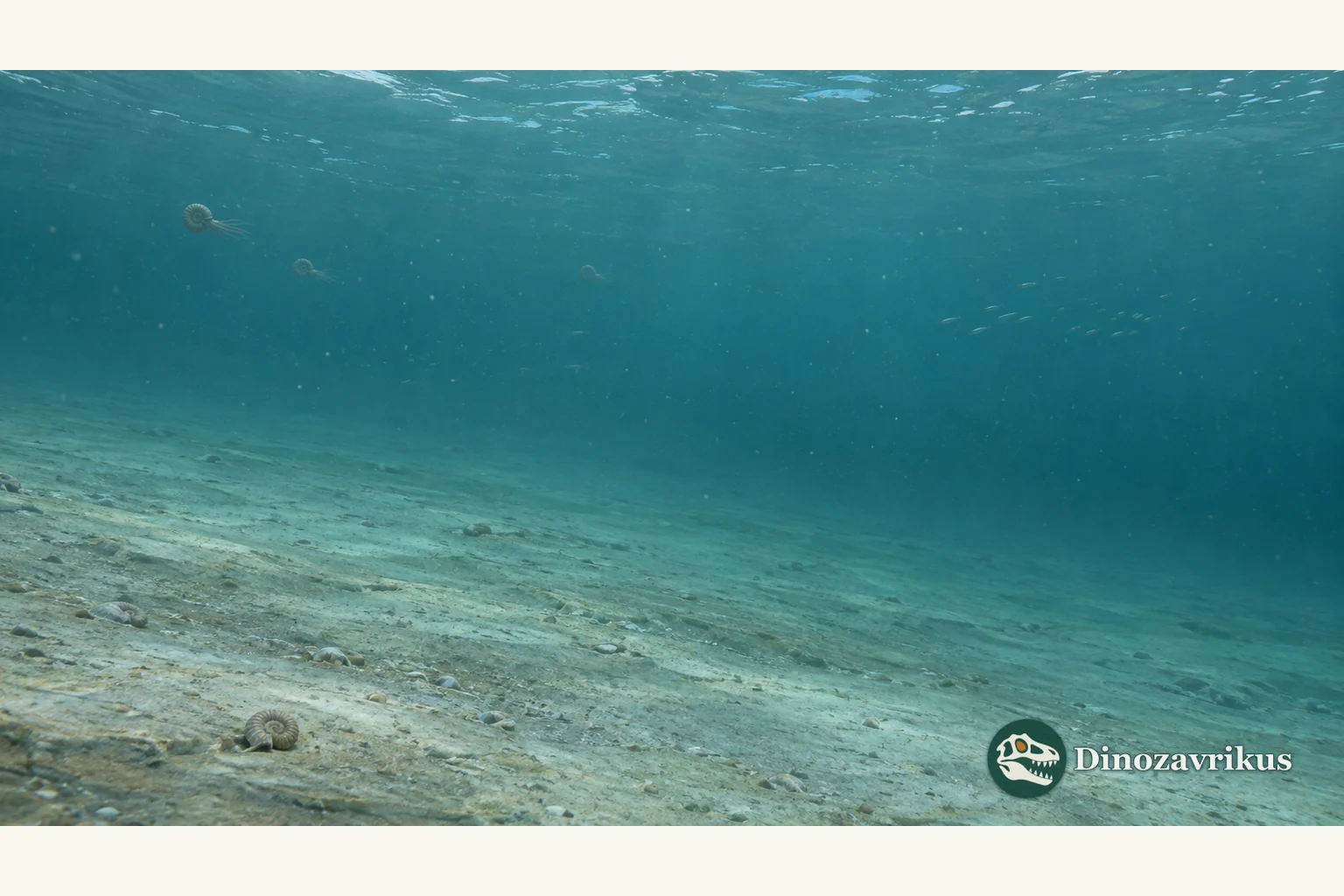
The Italian specimen came from hemipelagic deposits, and its estimated size supports the authors' pelagic interpretation. Earlier reports have also linked rostral spines with shallow marine or coastal settings. Those fossils come from different places and carry different levels of anatomical and stratigraphic certainty, so the genus should not be assigned one exclusive habitat based on a single outcrop. The unrelated fossil Misrichthys is another example of how isolated cartilaginous-fish remains preserve only part of an animal's anatomy.
Separating species and evidence
The literature commonly recognises O. radicalis and O. pharao. A Mexican study distinguished O. pharao by the form and structure of the rostral spine, while noting broader comparisons among sclerorhynchids. Most finds remain isolated, and their crowns may be broken, worn or distorted. In some cases the geological position is reconstructed rather than observed in an undisturbed bed. A genus-level identification or a qualified ‘cf.’ can therefore be more defensible than a firm species name.
The Italian skeleton changed the evidence available for the genus by joining diagnostic spines with a rostrum and vertebrae. It allowed researchers to estimate body length and age, while leaving colour, precise fin outline, diet, swimming speed, reproduction and lifespan unknown. A realistic illustration can suggest the likely silhouette of a sclerorhynchiform ray, but details not supported by fossil cartilage or bone remain artistic interpretation. For comparison with another extinct rostral fish, see Onchopristis; a similar tool-like outline alone does not establish direct ancestry.
Frequently asked questions
Was Onchosaurus a shark or a ray?
It was a sclerorhynchiform, an extinct cartilaginous fish within the batoid group. Its long rostrum carried lateral toothed spines.
What fossils are known?
Most finds are isolated rostral spines. A rare Italian specimen also preserves the rostrum, mineralised cartilage fragments and 87 disarticulated vertebrae.
Did Onchosaurus really reach 4.5 metres?
That is a calculated estimate for one Italian O. pharao specimen, based on vertebral size and number plus comparative proportions. It is not a direct measurement of a complete skeleton or a confirmed maximum for the genus.
What did it eat?
Its exact prey is unknown. The toothed rostrum shows specialised anatomy but does not by itself preserve diet or hunting behaviour.