

Orientognathus chaoyangensis is known from a damaged, incomplete skeleton found in Liaoning, northeastern China. It combined a long tail, teeth behind a pointed toothless lower-jaw tip, and a short wing metacarpal relative to the humerus. The original analysis placed it among rhamphorhynchids. The bones are more precisely documented than the age of their particular bed.
Quick facts
| Named species | Orientognathus chaoyangensis, Lü and colleagues, 2015 |
|---|---|
| Holotype | 41HIII-0418, incomplete skeleton |
| Repository | Henan Geological Museum, Zhengzhou |
| Locality | Chaoyang area, Liaoning, China |
| Rock unit | Tuchengzi Formation, near the Jurassic–Cretaceous transition |
| Estimated wingspan | About 1.1 m for the described specimen |
What can the fossils tell us?
The holotype includes skull and postcranial elements. It allows skeletal comparisons but does not preserve living colour or individual variation.
Teeth occur farther back on the lower jaw. Their presence does not identify a particular prey item.
The fourth wing metacarpal measures about 0.38 of the humerus length. That ratio cannot reconstruct the entire flight membrane.
The first description favoured a Late Jurassic age. Later radiometric work on other Tuchengzi levels spans the transition to the Early Cretaceous, without dating this slab directly.
A single skeleton from Chaoyang
Lü Junchang and five colleagues named Orientognathus chaoyangensis in 2015. The genus name refers to the east and to a jaw; the species name refers to Chaoyang. Holotype 41HIII-0418 is housed in the Henan Geological Museum in Zhengzhou. It is a damaged and incomplete skeleton, not a series of individuals of different ages.
Parts of the skull and lower jaw, wing bones and hindlimb survived. This is more evidence than an isolated tooth, yet it is no complete outline of the living animal. No skin membrane or body colour was reported for the slab. The shape of a living wing therefore depends in part on comparison with other pterosaurs.
Jaw and limb proportions
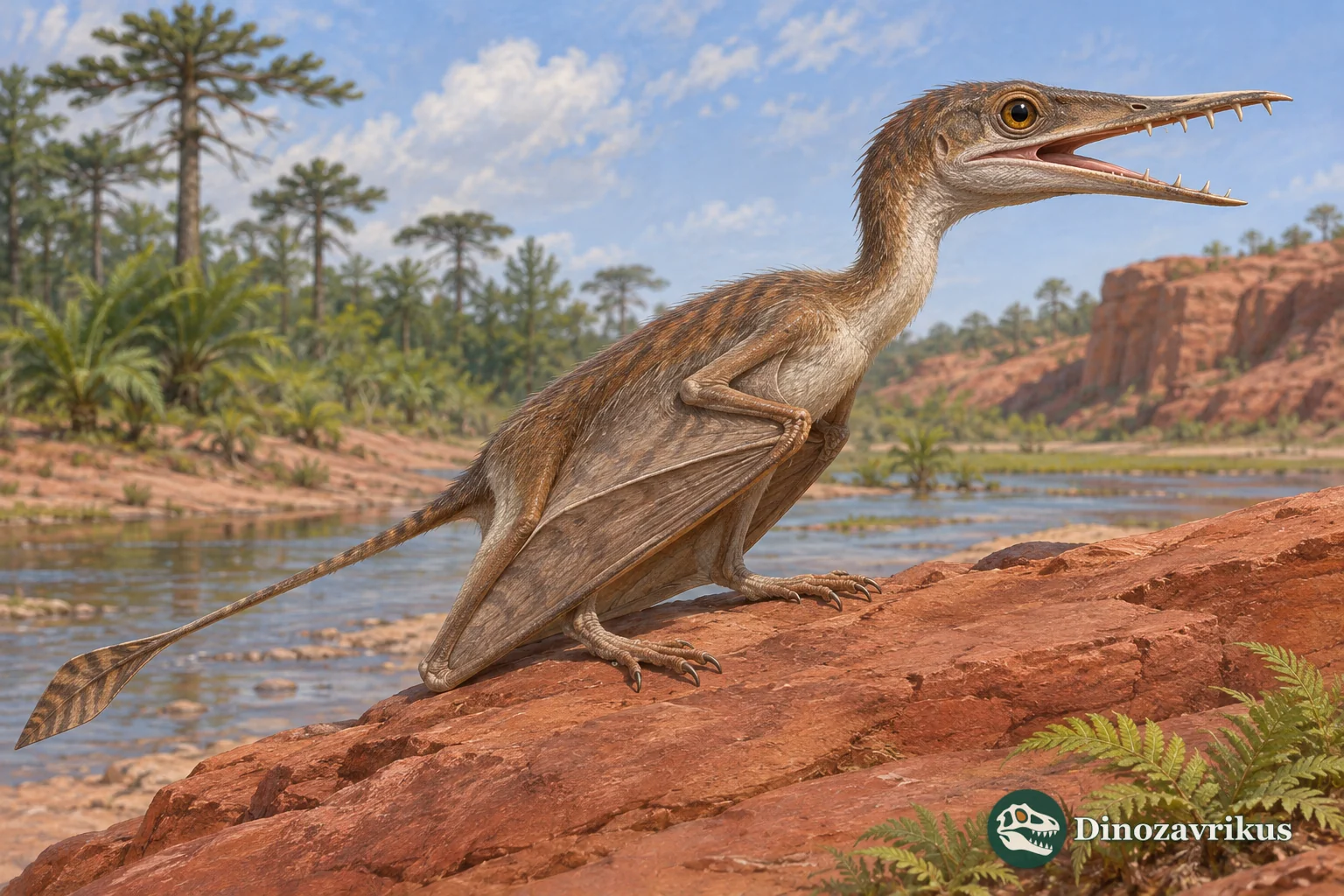
The front end of the lower jaw is slightly pointed and toothless, while teeth occur farther back. The approximately contemporary Fenghuangopterus has been compared by jaw and tooth characters, but such comparisons do not identify what this individual ate. No stomach contents or prey remains were described with the holotype.
The fourth wing metacarpal is about 0.38 times the humerus length. It is relatively short compared with some Jurassic forms, including Changchengopterus. The ulna is shorter than the preserved wing-finger phalanges, and the tibia is approximately as long as the femur. The original diagnosis and phylogenetic analysis used this combination of features rather than a single measurement.
An estimated wingspan of about 1.1 m applies to a reconstruction of the one known specimen. A fully extended wing was not measured on the slab, and the size range of adults is unknown. Wingspan alone would not establish body mass or flight speed.
The age and setting of the Tuchengzi beds
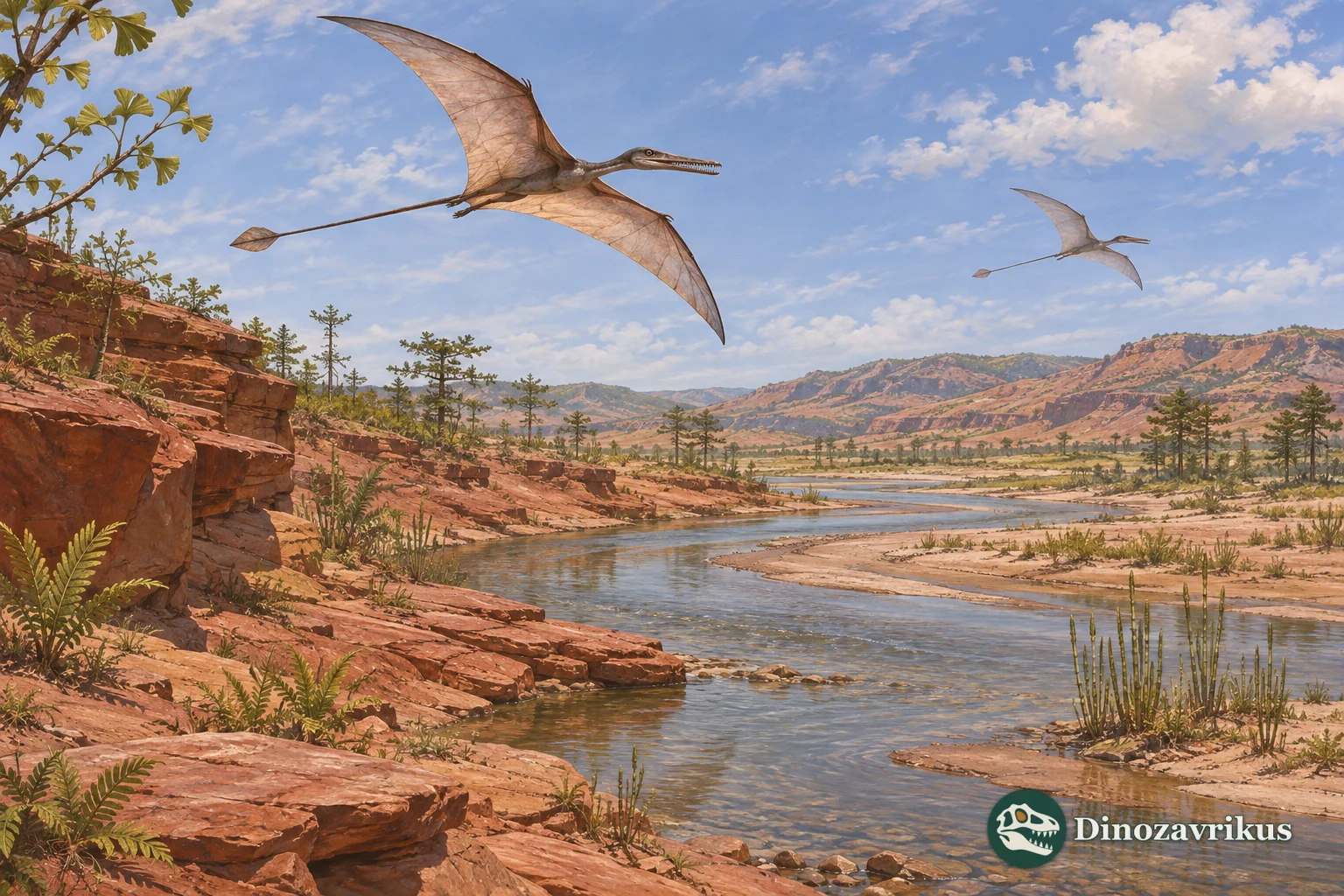
The slab came from the Tuchengzi Formation. Its original authors regarded its horizon as probably Late Jurassic. Subsequent uranium–lead dates from other formation levels in western Liaoning indicate deposition across the Jurassic–Cretaceous transition. Those dates do not pin the holotype itself to a particular Tithonian or Berriasian year.
The red beds record a continental setting that included river processes. A flying animal over a river is a possible scene, not a witnessed behaviour or a map of the precise discovery site. The long tail and wing bones identify an animal built for flight, but one skeleton cannot specify its routes, prey-catching method or time of activity.
Frequently asked questions
How many skeletons define Orientognathus?
The name rests on one incomplete holotype, 41HIII-0418. Bones from several body regions do not imply multiple individuals.
Was the tip of the lower jaw toothed?
No. The slightly pointed front tip lacked teeth, but teeth were present farther back on the jaw.
Is its Late Jurassic age certain?
The first description favoured that age. The Tuchengzi Formation extends across the boundary with the Early Cretaceous, and the exact slab lacks an independent direct date.
How was its wingspan estimated?
About 1.1 m is a reconstruction based on surviving bones, not the length of an intact fully outstretched wing measured on the fossil.