

Ornithostoma sedgwicki was named from a short toothless jaw fragment from the Cambridge area of England. Its cross-section and small lateral openings allow comparison with other azhdarchoids, but the holotype contains neither a whole skull nor wings. A 2026 reassessment removed the separate skull fragment that had once supplied this animal with an apparently tall rear crest.
Quick facts
| Named species | Ornithostoma sedgwicki, Seeley, 1891 |
|---|---|
| Holotype | CAMSM B54485, toothless jaw fragment |
| Repository | Sedgwick Museum of Earth Sciences, Cambridge |
| Deposit | Cambridge Greensand, eastern England |
| Age | Likely Late Albian fossil reworked into Early Cenomanian strata |
| Known wingspan | Cannot be determined from jaw fragments |
What can the fossils tell us?
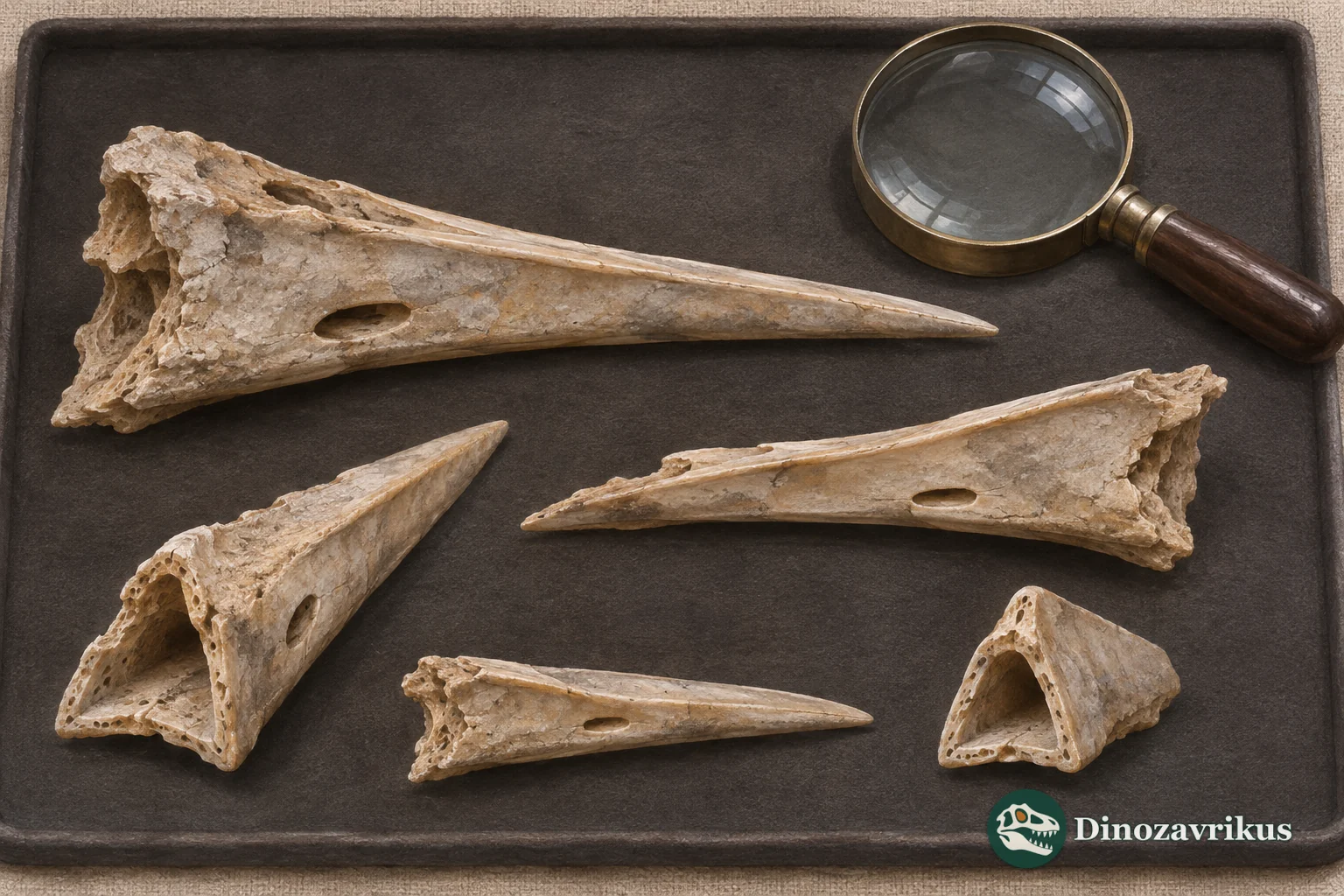
CAMSM B54485 is a toothless fragment with a distinctive cross-section and small openings. It includes no entire skull, neck or wing.
Other toothless fragments were compared with the holotype, but they are not parts of one articulated skeleton.
CAMSM B54406 was once assigned to Ornithostoma. A 2026 paper named a different genus from it, so its crest is not an established feature of Ornithostoma.
The Cambridge Greensand accumulated in the Early Cenomanian, but many phosphatised bones had been reworked from older Late Albian deposits.
From a supposed wing bone to a jaw name
Richard Owen illustrated the future holotype in 1859 and interpreted it as part of a wing metacarpal. Harry Govier Seeley later recognised a possible toothless jaw. He proposed the genus name Ornithostoma in 1871 and established Ornithostoma sedgwicki in 1891. The species date refers to that later publication, not the first mention of the genus.
Holotype CAMSM B54485 is held in Cambridge's Sedgwick Museum. It originally measured about 59 mm in length and retains roughly 48 mm after a section was removed. These are dimensions of a bone fragment, not of the animal's entire jaw. Authors have interpreted it as part of the upper or lower jaw. No attached complete skull resolves the distinction.
What the jaw can show
The bone is toothless, with a rounded triangular cross-section, convex lateral faces and small elongated openings. A 2021 reassessment compared two surviving fragments, BMB 019582 and CAMSM B40091, with the holotype. Two older reported pieces could not subsequently be located. The 2026 revision restricted the material of the genus to jaw fragments. Referral of loose pieces is an anatomical comparison, not evidence that they belonged to one individual.
Early authors compared Ornithostoma with Pteranodon. Later work placed it among azhdarchoids, while a 2026 revision found chaoyangopterid similarities; Chaoyangopterus is another member of that wider group. This is a classification based on jaw anatomy. It cannot give Ornithostoma its relatives' complete skeleton, size or feeding behaviour.
The skull fragment that changed names
Skull fragment CAMSM B54406 was long discussed together with Ornithostoma. Its rear part encouraged reconstructions with a crest. In 2026 researchers reassigned it and named Hintighernia edingerae. The crest on CAMSM B54406 is therefore no longer an established feature of Ornithostoma sedgwicki. Earlier drawings record a former identification, not the holotype's anatomy.
The historical name Ornithostoma orientalis was based on a separate vertebra from Russia. That find was later named Bogolubovia. It is not an additional English specimen of O. sedgwicki and does not join the two fossil records.
Reworked age and limits of reconstruction
The Cambridge Greensand occurs at the base of the West Melbury Marly Chalk Formation. The deposit is Early Cenomanian, but many of its phosphatised vertebrate remains were eroded from older Late Albian sediment. Ornithostoma is therefore commonly treated as probably Late Albian, with that uncertainty kept distinct from the age of the enclosing layer.
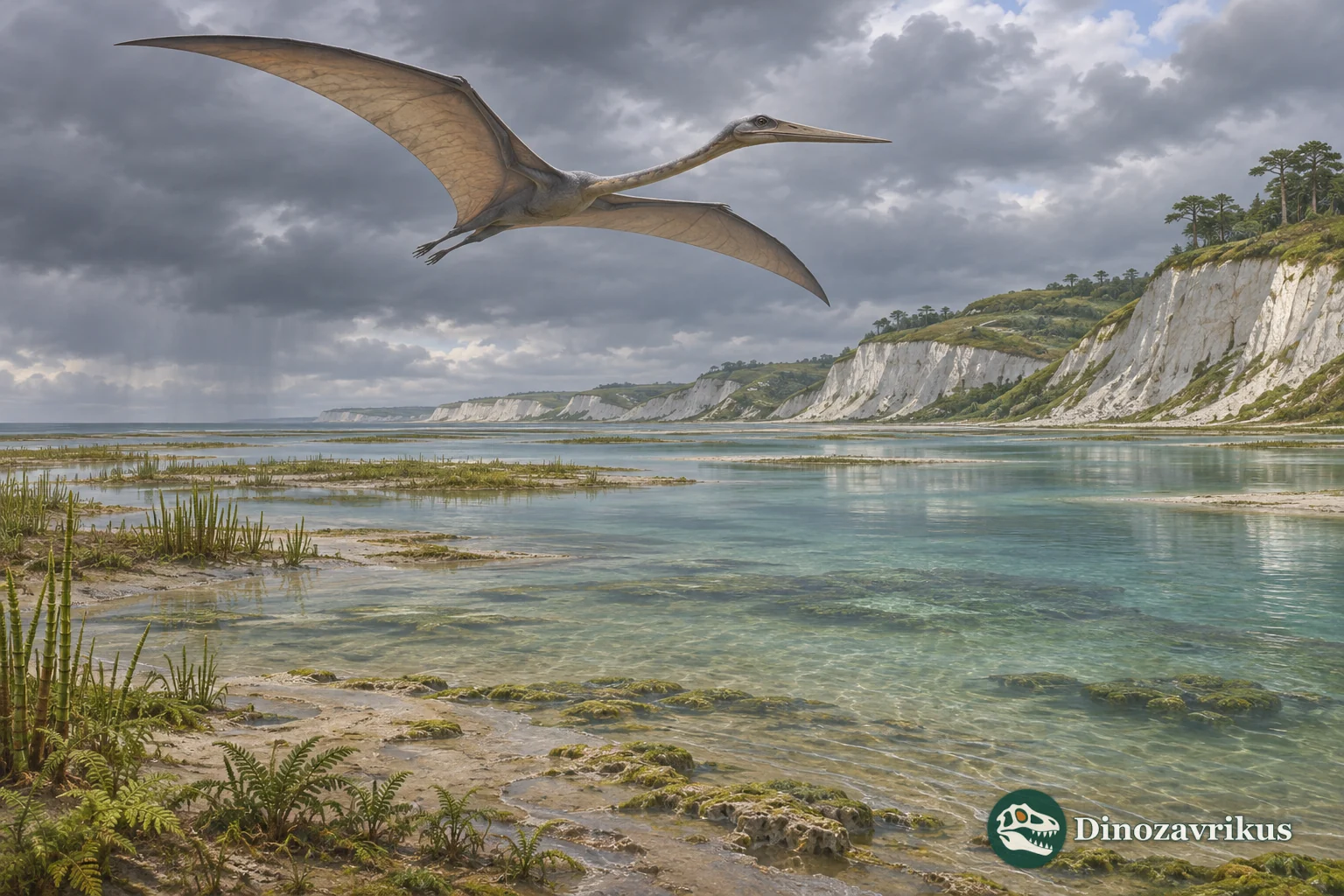
Several jaw pieces cannot establish wingspan, body mass, growth, soft-tissue crest shape or particular prey. The shore and flying pterosaur in the painting are a possible environment, not a record of where this individual lived or hunted.
Frequently asked questions
Was a complete Ornithostoma skull found?
No. The name is based on the short jaw fragment CAMSM B54485. A separate skull fragment once associated with it was reassigned in 2026.
Why did older reconstructions have a tall crest?
They used the separate CAMSM B54406 skull fragment. Its reassignment means that crest is not a confirmed Ornithostoma feature.
Was the animal toothless?
The known jaw fragments lack teeth. The full length and shape of the jaws are still incompletely known.
Why is an Albian fossil in a Cenomanian layer?
Older bones could be eroded and buried again as the Cambridge Greensand formed. The deposit's age is not automatically each fragment's original age.