

Osteopygis was a North American turtle named for a fossil preserving shell bones. Its old description also included skulls later assigned to the sea turtle Euclastes. Separating the material changed both its identification and the interpretation of its habitat.
Quick facts
| Group | Turtles, early relatives of hidden-necked turtles |
|---|---|
| Age | Late Cretaceous and Paleocene |
| Region | North America: United States and Canada |
| Type species | Osteopygis emarginatus |
| Holotype | AMNH 1485, shell and other bones |
| Scientific name | Osteopygis |
| Diet | No direct evidence |
What can the fossils tell us?
The carapace of the type species tapers at the front and rear. This shape helps diagnose the species alongside the arrangement of its plates and scutes.
The skulls historically attributed to Osteopygis lack a secure association with its diagnostic shells. Their marine turtle traits belong to Euclastes.
A 2023 study assigned the main fossil bed of the Hornerstown Formation an age of about 66.5–65.5 million years, spanning the Cretaceous–Paleogene boundary.
The name-bearing specimen from New Jersey
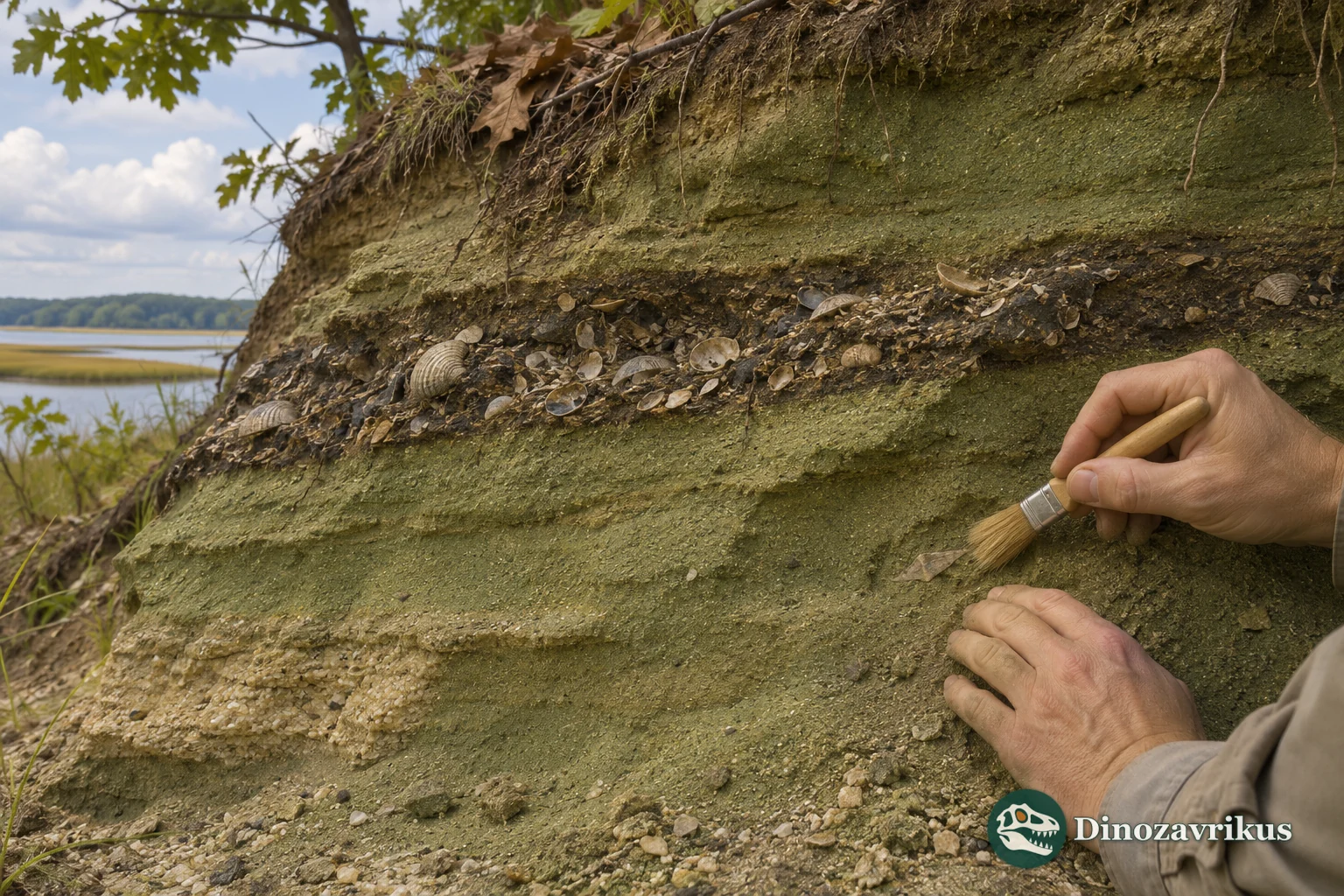
Edward Drinker Cope named Osteopygis emarginatus in 1869. Its holotype, AMNH 1485, comes from the Main Fossiliferous Layer of the Hornerstown Formation. The precise age is debated. A 2023 revision assigned the layer a range of roughly 66.5 to 65.5 million years, from the latest Cretaceous to the earliest Paleocene.
The carapace tapers at both ends. The positions of its sutures and the grooves marking the margins of the scutes help diagnose the type species. An opening in the middle of the plastron is part of the revised diagnosis of the genus.
How the skulls changed the story
In the twentieth century, skulls found apart from diagnostic shells were assigned to Osteopygis. Those skulls provided the main argument for classifying it as a sea turtle. In 2005 James Parham reviewed the history of the identifications, the anatomy and the circumstances of burial. The skulls went to Euclastes, while the shell-based name Osteopygis stayed with the fossils on which it was founded.
The name-bearing shell resembles those of extinct non-marine turtles close to the origin of the hidden-necked lineage. Bones coming from the same fossil-rich bed can be from several species. In this case, a secure association would have required more than a shared locality and horizon.
A wider range for the genus
A 2023 study reassigned three species formerly placed in Judithemys, bringing the total to four in the revised genus. Those species range from the Maastrichtian into the Paleocene. Records include New Jersey, Maryland and Saskatchewan. Other fragmentary occurrences were kept separate or left without a species-level identification.
Frequently asked questions
Was Osteopygis a sea turtle?
The shell points to non-marine affinities. The marine features in older accounts came from skulls reassigned to Euclastes.
Which fossil defines the name?
AMNH 1485, the holotype from the Hornerstown Formation of New Jersey, preserves shell and other postcranial bones.
When did the type species live?
Its fossil layer has been assigned an age of about 66.5 to 65.5 million years, close to the end of the Cretaceous.
Why is Osteopygis reported from Canada?
The 2023 revision included species previously assigned to Judithemys, some of which are known from Saskatchewan.