

Pagodia was a Late Cambrian trilobite genus. The Fenghuangshan section in China yielded more than a thousand pieces of its armour. By comparing head and tail shields, palaeontologists refined the features that distinguish three species in the collection.
Quick facts
| Group | Trilobites |
|---|---|
| Age | Late Cambrian, Furongian |
| Region | Asia (China), Australia (Queensland), Europe (Spain), Antarctica (Victoria Land) |
| Diet | Unknown |
| Type species | Pagodia lotos |
| Genus named by | Charles Doolittle Walcott, 1905 |
What can the fossils tell us?
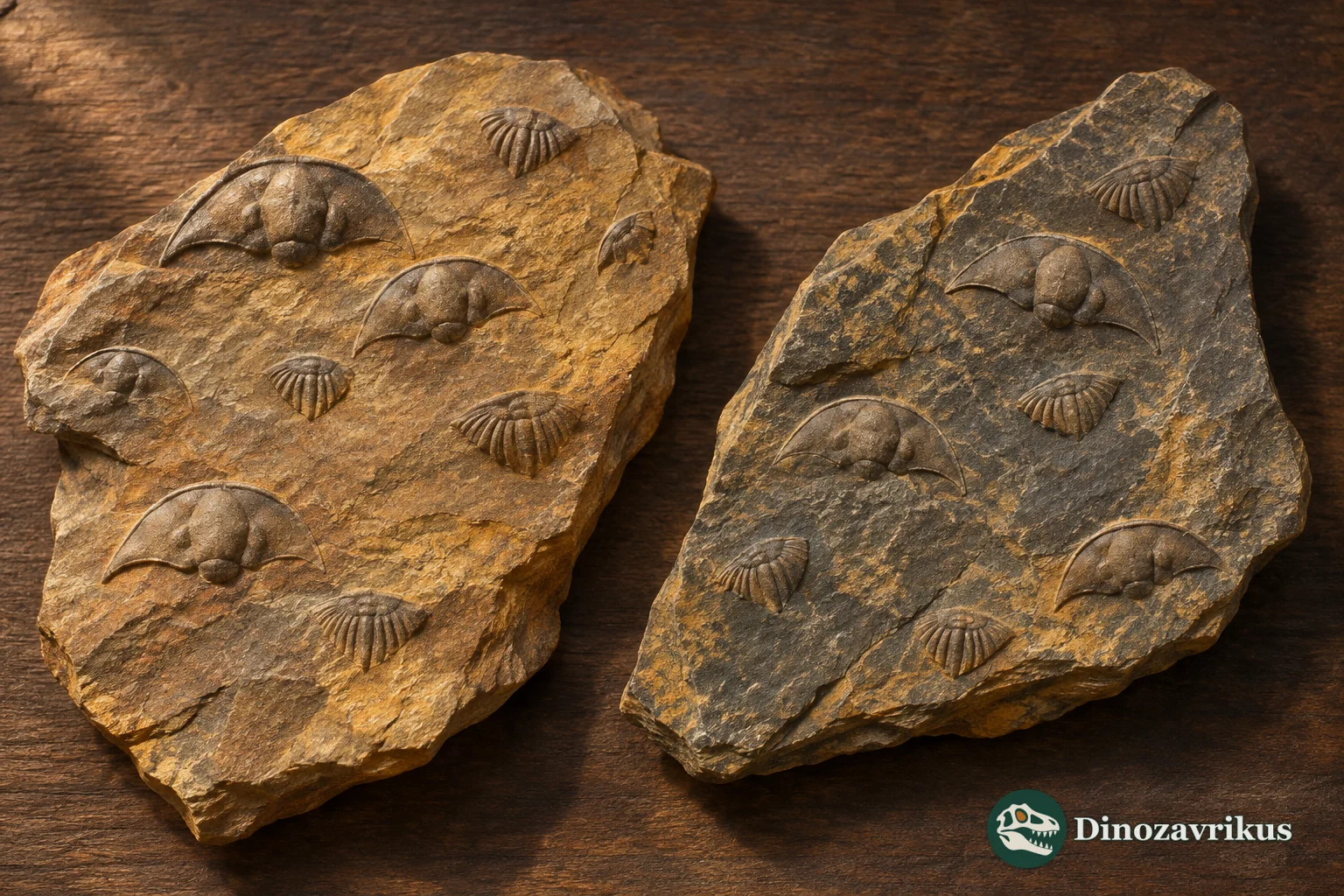
The central lobe of the head is nearly rectangular in P. lotos and constricted midway along its length in P. bia. Other features of the shield also matter.
Some smooth fossils have lost their outer shell. Granulation alone gives a poor basis for distinguishing species.
One specimen from the Chinese collection preserves the parts in place. Most fossils are separate head shields, free cheeks or tail shields.
More than a thousand pieces from Anhui
Charles Doolittle Walcott named Pagodia in 1905. Its type species, Pagodia lotos, comes from Late Cambrian limestone near Jinan in Shandong. Qian-Ping Lei and colleagues studied material from the Fenghuangshan section in northern Anhui. The fossil-bearing interval runs from the upper Jiangshanian through Cambrian Stage 10.
The collection included cranidia, the central pieces of head shields, alongside detached free cheeks and pygidia, or tail shields. In the type species, the tail shield is semicircular and its central axis tapers towards the rear. A combination of such traits allowed the researchers to distinguish P. lotos, P. bia and P. depressa. The shape and relief of the head shield also help identify another Late Cambrian trilobite, Ptychaspis.
Records from Queensland to Victoria Land
The Queensland species P. venusta was originally described in a separate genus, Idamea. Later researchers placed it in Pagodia after reassessing differences such as cheek width and furrow shape. In the Spanish province of Zaragoza, P. alarbaensis was assigned to the subgenus Wittekindtia.
Five cranidia from Reilly Ridge in northern Victoria Land were placed in Pagodia without a species name. A tail shield from one of the two localities was associated with them provisionally. The cranidia document the Antarctic occurrence, while the shape of the tail in that form remains less certain.
Frequently asked questions
Which species defines Pagodia?
Pagodia lotos, described from fossils near Jinan in Shandong.
How old are the Fenghuangshan fossils?
They range from the upper Jiangshanian through Stage 10, the final stage of the Cambrian.
Is the thorax of Pagodia known?
A nearly complete articulated P. depressa specimen preserves it. Most finds are detached hard parts.
Were the Antarctic fossils assigned to a species?
The cranidia were identified as Pagodia, but the authors did not assign them a species name.