

Palaeocentroscymnus had tall, pointed upper teeth and low lower teeth shaped like blades. The two forms look strikingly different when found loose in sediment. Researchers named the genus from Miocene material, then recognised an older species from Bavaria. Its teeth reach back to the closing stages of the Cretaceous, before the mass extinction at the end of the period.
Quick facts
| Order | Squaliformes |
|---|---|
| Family | Sleeper sharks |
| Type species | Palaeocentroscymnus horvathi |
| Type specimen | Lower tooth SNM Z 27473 |
| Fossils | Isolated upper and lower teeth |
| Key localities | Bavaria, Austria and Slovakia |
What can the fossils tell us?
The Slovak holotype fixes the name of the species. Loose teeth from the same section reveal the shape of its upper crowns.
A low, inclined lower cusp contrasts with the tall upper point and its small side cusplets. These shapes give no direct record of prey.
Bergen yielded late Maastrichtian teeth. Waidach yielded Danian material assigned to the same genus. The fossils establish occurrences at particular horizons.
The Slovak type material
Charlie Underwood and Ján Schlögl introduced the type species in 2013 as Paraetmopterus horvathi. Its holotype comes from the Cerová-Lieskové section of the Vienna Basin in Slovakia. They described a lower tooth, SNM Z 27473, and counted 38 additional lower and 15 upper teeth, including incomplete specimens. The species honours the Horvath family.
The teeth came from silty clays of the Lakšárska Nová Ves Formation, close to the end of the Burdigalian. Tiny squaliform teeth dominate the local shark assemblage. The fossils and sediments point to a deeper marine setting. They tell us about the community in that part of the Paratethys, while the shark’s skin, fins and body outline remain unknown.
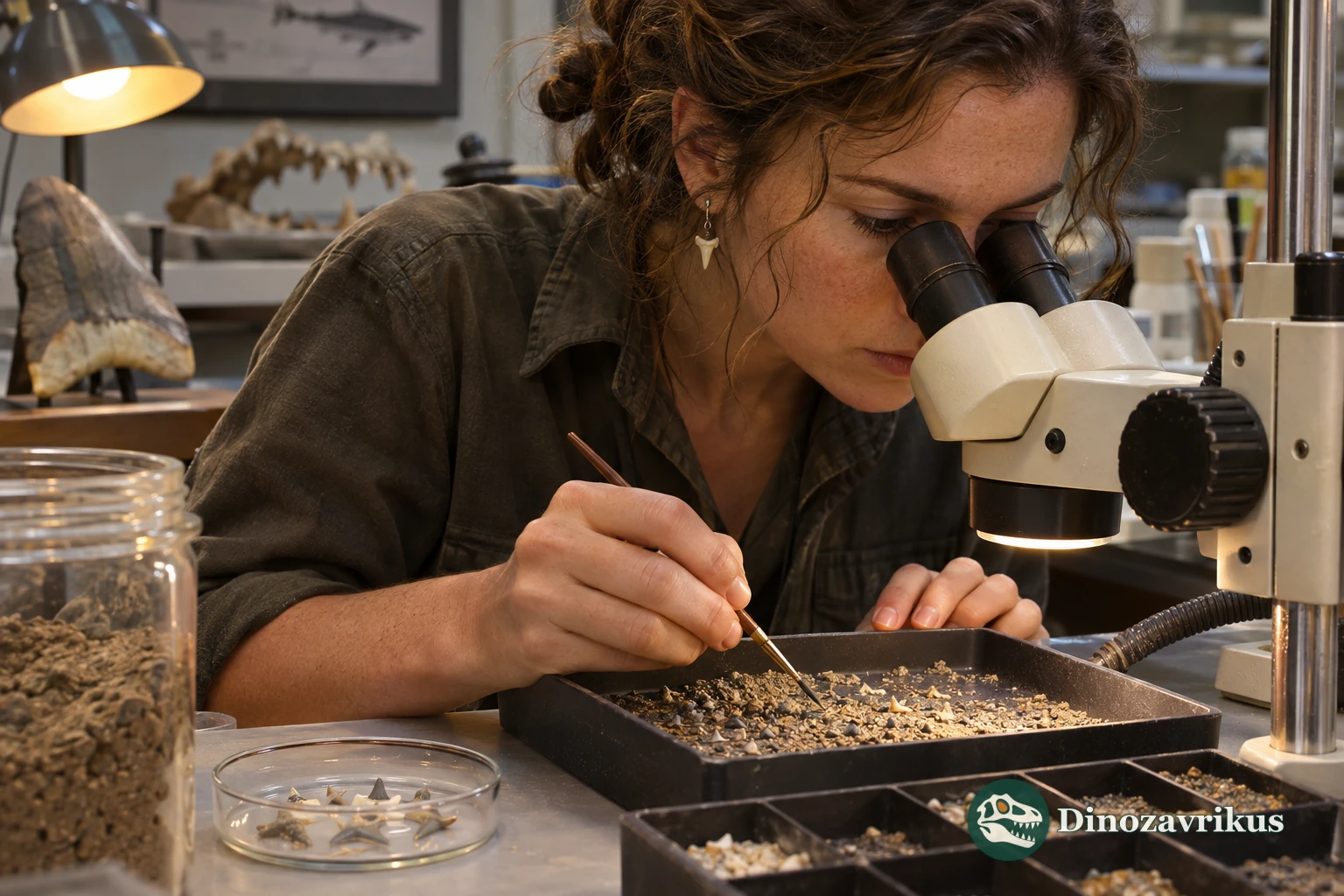
Two different sets of teeth
An upper tooth carries a tall central cusp with one or two pairs of short points beside it. On a lower tooth the single cusp tips so far sideways that much of its smooth cutting edge is almost horizontal. Most lower roots have three conspicuous openings on the outer face, two near the crown and a smaller one farther down. Such features help distinguish an isolated lower tooth from superficially similar teeth of other sharks.
In 2018, Jürgen Pollerspöck, Christina Flammensbeck and Nicolas Straube compared teeth from Aquitanian deposits in Upper Austria with those of fossil and living sharks, using 31 dental characters. Two analytical methods placed the fossils close to the living sleeper shark genus Centroscymnus. The comparison led the team to establish Palaeocentroscymnus as a separate genus. The fossil shark Cretascymnus represents another branch of squaliforms whose identity is also based on dental characters.
Before and after the end of the Cretaceous
In 2025, Iris Feichtinger and colleagues described Palaeocentroscymnus bavaricus from upper Maastrichtian sediments in the Oberwaldgraben section at Bergen, Bavaria. They compared the fossil assemblage with Waidach in Austria, where the genus appears in Danian rocks. The finds place the genus on either side of the end-Cretaceous crisis. The available teeth cannot track individual populations across the boundary or show which lineage led to the Miocene species.
Frequently asked questions
What is the difference between the teeth of the two jaws?
The upper ones have a tall point with smaller points to either side. The lower ones carry a low cutting edge.
Where is the holotype of the type species?
The lower tooth SNM Z 27473 is in the Slovak National Museum.
Which shark family includes the genus?
It is assigned to the sleeper sharks, Somniosidae.
How large was the shark?
The described teeth give no secure body-length estimate.