

Palaeocordylus was an early Miocene girdled lizard from what is now Czechia. A lower jaw fragment from Dolnice, near Cheb, preserves tooth positions and the surfaces where other parts of the jaw fitted together. Those details provide evidence of its relationships.
Quick facts
| Group | Scincoids (Scincoidea), girdled lizards (Cordylidae) |
|---|---|
| Age | Early Miocene |
| Region | Europe, Czechia, Dolnice |
| Type species | Palaeocordylus bohemicus |
| Scientific name | Palaeocordylus |
| Diet | No direct evidence |
What can the fossils tell us?
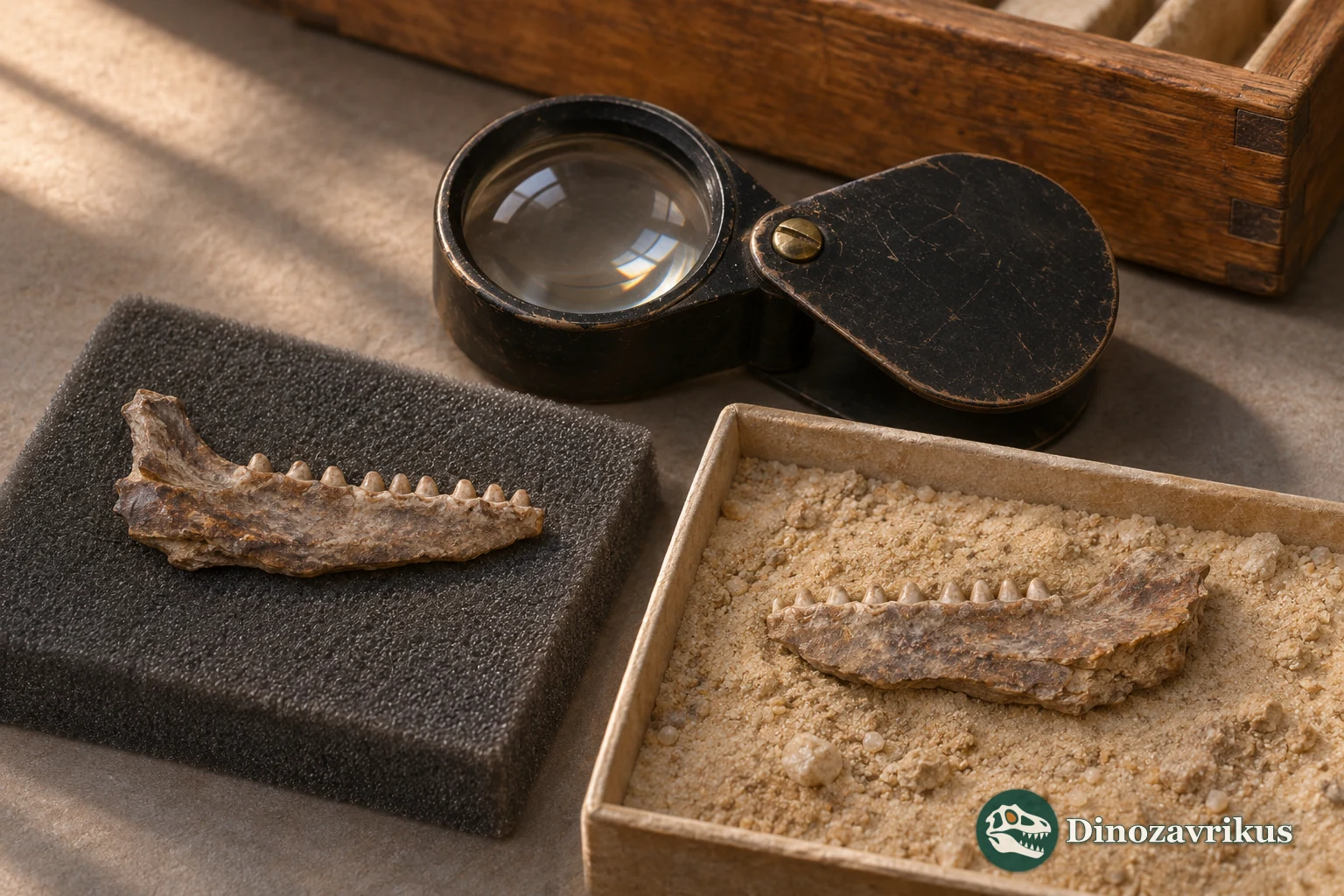
DP FNSP 97 is an incomplete left dentary. The preserved piece is 14.8 mm long and carries 19 tooth positions.
The open groove on the inside of the jaw and the surfaces for the splenial help identify the material as cordylid.
A jaw from Merkur-North and fossils from Maramena show similarities to Palaeocordylus. Their more precise identification is still open.
The Dolnice material
Zbyněk Roček described Palaeocordylus in 1984 from western Czechia. Dolnice belongs to the early Miocene MN 4 European mammal zone. The holotype, DP FNSP 97, is a piece of left dentary with 19 tooth positions. It measures 14.8 mm as preserved and has a broken rear end.
Grooves and contact surfaces
Meckel's groove remains open on the inner side of the dentary. The bone also preserves facets for the splenial, which lay along its inside edge. These features, combined with the shape of the jaw process and teeth, support a relationship with girdled lizards. Dolnice is also the type locality of Miolacerta, a lizard from a separate family.
An earlier jaw from Merkur-North
In 2012 Andrej Čerňanský described a similar right dentary, Ah-1088 SGDB, from Merkur-North in north-western Czechia. The bone is about 10 mm long with 22 teeth across 25 positions. The extent of its splenial facet and details of the teeth differ from those of the Dolnice specimen. Developmental differences may account for some variation. The author used aff. Palaeocordylus bohemicus to note the resemblance while leaving the species identification open.
The proposed Greek comparison
Upper and lower jaw bones from Maramena, Greece, also resemble Palaeocordylus. They come from close to the Miocene–Pliocene boundary. The posterior teeth of the Czech species are more robust and its crowns are more inflated on the inner side. The study therefore reported the Maramena series as aff. Palaeocordylus sp.
Frequently asked questions
Which family includes the Dolnice material?
Cordylidae, the girdled lizards. The attribution rests on a combination of dentary characters.
What measured 14.8 mm?
The preserved part of the lower jaw in holotype DP FNSP 97.
What does aff. mean in the Merkur-North identification?
It marks a close resemblance to the Dolnice species while leaving the exact identity open.
Is its diet known?
The fossils show tooth shape and jaw anatomy. There is no direct evidence of what it ate.