

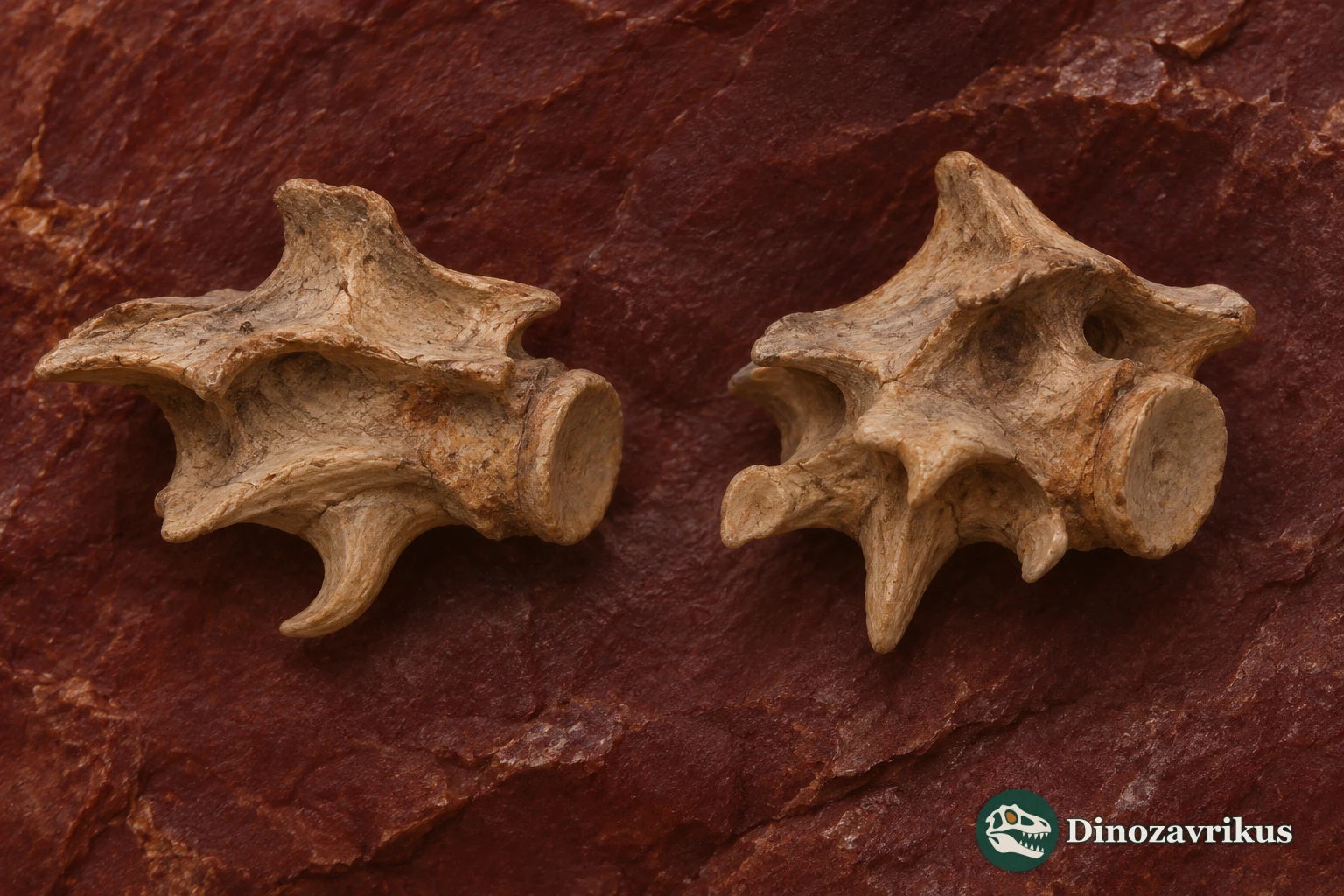
Palaeonatrix is a fossil snake from the Miocene of Europe, placed among the natricids. One of its distinguishing features is visible on the underside of a trunk vertebra, where a plate-like process continues into a longitudinal ridge.
Quick facts
| Group | Snakes (Serpentes), natricids (Natricidae) |
|---|---|
| Age | Early and middle Miocene |
| Region | Europe, Poland, Czechia, Germany, France and Spain |
| Type species | Palaeonatrix silesiaca |
| Scientific name | Palaeonatrix |
| Diet | Diet unknown |
What can the fossils tell us?
The type species was described from fragmentary Polish material. A second species comes from early Miocene deposits in Czechia.
The front ridge of the plate-like process, the elongated centrum and the strong ridges underneath it all help identify the vertebrae.
Southern German vertebrae resemble those from Czechia. Differences in the underside of the centrum mean they cannot be confidently assigned to the same species.
Two species from Central Europe
Zbigniew Szyndlar named Palaeonatrix silesiaca in 1982 from middle Miocene deposits at Opole, Poland. Only the base of the lower process survives on its fragmentary material. The early Miocene species from Dolnice in Czechia was first named Dolniceophis lehmani. It was transferred to Palaeonatrix after comparisons of the vertebrae.
Reading an isolated vertebra
The plate-like projection under the centrum is called a hypapophysis. In Palaeonatrix, its anterior ridge forms a pronounced step near the front joint socket. An elongated centrum and strong ridges on the underside are also useful for identification. Separate vertebrae from the same Wintershof-West assemblage have been tentatively compared with Falseryx.
Further records in Germany and Spain
The Wintershof-West vertebrae resemble the finds from Petersbuch, but the underside of the centrum differs from that of the Czech material. Their assignment to the Czech species remains provisional. Vertebrae from the early Miocene Ribesalbes-Alcora Basin in Spain have also been assigned to the genus without a species identification.
Frequently asked questions
Where was the type species found?
It was found in the middle Miocene deposits of Opole in southern Poland.
What is a hypapophysis?
It is a projection on the underside of a vertebra. In Palaeonatrix, it forms a distinctive plate with a ridge.
Why did the Czech species change names?
It was first called Dolniceophis lehmani and was later transferred to Palaeonatrix after comparisons of the vertebrae.
Do the vertebrae reveal its diet?
They help identify the animal. They do not establish what it ate.