

Palaeoryctes is a genus of small fossil mammals known chiefly from teeth, jaws and parts of the skull. Its name has been applied to material from several North American Paleocene and early Eocene faunas, but the species list and the genus’s broader relationships have changed as researchers compared the type with later finds.
The genus belongs in the ancient mammal catalogue. Its dental record can be compared with the better-known North American genus Cimolestes, while that comparison does not resolve the disputed limits of Palaeoryctes itself.
Quick facts
| Scientific name | Palaeoryctes Matthew, 1913 |
|---|---|
| Type species | Palaeoryctes puercensis Matthew, 1913 |
| Group | Early eutherian; higher placement debated |
| Age | Paleocene to early Eocene records, depending on species assignment |
| Range | Western North America, including New Mexico and Wyoming |
| Type specimen | AMNH 15923, partial skull and lower jaw |
| Known remains | Teeth, jaw fragments and limited cranial material; some species include postcranial fragments |
| Key limitation | No complete associated skeleton establishes the genus-wide body form |
What do the Palaeoryctes fossils show?
Matthew described Palaeoryctes puercensis from AMNH 15923, a partial skull and lower jaw from the San Juan Basin. Its preserved anatomy anchors the name, but the specimen lacks some external details needed for confident comparisons with later material.
Researchers compare cusp shape, tooth proportions and jaw anatomy across isolated and fragmentary specimens. Those characters can distinguish fossils, but similar dental features may evolve in unrelated mammals and rarely reveal a whole-body silhouette.
A 2004 revision discussed P. jepseni, P. punctatus and other species in relation to later palaeoryctines. The authors’ proposed relationships are phylogenetic interpretations, not a directly observed ancestor-to-descendant sequence; the genus may not be a single natural group.
Palaeoryctidae and its constituent genera have been recovered differently across classifications. Sparse cranial and postcranial evidence means that a tooth-based placement should be treated as a hypothesis rather than a settled position among living mammal groups.
The name and its type material
William Diller Matthew established Palaeoryctes in 1913 while describing a zalambdodont mammal from the basal Eocene of New Mexico. The type species, P. puercensis, is anchored to AMNH 15923 from the San Juan Basin. The specimen preserves a partial skull and lower jaw, not a complete skeleton.
Later stratigraphic and faunal work has placed the relevant San Juan Basin deposits within the Paleocene, despite the older “basal Eocene” wording in the original account. Historical age labels therefore need to be read in the context of later geological correlation. The specimen’s incompleteness also matters: a later systematic study discussed its affinities within the disputed Palaeoryctidae and noted that key external features needed for a secure diagnosis are absent.
Dental evidence and feeding limits
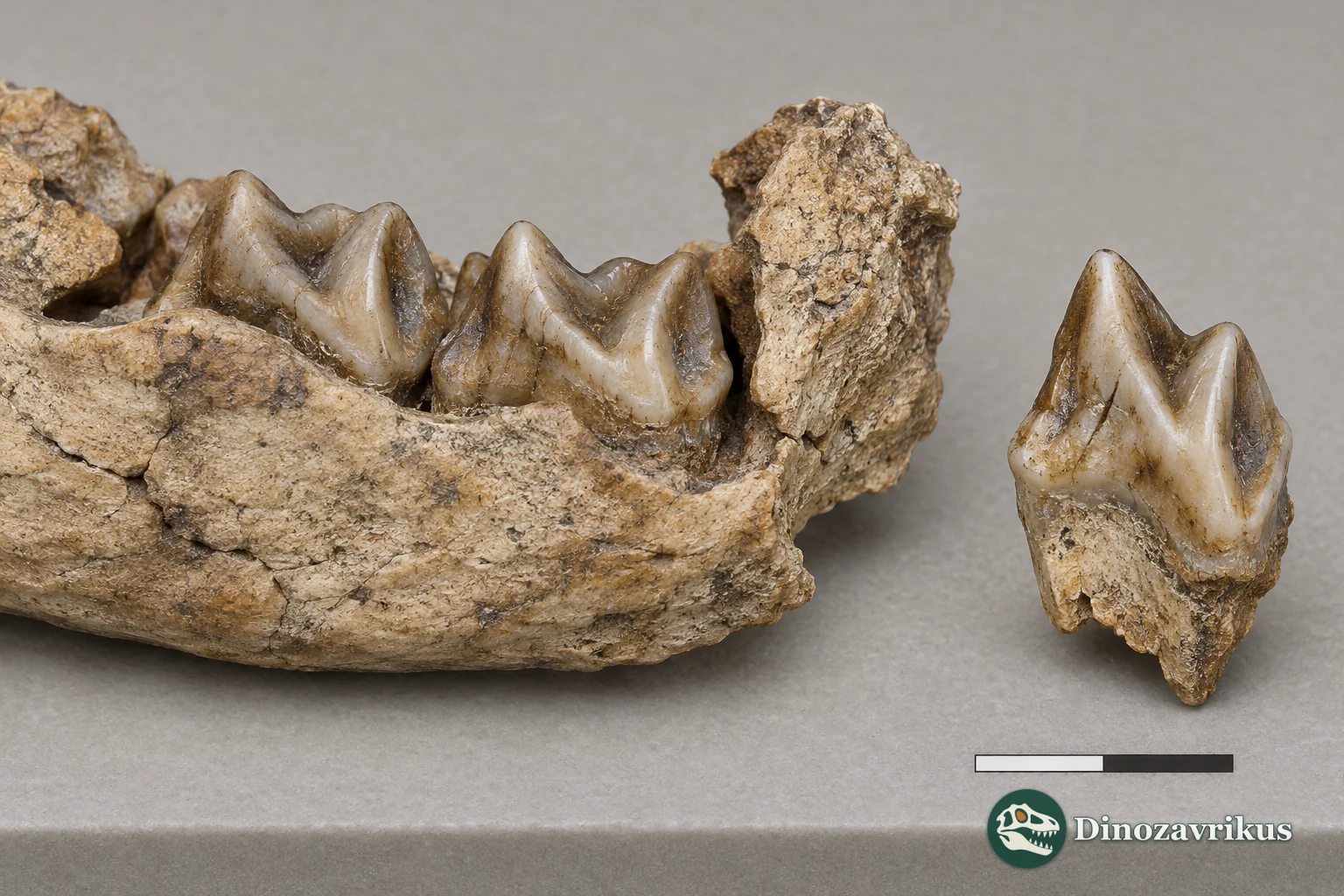
Much of the genus’s diagnosis relies on cheek teeth and jaw fragments. The shape of cusps and basins, the proportions of adjacent teeth and the way the lower jaw supports them help researchers compare specimens. For P. puercensis, published summaries report a mean second lower molar length of about 1.4 millimetres. That is a tooth measurement, not a body-size estimate.
The teeth are compatible with a small mammal that could process animal food, and insect prey has often been suggested. No preserved stomach contents or direct feeding traces establish a precise diet. Tooth shape supports a broad functional interpretation only when combined with comparisons to other mammals; it cannot identify a specific menu.
Species and proposed relationships
Authors have assigned several species to Palaeoryctes, including P. puercensis, P. cruoris, P. jepseni and P. punctatus. Their records differ in age, locality and the kind of material available. A 2004 study of late Paleocene and early Eocene palaeoryctines proposed relationships among some of these species and later genera, while also recognizing a separate line involving P. cruoris and Aaptoryctes.
Such a branching diagram is an inference from shared character states. It does not show that a named fossil species directly transformed into another. The authors cautioned that a simple sequence could oversimplify the pattern, and later discussion has questioned whether Palaeoryctes as traditionally assembled is paraphyletic. “Paraphyletic” here means that the named genus may exclude some descendants of its common ancestor.
Isolated limb bones referred to some species add useful anatomical information, but the evidence is not equally complete for every species. A feature found in one fragment cannot automatically be generalized to the whole genus.
Localities, age and preservation
The best-known occurrences come from western North America. The type material of P. puercensis is from the San Juan Basin of New Mexico; later species and referrals include Paleocene and early Eocene localities in Wyoming. Locality and stratigraphic context provide the age framework, while the fossils themselves are not all directly dated.
The broad published range combines records assigned to different species under an evolving taxonomy. It should not be read as one precisely measured lifespan or a single population spreading across the continent. Small teeth and jaw pieces are also more likely to be recovered and identified than an associated skeleton, so the fossil record is strongly filtered by preservation and collecting.
What can be reconstructed?
The available fossils support a small-bodied mammal with specialized teeth, but the remains do not provide a secure full-body reconstruction. Fur, colour, ear shape, tail length and exact proportions are artistic choices. The cover therefore depicts a generalized small early mammal rather than a specimen-based portrait.
Likewise, a woodland-floor scene is a plausible illustration, not direct evidence of a particular habitat or behaviour. More associated skull, limb and vertebral material could test body proportions and the proposed relationships among species. Until then, the most reliable account stays close to the teeth, jaws and stratigraphic context.
Frequently asked questions
When did Palaeoryctes live?
Its named species and referred fossils span Paleocene to early Eocene North American faunas. The exact range depends on which species assignments are accepted.
What is the type specimen?
AMNH 15923, a partial skull and lower jaw from the San Juan Basin, anchors the type species Palaeoryctes puercensis.
How large was it?
The fossils support a small mammal, but no complete skeleton provides a reliable body-length or mass estimate. A published molar measurement describes a tooth only.
Is Palaeoryctes a secure natural group?
That remains debated. Studies have proposed relationships among named species, while some authors have questioned whether the traditional genus is paraphyletic.