

Palodromeus was described from a small Late Carboniferous skull with lower jaws in Ohio. A long opening in the palate and a ridge behind the eye helped researchers compare it with an early branch of dissorophoid amphibians.
Quick facts
| Group | Temnospondyls, dissorophoids |
|---|---|
| Age | Late Carboniferous |
| Region | North America: Ohio, United States |
| Type species | Palodromeus bairdi |
| Scientific name | Palodromeus |
| Diet | Exact prey is unknown |
What can the fossils tell us?
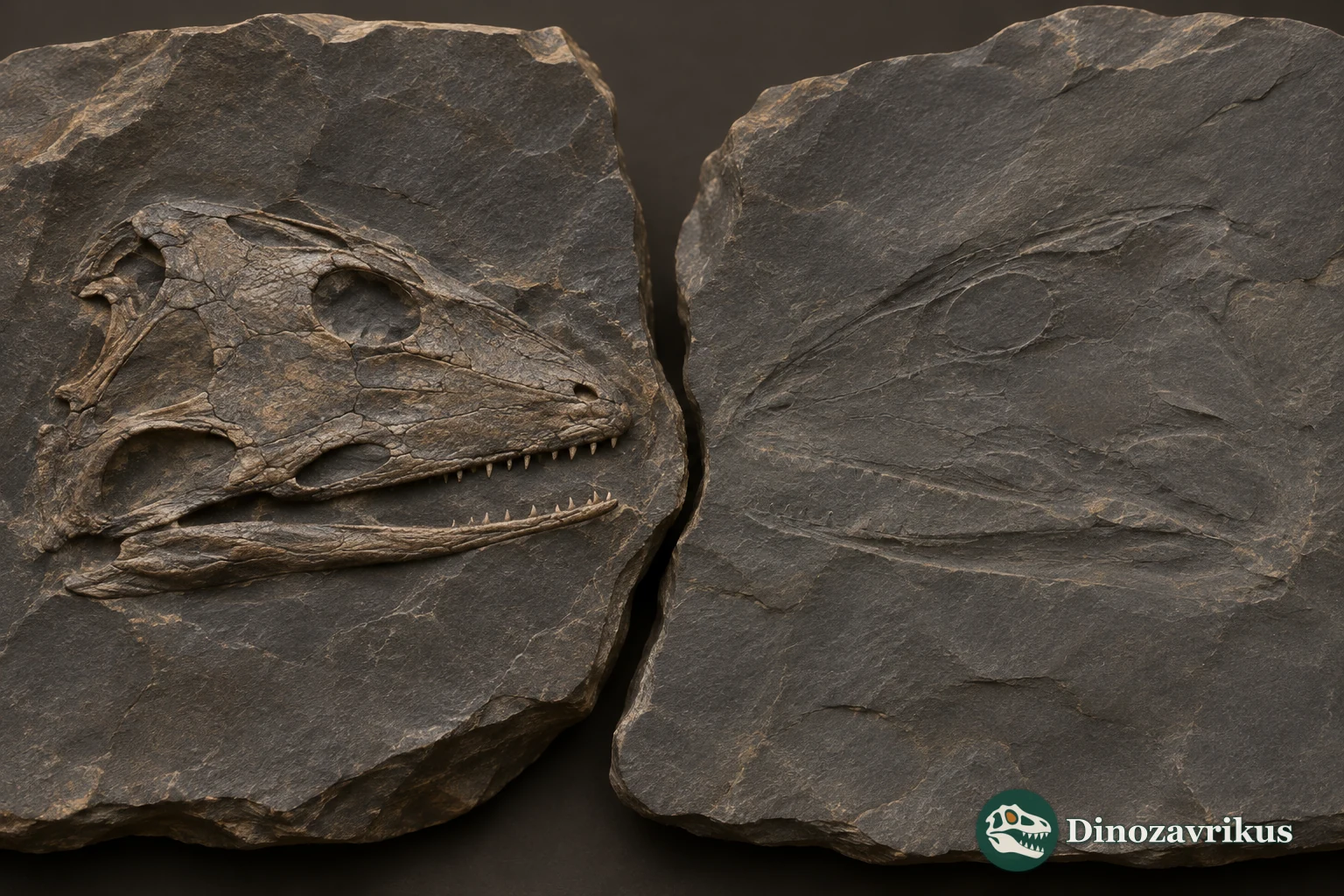
The specimen from Five Points was recovered as part and counterpart, the matching surfaces exposed when the rock split.
The published analyses place Palodromeus near the base of the olsoniform radiation among dissorophoids. Its precise family relationships are less secure.
The bones behind the skull remain undescribed. The sediment that buried the skull does not show how the adult moved or where it spent most of its time.
A skull from Five Points
Rainer Schoch, Amy Henrici and Robert Hook described the genus from Five Points in Mahoning County, Ohio. The study appeared online in 2020 and in a 2021 journal issue. The locality belongs to the Allegheny Group. Dark, organic-rich sediment accumulated in abandoned channels there and preserves both fishes and tetrapods.
Features that distinguish the genus
The choana, an opening from the nasal chamber into the mouth, is long and slit-like. Behind the eye, a ridge crosses the postfrontal, postorbital and supratemporal bones. The parietal is about two-thirds as long as the frontal. The combination of these details separates the small skull from those of related amphibians.
An early branch of the family tree
The original analysis recovered Palodromeus as an early-branching olsoniform. The group also includes later dissorophoids such as the Permian Ecolsonia. Comparative work supports that wider relationship, with uncertainty over which family Palodromeus belongs to.
Frequently asked questions
What does the fossil preserve?
A small skull with lower jaws, preserved on two matching surfaces where the rock split.
Where and when did Palodromeus live?
Its fossil comes from Late Carboniferous rocks at Five Points in Ohio.
What is a choana?
It is an opening from the nasal chamber into the mouth. In Palodromeus it looks like a narrow slit in the palate.
How long was Palodromeus?
The skull is small. The specimen does not include enough of the body to measure the animal’s total length.