

Pampatherium was a large extinct relative of armadillos. Its bony armor had comparatively rigid shoulder and pelvic shields connected by movable transverse bands. That construction sets it apart from the more continuous dome of many glyptodonts. Fossils establish the armor's bones, while skin color and day-to-day behavior remain unrecorded.
This genus belongs in the ice-age animal catalogue. The related Holmesina helps show why superficially similar plates must be compared in detail; Glyptodon provides a different armor design among extinct cingulates.
Quick facts
| Group | Pampatheriidae, Cingulata |
|---|---|
| Time | Pleistocene |
| Fossil regions | South and Central America |
| Armor | Fixed shields with flexible transverse bands |
| Species in a 2025 revision | P. humboldtii, P. typum and P. mexicanum |
| Key evidence | Osteoderms, skulls and limb bones |
What can the fossils tell us?
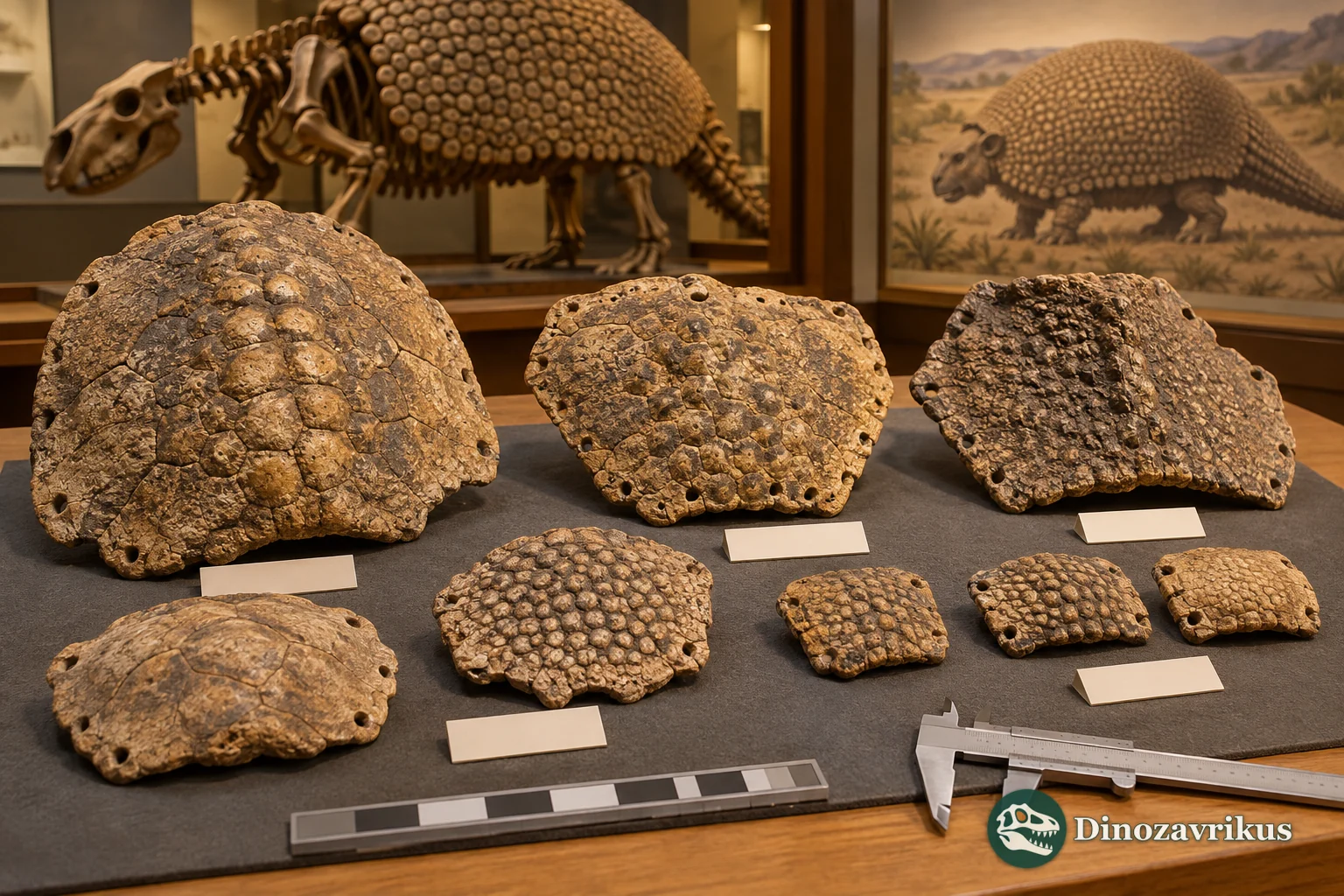
Fossil plates preserve the shape of their central field, margins and grooves. Wear and their different positions in the shell limit species identification from a single plate.
A review of older and newly collected fossils from Tarija, Bolivia assigned the studied pampathere material to P. humboldtii rather than the previously reported P. typum. This is a result for that assemblage, not a global synonymy.
Osteoderms in Santiago Roth's Zurich collection had long carried the name Chlamydotherium. Their shield features allowed a modern assignment to Pampatherium species, illustrating the value and limits of museum reidentification.
How the armor was built
Each osteoderm developed in the skin. Many plates formed the shoulder and pelvic shields, while rows between them allowed the trunk to flex. The exact curve of a living animal's back cannot be recovered from one isolated plate. Nor should an artist replace the movable bands with an unbroken glyptodont-like dome.
Researchers compare central figures, marginal grooves, surface relief and the plate's position in the armor. A 2025 revision redescribed historical material of P. humboldtii, addressed the neotype of P. typum, and examined P. mexicanum. It retained all three species. Individual weathered osteoderms, however, may lack enough information for a confident species name.
Why the Tarija fossils changed names
The Pleistocene Tarija Valley in Bolivia yielded pampathere remains once attributed partly to P. typum and partly to indeterminate Pampatherium. A taxonomic review combined older museum specimens with material collected in 2011–2013. Comparative osteoderm characters supported P. humboldtii for the studied assemblage and rejected the earlier P. typum record there.
That correction concerns the Tarija specimens, not the existence of P. typum elsewhere. The researchers linked the assemblage to late Pleistocene deposits of the Tolomosa Formation. Stratigraphic and faunal context constrain that age; the shape of a plate alone does not date a layer. The older Kraglievichia was another pampathere, but a shared armored outline cannot erase its distinct fossil characters and Miocene age.
Old names in museum collections
Some old collections used Chlamydotherium for fossils now treated as Pampatherium. A study of Santiago Roth's Pleistocene xenarthrans in Zurich reexamined osteoderms from the fixed bucklers. Differences in the relief of the central field and lateral margins supported assignment of some specimens to P. humboldtii and others to P. typum.
These plates document taxonomic diversity, but a detached osteoderm does not measure body length or mass. Occurrences from different places and ages should not be merged into a single continuous range without the relevant dates. P. mexicanum likewise requires direct comparison of its preserved plates rather than an identification based only on the country name.
Feeding and reconstruction limits
Pampatheres were terrestrial xenarthrans. Jaw form and comparisons with relatives support plant feeding as a reasonable inference, yet no stomach contents identify the preferred food of a particular Pampatherium. Movable armor bands imply flexion of the trunk; they cannot yield a measured running speed or a habitual route through the landscape.
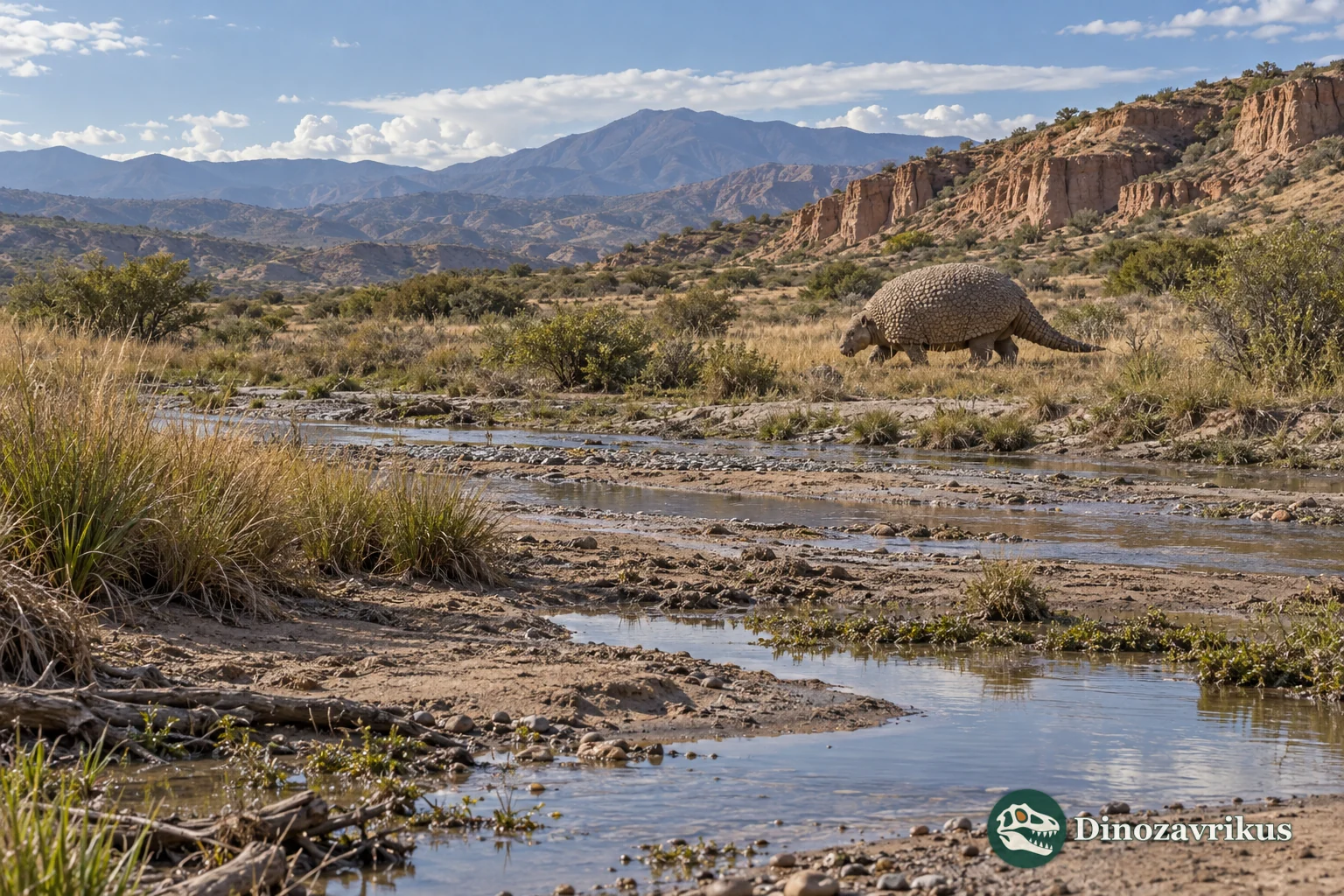
The cover depicts a plausible armored body, but its skin tone, soft tissues and vegetation are artistic decisions. Osteoderms directly establish bony armor; they do not preserve the appearance of the living animal in full.
Frequently asked questions
How did Pampatherium differ from a glyptodont?
Its shoulder and pelvic armor shields were linked by movable transverse bands; typical glyptodont back armor formed a much more rigid dome.
Which Pampatherium species did a 2025 review accept?
It retained P. humboldtii, P. typum and P. mexicanum, while noting that fragmentary plates are not always identifiable to species.
Why was P. typum removed from the Tarija list?
A review of the studied Tarija osteoderms found characters supporting P. humboldtii instead. That local correction does not invalidate P. typum elsewhere.
Can fossils reveal the animal's color?
No. Osteoderms preserve bony armor, but not the original color of its skin or other soft tissues.