

Kraglievichia was a South American pampathere, an armored relative of armadillos. Individual osteoderms, the bony plates under its shell, carry the most useful identifying features. Skull and limb material has also been reported from late Miocene river deposits, but much of it was separated before burial. A collection of nearby bones is not automatically one animal.
This genus is listed in the ancient mammal catalogue. Scirrotherium provides the critical comparison for shell relief. Vassallia and the later Holmesina show other combinations of pampathere armor and body form.
Quick facts
| Genus | Kraglievichia Castellanos, 1927 |
|---|---|
| Type species | K. paranensis (Ameghino, 1883) |
| Group | Pampatheriidae, Cingulata |
| Diagnostic evidence | Sculptured bony armor plates |
| Other species in the 2020 revision | K. carinatum |
| Type region | Paraná River basin, Entre Ríos, Argentina |
| Main fossil age | Late Miocene |
What can the fossils tell us?
Broad axial elevations and deep longitudinal grooves distinguish Kraglievichia armor plates. Plates from different parts of one carapace differ, so a lone plate must be compared with a homologous position.
The Ituzaingó bone-bearing conglomerate contains disconnected plates, skulls and limb bones. Proximity in a transported river deposit cannot securely attach them all to a K. paranensis individual.
A 2020 analysis found former Scirrotherium carinatum closer to K. paranensis than to the Scirrotherium type. The combination K. carinatum is a testable phylogenetic interpretation based mostly on armor characters.
The name and its fragmentary type material
Florentino Ameghino first named the species paranensis in 1883, using a different genus. Alfredo Castellanos established Kraglievichia in 1927, with K. paranensis as its type. The species was originally based on one osteoderm, making later identification of detached skull or limb bones difficult unless diagnostic plates are securely associated.
A relatively well-preserved skull, MACN Pv 2617, was collected by Enrique de Carles near Paraná and referred as Kraglievichia cf. paranensis. The 'cf.' records a comparison, not certainty: the skull lacks its teeth and was not found joined to the species-defining plate. Subsequent authors consequently use the osteoderms most confidently for species-level identifications.
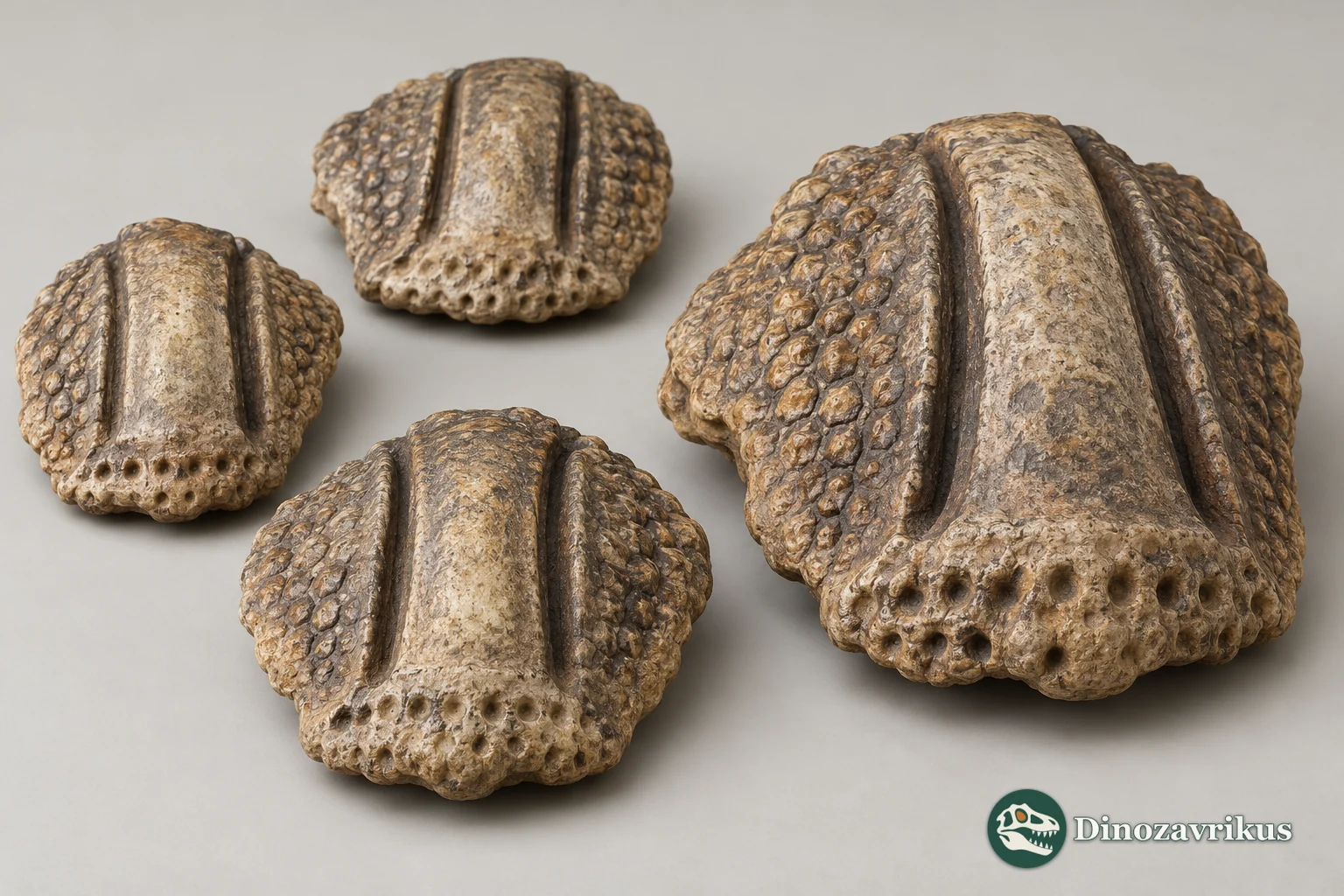
The shell's relief and a changed species name
Fixed Kraglievichia osteoderms bear a broad longitudinal axial elevation, deep depressions beside it and raised marginal areas. Some have small openings along the front edge. Plates from the fixed shields and mobile bands must be distinguished before comparing their size or relief; growth and abrasion add further variation.
Osteoderms described in 2013 as Scirrotherium carinatum were reassessed by Kevin Jiménez-Lara in 2020. The unusually deep grooves and other armor features placed that species closer to K. paranensis than to the type species S. hondaensis. He therefore proposed Kraglievichia carinatum. This placement is supported by the tested armor characters, although more associated skeletal material could refine the boundary.
Compared with K. carinatum, the axial elevation in K. paranensis plates is broader and depressed toward the front. This is a comparison of like-for-like osteoderms, not a complete shell reconstruction from a pile of detached plates.
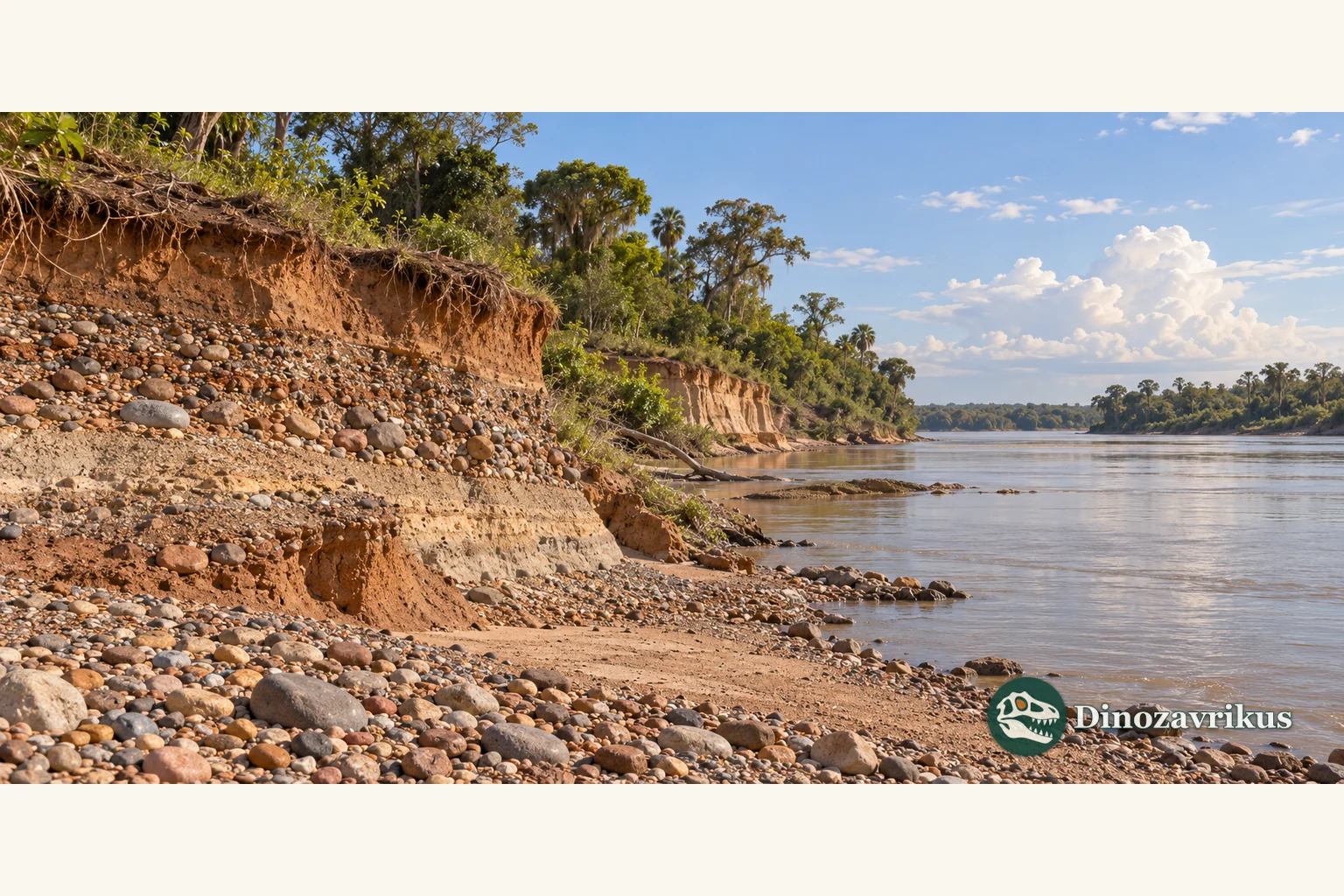
River transport and the limits of life art
The major Argentine material comes from the late Miocene bone-bearing conglomerate at the base of the Ituzaingó Formation in Entre Ríos. River action could move and mix remains. A plate, skull and femur in the same horizon may belong to different individuals or even different taxa. Additional reported occurrences elsewhere in Argentina and Uruguay need their own specimen and layer checks.
Recently described armor plates from the Palo Pintado Formation of northwestern Argentina were referred to K. paranensis using the shape of the axial elevation and grooves. They add a geographical record, not one exact date for the whole genus.
The cover's banded carapace and low head are a cautious pampathere reconstruction. Its complete curvature, skin color and feeding act are not recorded by the isolated type plate. Herbivory is a comparative inference from the group, not a preserved meal of the type individual.
Frequently asked questions
What is the type species of Kraglievichia?
K. paranensis, first named by Ameghino in 1883; Castellanos established the genus Kraglievichia in 1927.
Why are some skulls marked cf. paranensis?
The river deposit holds detached elements. A similar skull cannot be securely assigned to the species without a reliable association with diagnostic osteoderms.
What is a Kraglievichia osteoderm?
A bony armor plate whose broad axial elevation, deep side grooves and other details help distinguish pampatheres.
Why is Scirrotherium carinatum now sometimes called K. carinatum?
A 2020 phylogenetic analysis grouped its sculptured plates with K. paranensis rather than the Scirrotherium type species.