

Vassallia was a South American pampathere, an extinct armored relative of armadillos. Its type species, V. minuta, is anchored by a lower jaw from Catamarca, Argentina. A far more complete skull once assigned to V. maxima lies at the center of a debate about the boundary between Vassallia and Plaina. A fossil's identification therefore needs the name and the classification used by its author.
In the ancient mammal catalogue, Holmesina provides a comparison for cranial anatomy. The older Scirrotherium illustrates another stage in pampathere evolution, but a similar isolated armor plate alone does not make them the same genus.
Quick facts
| Scientific name | Vassallia Castellanos, 1927 |
|---|---|
| Type species | V. minuta, originally Chlamydotherium minutum |
| Family | Pampatheriidae |
| Type specimen of V. minuta | MLP 29-IV-15-4, nearly complete right lower jaw |
| Type region | Santa María Valley, Catamarca, Argentina |
| Associated skull described as V. maxima | FMNH P14424 |
| Taxonomic caution | Later revisions treated V. maxima as a synonym of Plaina intermedia |
What can the fossils tell us?
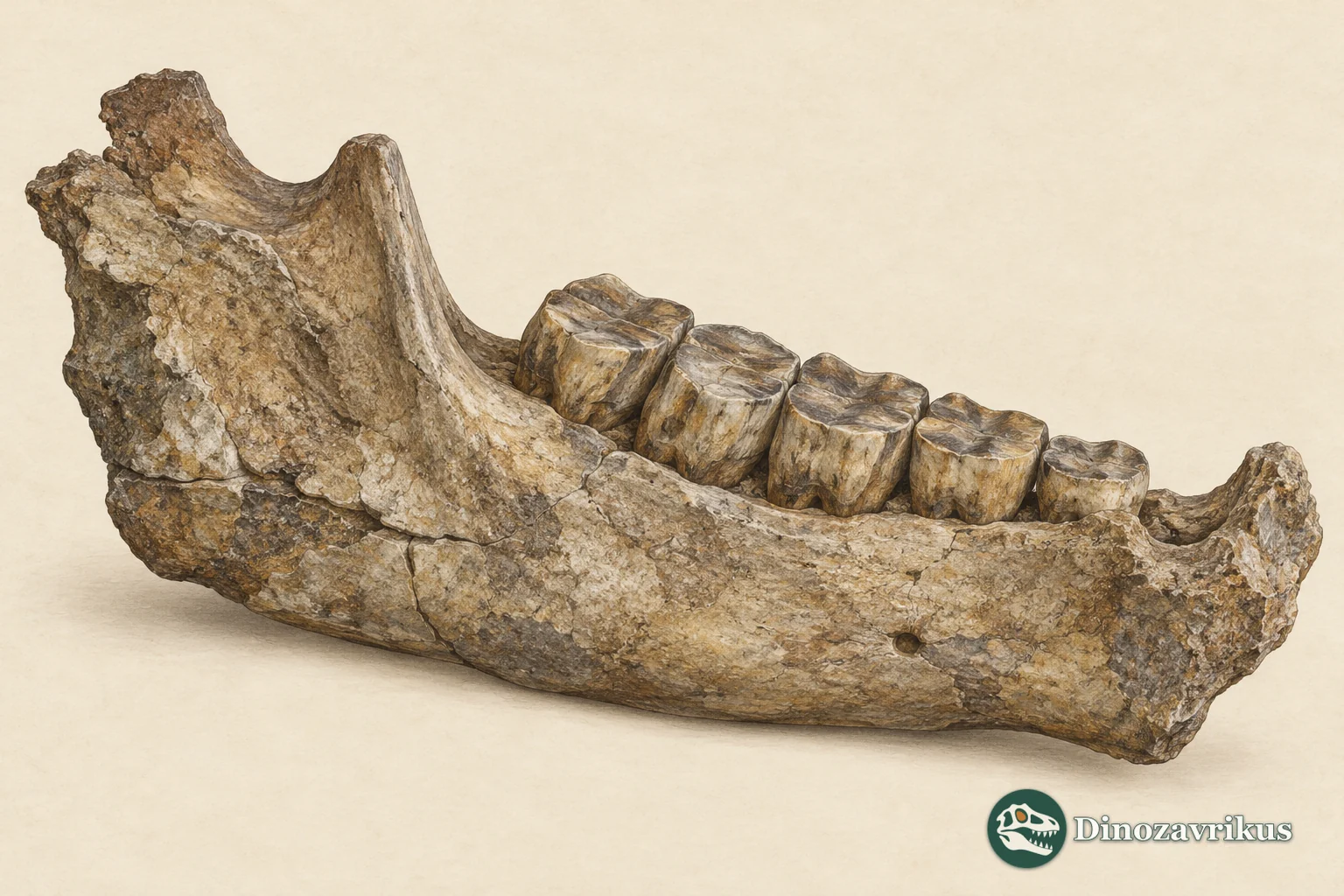
The type, MLP 29-IV-15-4, comes from Catamarca. It preserves no skull or complete carapace.
A nearly complete skull, jaw and osteoderms were described as V. maxima in 2002. Their taxonomic assignment was later reconsidered.
The 2002 authors discussed similarity with P. intermedia without formal synonymy; later revisions adopted a synonymy and retained V. minuta separately.
The name and type jaw
Francisco Moreno and Alcides Mercerat named Chlamydotherium minutum in 1891 from a nearly complete right lower jaw. Alfredo Castellanos established Vassallia for that species in 1927. A later Argentine specimen review identified the type as MLP 29-IV-15-4 from Santa María Valley. Its teeth and jaw permit anatomical comparison, but the type contains neither a skull nor a full carapace.
Other material assigned to V. minuta includes jaw fragments, teeth and osteoderms from Catamarca. MLP 29-X-10-12 is especially useful because jaw and armor remains occur together. Separate specimens and horizons should not be combined into one individual. Associated elements are needed to test whether an armor plate really belongs to the same animal as a named jaw.
The skull once called V. maxima
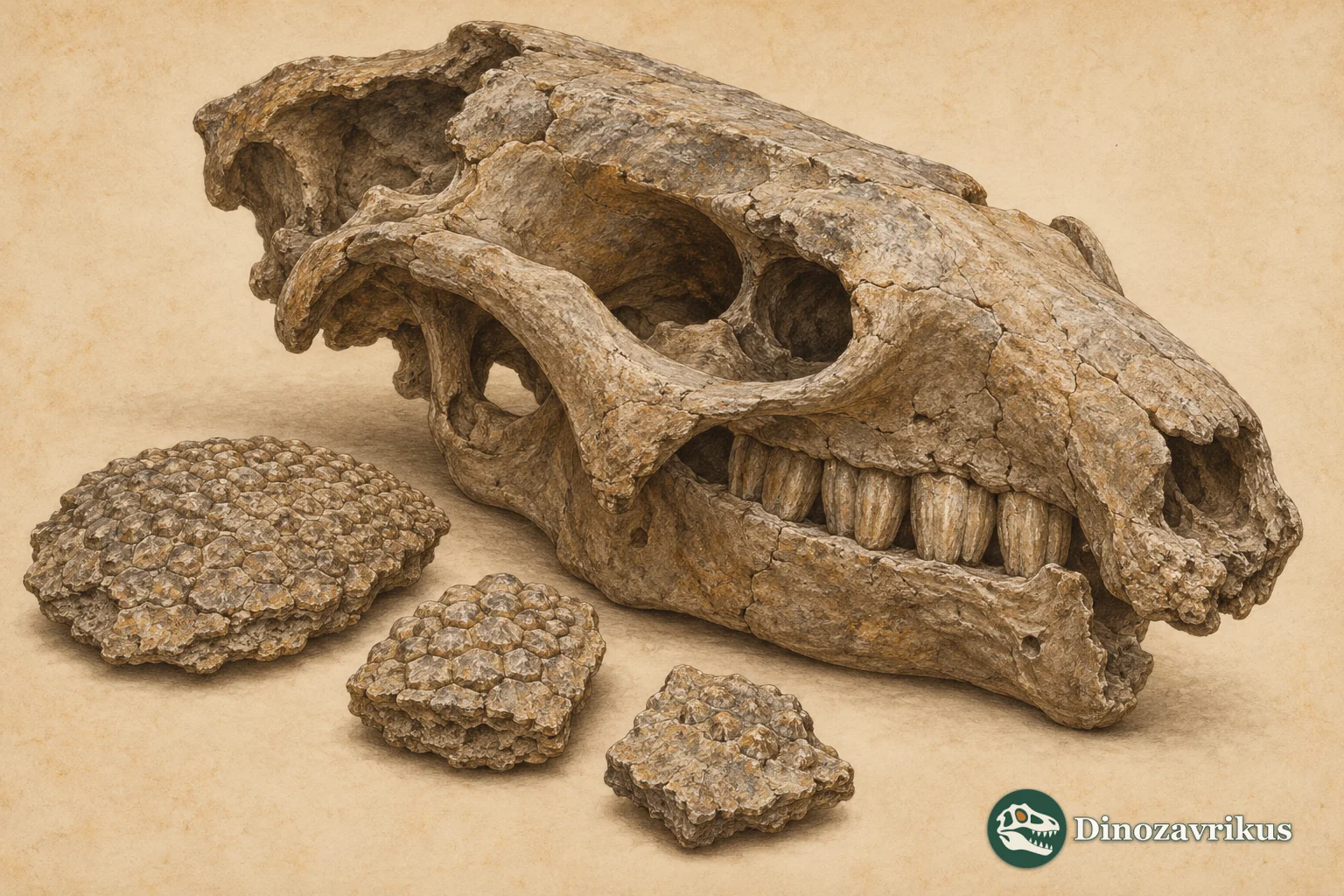
Castellanos introduced Vassallia maxima in 1946. In 2002 Gerardo De Iuliis and Alan Edmund described the almost complete skull FMNH P14424 from Puerta del Corral Quemado, along with a mandible and associated osteoderms. Some skull parts are damaged and several teeth are missing, yet the association provides a much stronger cranial and armor comparison than isolated plates.
The skull has a markedly flexed palate, inflated frontals, a tapered snout and robust cheek arches. Published measurements describe this individual, not a body-size range for all Vassallia. Variation among plates in the same associated suite warns against erecting species from small samples of isolated osteoderms.
Why the species name changed
De Iuliis and Edmund recognized similarities between V. maxima and the older Plaina intermedia, but did not formally unite them in 2002. Later systematic work went further: it treated V. maxima as a younger synonym of Plaina intermedia. Jiménez-Lara's 2020 analysis followed this treatment and analysed V. minuta separately.
The famous FMNH P14424 skull thus cannot be presented without qualification as the unquestioned skull of the type species Vassallia minuta. Historical labels remain useful records of how the specimen was studied, while the adopted taxonomic hypothesis must be stated explicitly.
Chewing, age and limits of reconstruction
Sergio Vizcaíno, De Iuliis and María Bargo compared the skulls and chewing muscles of Vassallia and Holmesina in 1998. Jaw form, cheek arches and teeth support processing of plant food. Herbivory is a functional inference, not stomach contents. An exact menu for V. minuta is especially unwarranted when the better-known skull has itself been reassigned in later work.
Fossils assigned to V. minuta occur in Late Miocene to Early Pliocene deposits of Catamarca. Older labels such as Araucanense are not precise dates for individual bones. Puerta del Corral Quemado also spans a broad Late Miocene to Early Pliocene context. Measurements of FMNH P14424 do not directly yield the mass or full body length of the type species; soft tissue and color in the cover are artistic choices.
Frequently asked questions
What is the type species of Vassallia?
V. minuta is the type species. Its type fossil MLP 29-IV-15-4 is a nearly complete right lower jaw.
Why is the name V. maxima disputed?
Later researchers compared the skull FMNH P14424 with Plaina intermedia and treated V. maxima as its junior synonym.
What does the skull suggest about diet?
Jaw, cheek-arch and tooth anatomy support plant processing, but no particular foods are preserved.
Can isolated armor plates all be assigned to one species?
No. Plates vary across one carapace, and disconnected fossils may belong to different taxa. Associated bones make identification stronger.