

Paracygnopterus is a fossil bird named from part of a bone that braced the shoulder against the breastbone. The English type inspired comparisons with living ducks. Similar bones from Belgium and Kazakhstan have since been assessed separately, with different conclusions about their affinities.
Quick facts
| Type species | Paracygnopterus scotti |
|---|---|
| Age of the type | Early Oligocene |
| Type locality | Yarmouth, Isle of Wight, England |
| Holotype | BMNH PAL 4407 |
| Type material | Shoulder end of a right coracoid |
| Later affinity | Anseriform close to ducks |
What can the fossils tell us?
The upper end and part of the shaft survive in the type. The bone records no features of the head or feet.
The Boutersem coracoid was compared with Paracygnopterus in 2001. A later reassessment assigned it to Anatidae without identifying a genus.
Specimen PIN 2974/27 resembles the English coracoid. It was referred to Paracygnopterus without a species name.
A shoulder fragment from Yarmouth
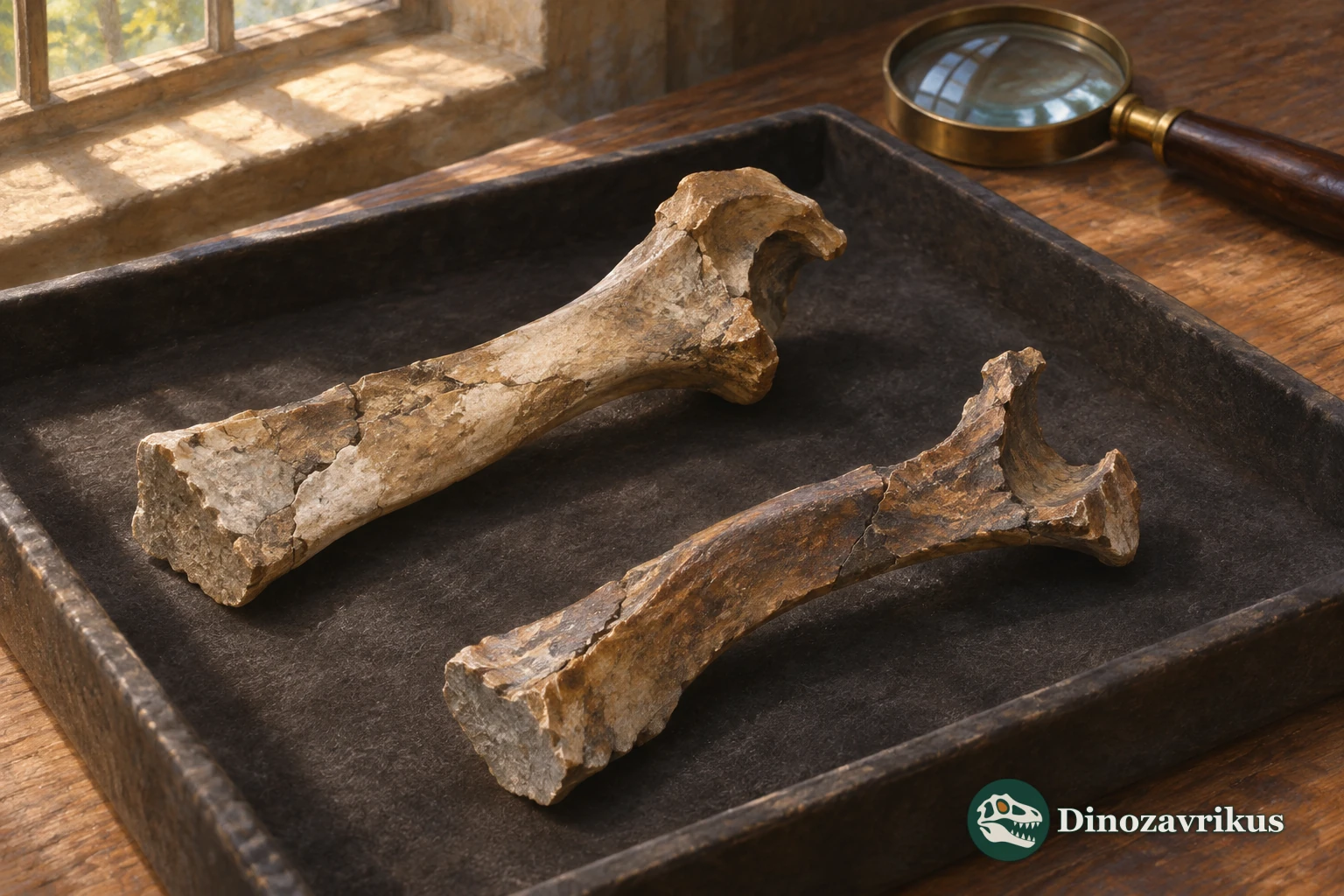
S. L. Wood recovered the type in 1925 from the early Oligocene Hampstead Beds near Yarmouth. Colin Harrison and Cyril Walker named the species in 1979. The preserved parts of BMNH PAL 4407 are the upper end and part of the shaft of a right coracoid. A break crosses the surface that articulated with the humerus.
The original description compared the bone to the coracoid of a whistling duck, Dendrocygna. Gareth Dyke’s 2001 review found little in the preserved surfaces to place the fossil securely in an order. Gerald Mayr’s later comparisons favoured an affinity with Romainvilliidae, an extinct group close to living ducks.
Comparisons from Boutersem to Kazakhstan
A nearly complete right coracoid from Boutersem in Belgium, IRScNB Av 33, was initially described as cf. Paracygnopterus. Mayr subsequently left it as an unnamed member of Anatidae, so it offers no confirmed second record of the English bird.
In 2024, Nikita Zelenkov referred a right coracoid from the early Oligocene Chelkarnura Formation to Paracygnopterus sp. The Kazakh specimen, PIN 2974/27, resembles the English type in outline but is smaller. Other birds described from the Kazakh assemblage include early anatids such as Mionetta.
Frequently asked questions
Does its name identify a swan?
The later comparisons place it near early relatives of living ducks. There is no fossil evidence that identifies it as a swan.
Which part of the skeleton preserves the type?
The shoulder end of a right coracoid and an associated section of its shaft.
Is the Belgian specimen still assigned to the genus?
It was first compared with Paracygnopterus and later left as an indeterminate anatid.
Does the Kazakh bone belong to the English species?
Its assignment goes to genus level. The smaller Kazakh fossil has no species name.