

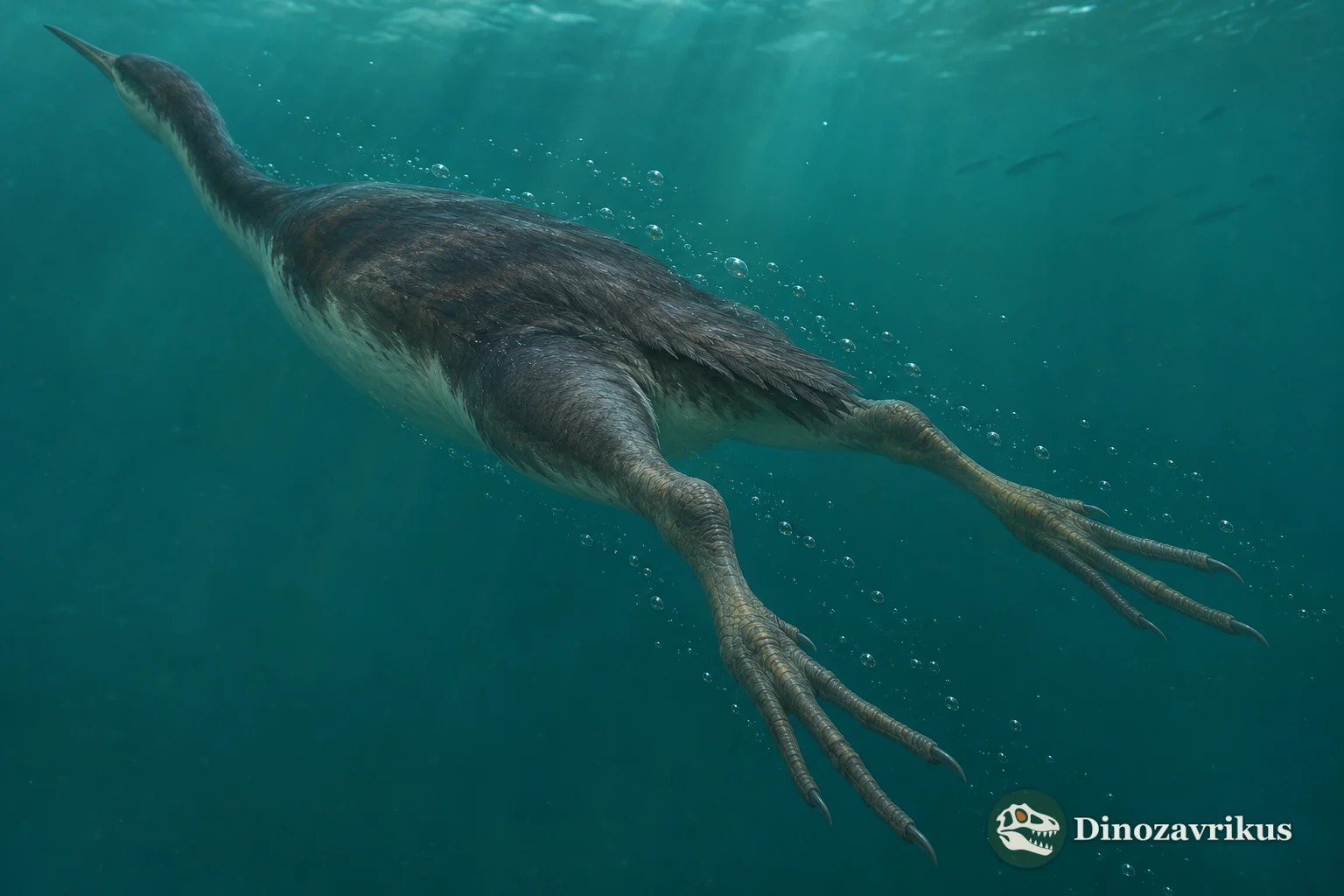
Parahesperornis was a Late Cretaceous bird that propelled itself underwater with its hind limbs. Its main fossils come from marine chalk in western Kansas. Two skeletons preserve enough of the limbs to compare its reduced wings and swimming legs with those of other hesperornithiforms. One also preserves rare traces of the skin around the foot.
Quick facts
| Group | Hesperornithiforms (Hesperornithiformes) |
|---|---|
| Age | Late Cretaceous (late Coniacian to early Campanian age of the host beds) |
| Region | North America (Kansas, United States) |
| Diet | Probably aquatic prey. Exact diet unknown |
| Type species | Parahesperornis alexi |
| Holotype | KUVP 2287, nearly complete skeleton with skin impressions |
| Deposits | Smoky Hill Chalk Member, Niobrara Formation |
What can the fossils tell us?
The slender humerus has reduced surfaces for the flight muscles. Its form and the structure of the shoulder girdle indicate that the bird had lost powered flight.
The lower leg and tarsometatarsus exhibit shapes consistent with foot-propelled diving. The bones cannot give a typical swimming speed or depth.
Impressions next to the foot bones of KUVP 2287 record several differently sized scutes. They show the texture of part of the foot, while the tissues between the toes remain uncertain.
A Kansas fossil with an earlier name
Henry T. Martin recovered KUVP 2287 in Graham County in 1894. Samuel Williston initially suggested that it represented Hesperornis gracilis, a species based on an isolated tarsometatarsus in a different collection. Larry Martin distinguished the Kansas skeleton in 1984 and named Parahesperornis alexi. Differences in the foot bones helped show why the earlier identification had been mistaken.
Orville Bonner found a second substantial skeleton, KUVP 24090, in Gove County in 1981. The University of Kansas Natural History Museum holds both specimens. Alyssa Bell and Luis Chiappe described their anatomy in detail in 2020. The holotype retains a crushed skull, while the second specimen adds well-preserved vertebrae and parts of the hind limbs.
Short wings and powerful feet
The upper arm bone is slender, with poorly developed ends, consistent with a severe reduction of the wing. The lower leg, foot joints and elongated kneecap tell a different story. Their shapes fit movement through water powered by the feet. The same broad division of functions is visible in Hesperornis, with differences in the details of its hind limbs.
The skeleton combines strong diving adaptations with features shared by other early members of the group. Its traits form a mosaic, which makes the original picture of a simple intermediate between Baptornis and Hesperornis incomplete. Comparative anatomy groups Parahesperornis with Hesperornis in the family Hesperornithidae.
Skin impressions and life in the chalk sea
Two pieces of matrix next to the foot bones of KUVP 2287 retain impressions of the skin. Some preserve outlines of both large scutes and smaller scales. The impressions account for only part of the covering of the foot. They leave the extent of any toe webs or lobes, and the original colour, unresolved.
The Smoky Hill Chalk accumulated in the Western Interior Seaway. The shape of the legs and the bird's toothed jaws are compatible with catching aquatic prey. Neither of the two well-described skeletons has yielded an identified meal that establishes what it regularly ate.
Frequently asked questions
Could Parahesperornis fly?
The greatly reduced upper arm and the structure of the shoulder girdle indicate that it had lost powered flight.
How did it swim underwater?
The shapes of the pelvis, lower leg and foot are consistent with propulsion by the hind limbs.
Which soft tissues were preserved?
The holotype retains skin impressions near the tarsometatarsi and toe bones. These show scutes on parts of the foot.
Where were the main fossils found?
Both principal skeletons are from the Smoky Hill Chalk Member of the Niobrara Formation in western Kansas.