

Parapengornis eurycaudatus was an Early Cretaceous enantiornithine from China. Its short bony tail is preserved beside two feathers with thick shafts. The tips are missing, yet the surviving portions reach more than 13 centimetres from the base of the tail. That combination of bone and plumage prompted the suggestion that the bird could brace itself with its tail while climbing.
Quick facts
| Group | Enantiornithines (Pengornithidae) |
|---|---|
| Age | Early Cretaceous (Aptian) |
| Region | Asia (western Liaoning, China) |
| Diet | No direct evidence |
| Type species | Parapengornis eurycaudatus |
| Holotype | IVPP V18687 |
| Formation | Jiufotang Formation |
| Tail plumage | A pair of long feathers, preserved for 131.5 mm |
What can the fossils tell us?
The holotype IVPP V18687 preserves most of the skeleton. Small teeth remain in the jaws and impressions of feathers surround the tail bones.
A short, broad bone formed by fused vertebrae lies at the base of a pair of long feathers. Their vanes are visible along the preserved portions. The tips are missing.
Thin sections preserve no lines of arrested growth. The original team interpreted the individual as a growing bird probably less than a year old.
The slab from the Jiufotang Formation
The nearly complete skeleton was found near Lingyuan in western Liaoning. Han Hu, Jingmai O’Connor and Zhonghe Zhou named the species in 2015. Its specific name refers to the breadth of the base of the tail. The bones are flattened in the rock, but their positions still help to identify the feather impressions around them.
The upper and lower jaws bear many small teeth. Tooth shape alone leaves the food of this bird uncertain. In comparisons with other enantiornithines such as the Spanish Iberomesornis, the available parts vary: the latter lacks a known skull, so comparisons rely largely on the trunk and limb bones.
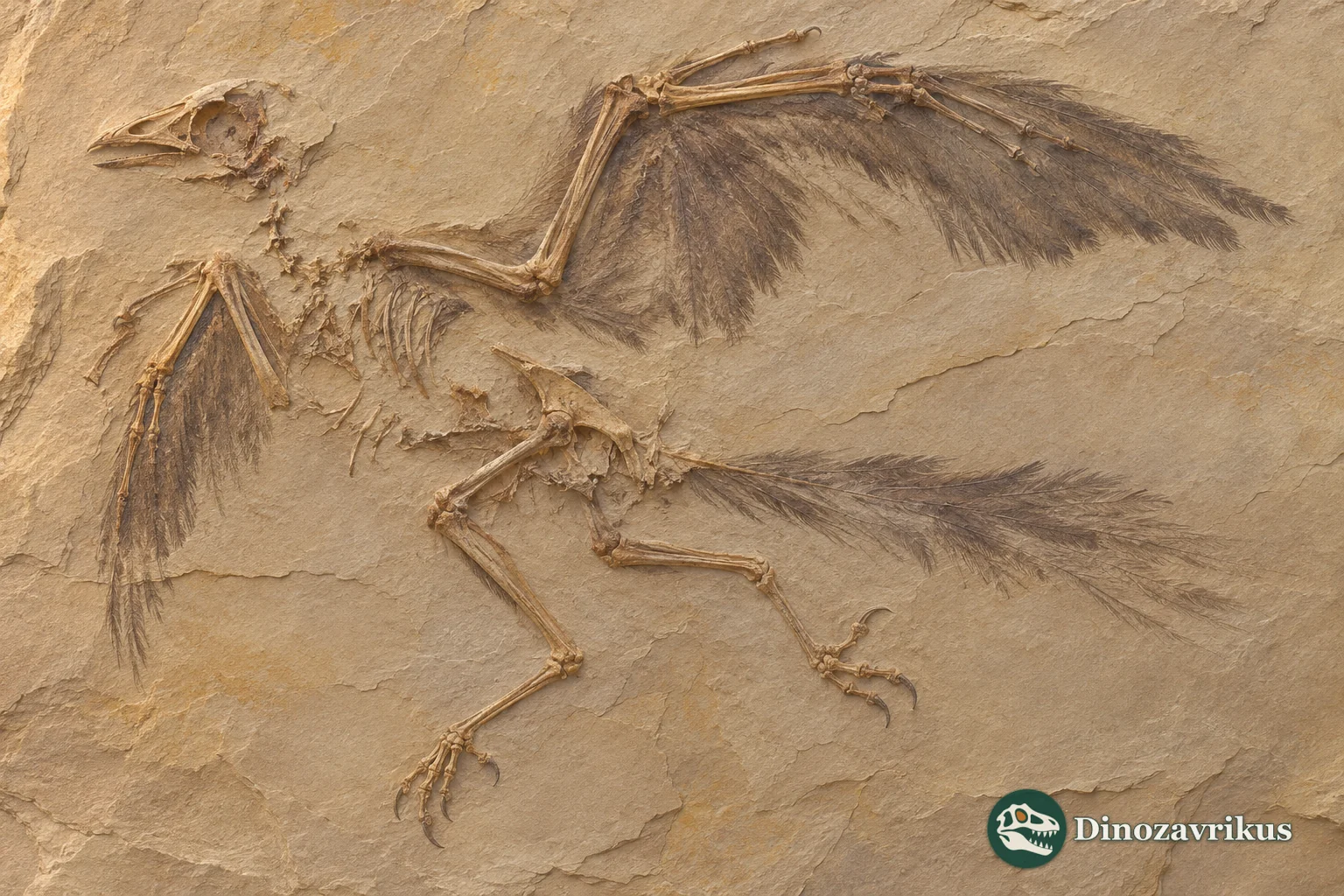
Two long feathers on a short bony tail
The pygostyle, formed by the fusion of the terminal tail vertebrae, is short and broad. The two elongate feathers have stout central shafts and continuous vanes along the portions that survive. They extend 131.5 mm from the pygostyle to their preserved ends. The missing tips leave their full length and terminal shape open.
The original description compared this combination with the tail that living woodpeckers use for support during climbing. The relatively long first metatarsal was also taken as evidence of a foot suited to grasping. A later comparison of pygostyles in living and fossil birds found limits to the analogy: the relevant parts of the bone differ in construction. The fossils provide a basis for testing the climbing hypothesis, while the exact pose and movement remain unknown.

Was it a fish eater?
In 2023 researchers compared foot proportions, jaw mechanics and computer simulations of loading with evidence from living birds. Taken together, the results made fish the leading candidate for its diet. Individual tests offered weak support for that possibility, so the diet remains uncertain.
How much of the record belongs to this bird?
Thin sections show that the type individual was still growing. Its dimensions therefore describe a juvenile, and even a close comparison with other species has to take developmental age into account.
The skeleton IVPP V18632 was first identified as Pengornis and provisionally referred to Parapengornis in the 2015 description. A later dietary study treated it as an indeterminate pengornithid. Any dietary signal from that second specimen must be kept distinct from the evidence on the holotype.
Frequently asked questions
Where was Parapengornis found?
The holotype comes from the Early Cretaceous Jiufotang Formation near Lingyuan in China’s Liaoning Province.
How many long tail feathers are preserved?
Two. Each was fully vaned along the portion preserved, and the pair reaches 131.5 mm from the base to the broken ends.
Did Parapengornis climb like a woodpecker?
The tail and foot prompted that suggestion. Comparisons of the tail bones have since shown differences, so the way it climbed remains unresolved.
Do the teeth tell us what it ate?
Fish is a plausible prey based on the jaws and other anatomical evidence. Identifiable food remains in the holotype would provide a more direct test.