

Paraprefica was an Eocene relative of modern potoos. Two species are known from the Messel Pit in Germany, and one preserves a skull complete enough to test an early suggestion that it belonged near oilbirds. The fossils show that an early branch of the modern American potoo family once lived in Europe.
Quick facts
| Type species | Paraprefica kelleri |
|---|---|
| Other species | Paraprefica major |
| Affinities | Early branch of the potoo family |
| Age | Eocene, about 48 million years ago |
| Locality | Messel Pit, Germany |
| Type specimen | SMF-ME 3376 |
| Complete skeleton | SMF-ME 3727a+b |
What can the fossils tell us?
Both sides of the slab of SMF-ME 3727 retain parts of a complete skeleton. The skull makes features available that were difficult to assess from the type.
The bill was proportionally longer, and it lacked the characteristic tooth-like projection of the maxilla seen in living potoos. Neither feature tells us what colour the bird was.
The 2005 analysis placed Paraprefica near living potoos and the superficially similar Prefica near the oilbird. The initial grouping had relied on less complete material.
Two species in an Eocene lake deposit
Gerald Mayr named Paraprefica kelleri and P. major in 1999. The type of P. kelleri, SMF-ME 3376, is a partial skeleton. The more complete skeleton SMF-ME 3727a+b later provided a well-preserved skull along with the rest of the body. The two suffixes refer to the two sides of the split slab.
The type material of P. major, SMNS 81654, preserves the front of the skeleton. Another skull of that species confirmed that enlarged palatal bones were a feature of the genus. Both species occur in the same Messel lake deposits, which accumulated over a span of time.
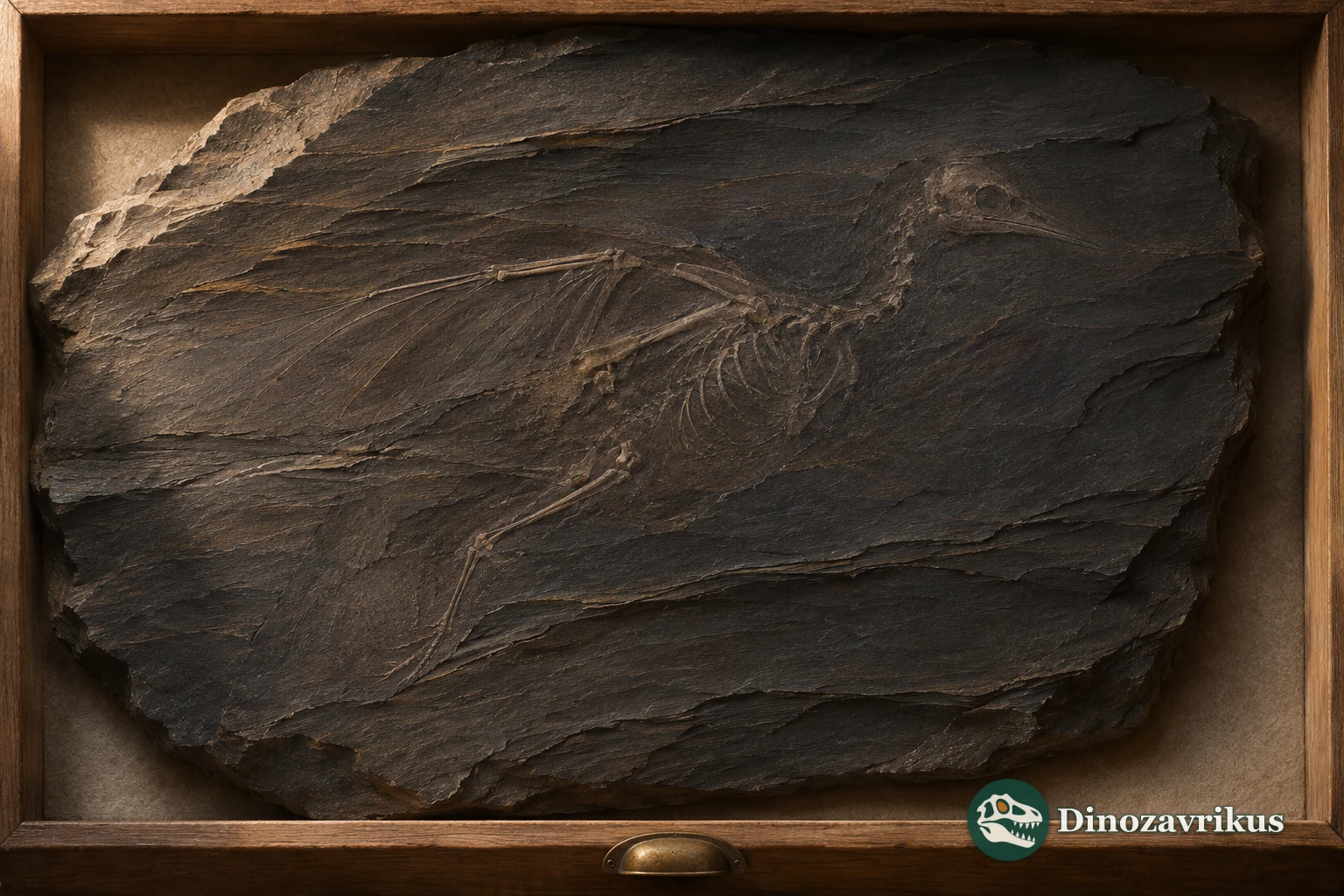
A skull with a different combination of traits
Mayr originally associated Paraprefica with the North American fossil Prefica and the oilbird lineage. His later analysis of 98 skeletal traits supported living potoos as the closest living relatives, while Prefica still grouped with the oilbird. Some similarities of the two fossil genera may come from a common ancestor farther down the tree.
Compared with present-day potoos, Paraprefica had a longer bill relative to the rest of the head, lacked their tooth-like projection along the upper jaw and had a slender carpometacarpus, the fused bone in the hand of the wing. Thiago Costa and colleagues proposed the extinct subfamily Parapreficinae for the Messel species in 2021.
The setting at Messel
The fossils occur in the finely layered deposits of a volcanic crater lake. Oxygen-poor conditions near the lake floor helped delicate skeletons survive. The colour of the reconstructed bird is conjectural and the skeleton gives no direct record of when it hunted. Potoos belong to a broader group that also includes swifts and hummingbirds. The fossil hummingbird Eurotrochilus illustrates the very different specialisations reached on a separate branch.

Frequently asked questions
Which species are known?
Paraprefica kelleri and P. major. Both are from the Eocene of Messel, Germany.
Why was the complete skull important?
It revealed features of the jaws and palate that could be compared with living potoos and the oilbird.
Do potoos live in Europe today?
Living potoos are restricted to the tropical Americas. The Messel birds belong to an extinct European branch.
Are Paraprefica and Prefica close relatives?
They were once grouped together, but a later skeletal analysis placed Paraprefica with potoos and Prefica with the oilbird lineage.