

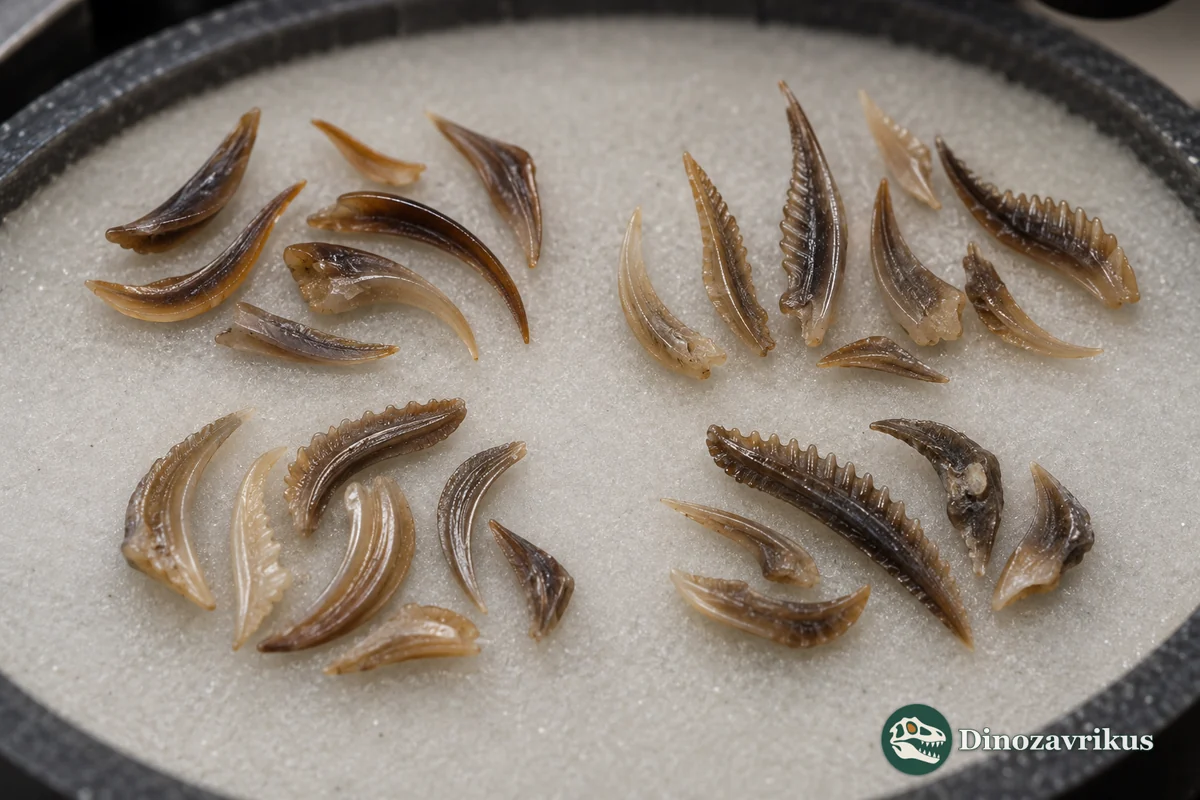
Paroistodus is an Ordovician conodont genus known chiefly from tiny phosphatic elements of its feeding apparatus. A Swedish study compared almost 75,000 elements from four successive species and proposed a model with seven element types.
This is not a complete animal fossil. Researchers infer which isolated shapes belonged together by comparing their proportions and frequency in large collections. No articulated body or soft tissue is known for Paroistodus, so claims about its size, appearance and behaviour remain limited.
The early animal catalogue gathers fossil marine taxa; its broad scope does not change the Ordovician age of this genus.
Quick facts
| Scientific name | Paroistodus Lindström, 1971 |
|---|---|
| Type species | Oistodus parallelus Pander, 1856 |
| Group | Conodonts, early vertebrates |
| Main material | Isolated mineralised apparatus elements |
| Detailed sample | Almost 75,000 elements of four species from Swedish sections |
| Age of sample | Early Ordovician; species succeed one another through the sections |
| Model | Seven element morphotypes in the 1997 revision |
| Limit | The genus's complete body and diet are unknown |
What can the fossils tell us?
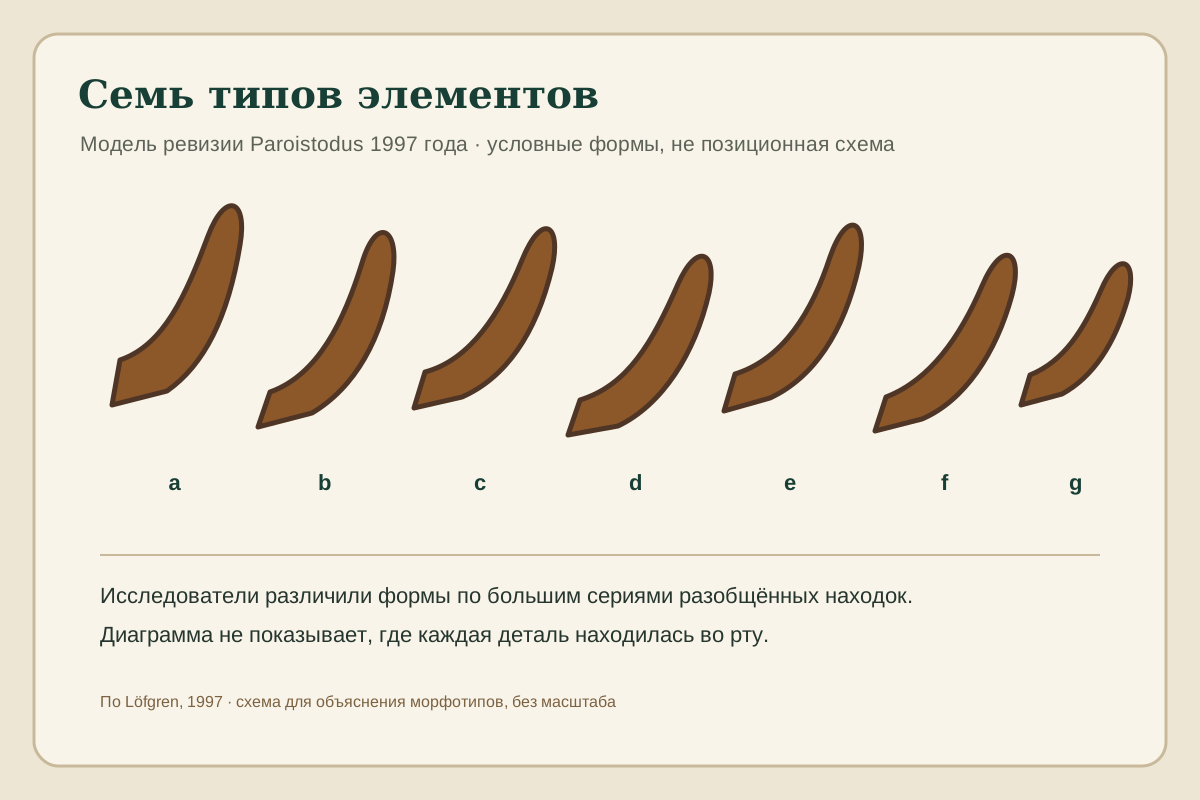
Collections contain separate phosphatic elements with different outlines and curvature. Löfgren compared their frequency and association; seven morphotypes are a model of related parts, not seven complete teeth found together in one mouth.
The Swedish collections included almost 75,000 elements from four species, from the upper Tremadoc to the lower Llanvirn in the regional terminology used by the paper. The number counts elements, not animals.
The genus is documented through apparatus elements. A notochord, muscle blocks, fins and internal organs have not been observed in this genus; body fossils from other conodonts are comparative evidence only.
The fossils come from marine Ordovician strata in several regions. Their ages and depositional settings apply to specific samples and do not establish one depth or habitat for every species.
Name and type species
Karl Heinrich Pander described Oistodus parallelus in 1856. Einar Lindström established Paroistodus in 1971, with Pander’s species as its type. The older name remains part of the nomenclatural history even though the species is now placed in a different genus.
Conodont taxonomy changed as researchers moved from naming isolated tooth-like fossils to reconstructing multi-element apparatuses. A resemblance between one cone-shaped element is not enough to establish synonymy; type material and later revisions must be compared.
How researchers reconstructed the apparatus
Before Anita Löfgren’s 1997 revision, the genus was often treated as a two-element apparatus despite the variation among its drepanodontiform forms. Löfgren examined almost 75,000 elements from Swedish sections and compared four species: P. numarcuatus, P. proteus, P. parallelus and P. originalis. The species occur in sequence through the studied Lower Ordovician strata.
The revision distinguished seven element types in each of these species and found the proposed apparatus comparable to that of Drepanodus. This inference rests on recurring combinations in large samples, not on a single fossil preserving every part in position. Other studies can recognise fewer forms when samples are smaller or use a different grouping scheme.
Age and localities
The Swedish series spans from the upper Tremadoc to the lower Llanvirn in the regional terminology used in the study. A separate description records P. numarcuatus from the Early Ordovician Thung Song Formation on Tarutao Island, Thailand. These are different basins and samples, not one population living everywhere at once.
Conodont forms changed through time, making them useful for correlating strata. The age of a particular element comes from its section and associated microfossils; a compiled range is not a precise date for the genus’s origin or extinction. The Ordovician overview provides the broader geological setting. A related example of apparatus reconstruction from isolated parts is Protopanderodus.
Body, feeding and limits
Conodonts are regarded as early vertebrates, based in part on rare articulated fossils of other genera. No such body is known for Paroistodus. A fish-like image may help visualise the group, but its head, body length, fins and soft tissues are not direct observations of this genus.
The apparatus may constrain how the mouth worked, but its shapes alone do not reveal a menu. A specific diet would need evidence such as a body-associated apparatus, wear patterns or a functional study of named species. Swimming speed, depth and behaviour are likewise unknown.
Frequently asked questions
Why is Paroistodus treated as an apparatus taxon?
Most fossils are isolated phosphatic elements. Their repeated forms and frequencies let researchers infer an apparatus, but no complete mouth is preserved.
How many element types were proposed?
Löfgren’s 1997 revision distinguished seven morphotypes for four well-known species, based on large Swedish collections.
Where was Paroistodus found?
The detailed series comes from Sweden; published records also include other Ordovician basins, including Thailand.
Is its body or diet known?
No articulated body is known for the genus, and element shape alone does not establish a precise diet.