

Parvinatator wapitiensis is an early marine ichthyopterygian known mainly from one incomplete specimen found near Wapiti Lake in British Columbia, Canada. Its skull is deformed, and the tip of the snout and front of the lower jaw are missing. The fossil is important for comparing early ichthyopterygians, but it cannot provide a complete portrait of the animal.
Quick facts
| Type species | Parvinatator wapitiensis Nicholls & Brinkman, 1995 |
|---|---|
| Age | Exact stage unknown; the formation spans parts of the Early and Middle Triassic |
| Locality | Wapiti Lake region, British Columbia, Canada |
| Holotype | TMP 89.127.8, a fragmentary skull and paired forefins |
| Notable feature | A pronounced retroarticular process on the lower jaw |
| Unknowns | Reliable total length, diet and swimming style are not established |
Evidence guide
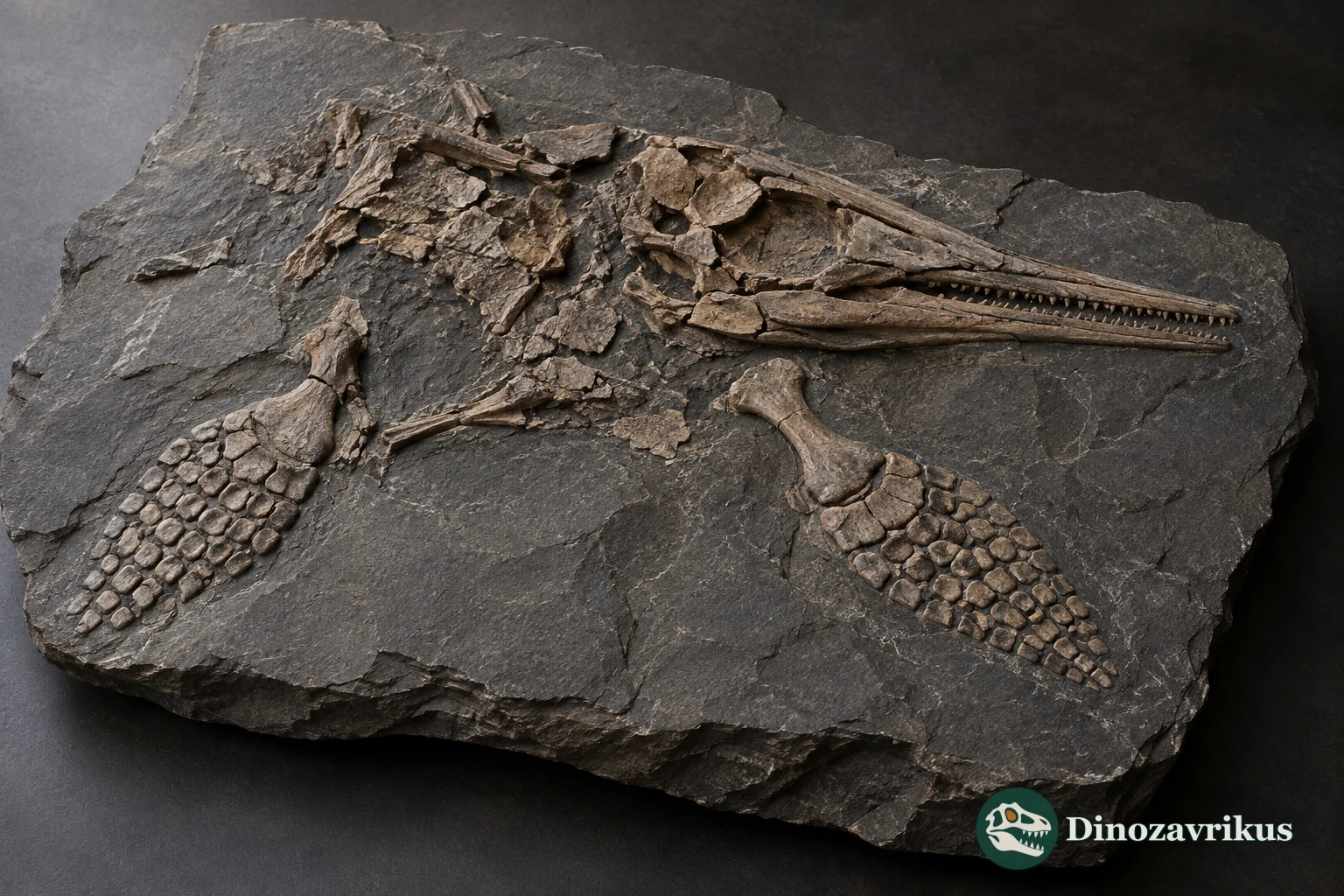
TMP 89.127.8 preserves a partly disarticulated, deformed skull and paired forefins. The snout tip and anterior end of the lower jaw are missing.
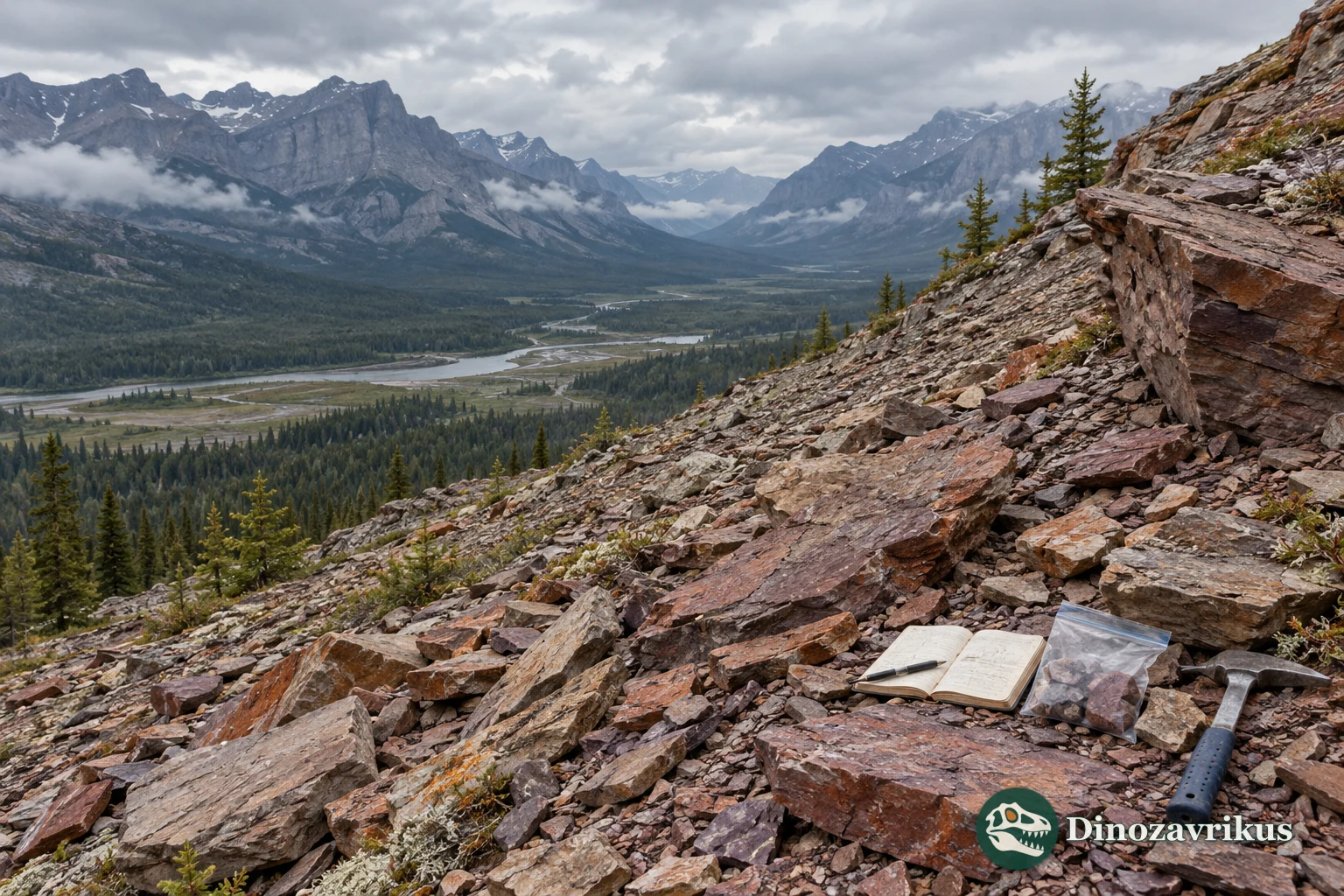
The specimen came from talus in the Sulphur Mountain Formation near Wapiti Lake. Its exact original horizon is unresolved, so a precise stage should not be assigned.
The pronounced retroarticular process is among the features discussed in comparisons. Deformation and missing bones limit direct measurements of the original skull.
Different character matrices place Parvinatator near early ichthyopterygians or within more derived ichthyosaurs. These are analytical hypotheses, not a demonstrated ancestor–descendant sequence.
A fossil from the Wapiti Lake region
Elizabeth Nicholls and Donald Brinkman named Parvinatator wapitiensis in 1995. The genus name combines Latin roots for ‘small’ and ‘swimmer’; the species name refers to Wapiti Lake. The holotype, TMP 89.127.8, was collected in the D Cirque area of north-eastern British Columbia.
The specimen was recovered from talus rather than from a documented, undisturbed bed. It is associated with the Sulphur Mountain Formation, but its exact stratigraphic position cannot be fixed. Another nearby fossil, TMP 89.127.3, has sometimes been discussed as a possible juvenile Parvinatator; shared geography and a few similarities are not enough to make that referral definitive.
What the holotype preserves
The principal specimen consists of a partly disarticulated, tectonically deformed skull and two forefins. The tip of the snout and the anterior tip of the dentary are missing. Overlapping and compressed bones make it difficult to recover the original skull proportions from every view.
The forefins show that the limbs were adapted for aquatic locomotion, but they cannot establish a precise swimming speed or style. The incomplete material also lacks the full trunk and tail needed for a reliable total-length estimate. Comparisons with early forms such as Utatsusaurus and Grippia help frame the anatomy without implying direct ancestry.
A formation with an uncertain horizon
The Sulphur Mountain Formation spans portions of the Early and Middle Triassic. Since the holotype was collected from a talus slope, its source layer is uncertain. The safest age statement is therefore broad: the fossil belongs to the Triassic succession of the formation, while a more exact stage has not been established for this specimen.
A formation-wide age range should not be mistaken for a precise date of the animal. Nearby fossils can inform the regional setting, but they do not resolve the exact horizon of TMP 89.127.8. The uncertainty is stratigraphic, not evidence that the specimen is misidentified.
Anatomy and competing placements
A pronounced retroarticular process projects behind the jaw joint. Researchers have compared this and other cranial and limb characters with those of early ichthyopterygians. Because the skull is deformed and incomplete, the available character sample is limited.
Published phylogenetic analyses have not produced one consistent placement. Some treatments group Parvinatator with very early ichthyopterygians, while other matrices recover it within Ichthyosauria. The family name Parvinatatoridae has also been used. Such placements are hypotheses inferred from coded characters; none shows that this genus was the direct ancestor of later forms such as Cymbospondylus.
What cannot be read from the fossil
No reliable total body length, stomach contents, prey remains, reproductive evidence or soft-tissue outline are known from the holotype. A specific diet or hunting strategy would go beyond the direct evidence. The cover illustration is a generalized reconstruction of an early marine reptile, not a life portrait based on a complete Parvinatator skeleton.
The fossil is most informative when its uncertainties remain visible: it documents a particular combination of skull and forefin bones, but its exact horizon, complete proportions and detailed biology remain unknown.
Frequently asked questions
Where was Parvinatator found?
The holotype came from the Wapiti Lake region of British Columbia, Canada, in the Sulphur Mountain Formation.
How old is the holotype?
Its exact source bed and stage are unknown because it was collected from talus. The formation spans parts of the Early and Middle Triassic.
What bones are preserved?
TMP 89.127.8 preserves a deformed, incomplete skull and paired forefins. The snout tip and front of the lower jaw are missing.
Do we know its length or diet?
No reliable total length or direct evidence of prey is known. The partial skull and forefins do not establish a specific diet or swimming style.