

Peipehsuchus teleorhinus is a Jurassic crocodylomorph from the Sichuan Basin of China. Its name is based on the rounded front of a snout. A nearly complete skull once assigned to the same species has since been treated separately in a major study of its relatives.
Quick facts
| Species | Peipehsuchus teleorhinus |
|---|---|
| Age | Jurassic |
| Type locality | Beipei, China |
| Holotype | IVPP RV 48001 |
| Preserved material | Front of the snout |
What can the fossils tell us?
The specimen IVPP RV 48001 preserves the anterior end only. Li Jinling described a rounded outline, an uneven bone surface and a deep groove along the midline.
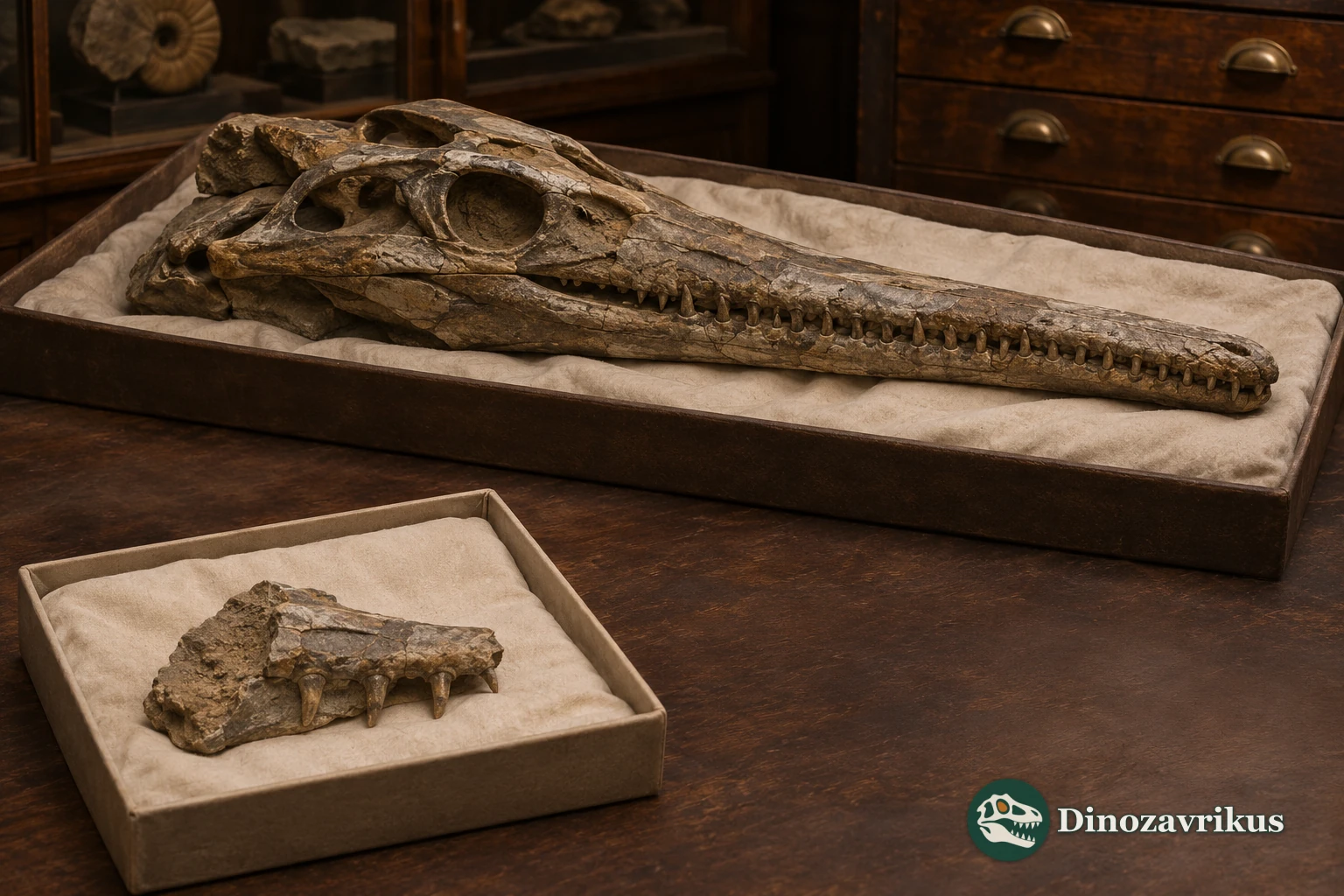
IVPP V 10098 is a nearly complete skull from another site. Comparing the overlapping bones is crucial when assessing whether it belongs to the same species.
The type fragment comes from the Ziliujing Formation. Different accounts place it in either the Da’anzhai or Ma’anshan Member.
The rounded snout tip from Beipei
C. C. Young initially identified the fragment from Beipei as part of a plesiosaur. In a paper dated 1948 he revised that identification and named Peipehsuchus teleorhinus. Viewed from above, the preserved tip widens into a roughly semicircular outline. The remainder of the skull and skeleton is missing from the type specimen.
The original reference to limestone points to the Da’anzhai Member of the Ziliujing Formation. Other work placed the fragment in the Ma’anshan Member. Li Jinling highlighted the difference when he reviewed the finds in 1993.
How a second skull was assigned
Li described the nearly complete skull IVPP V 10098 from Daxian as Peipehsuchus. He used similarities in the shape of the snout tip, size and the number of tooth sockets in the premaxillae to support the identification. The skull he measured was about 63 cm long. That figure applies to the Daxian specimen.
What comparisons with other fossils changed
A 2020 study treated the Daxian skull as a distinct, unnamed teleosauroid and compared it with taxa including Southeast Asian Indosinosuchus. In a separate systematic account, the original Peipehsuchus fragment was listed among early members of Metriorhynchoidea.
The name-bearing fragment reveals the outline of the snout tip. Its comparisons with better preserved skulls help test relationships, but the fossil leaves the length, limbs and typical prey of Peipehsuchus unknown.

Frequently asked questions
Which specimen defines the species?
IVPP RV 48001, the front of a snout from Beipei.
Why did early accounts associate the fragment with plesiosaurs?
Young initially described it as part of a plesiosaur. He later reidentified it as the snout of a crocodylomorph.
What does the 63 cm measurement refer to?
It is the length of the nearly complete Daxian skull, treated as a separate teleosauroid in 2020.
Can the type fragment be dated precisely?
Its assignment to a particular member of the Ziliujing Formation remains disputed.