

Periptychus carinidens lived in North America during the Paleocene, after the end-Cretaceous extinction. It was a stout, strong-limbed mammal with unusually folded tooth enamel and enlarged premolars. Its first named material consisted of jaw fragments; later skulls and limb bones from New Mexico made a much fuller reconstruction possible.
The fossils place it in the ancient mammal catalogue as a distinctive periptychid. They do not make it a proven ancestor of any living hoofed mammal merely because its body looks vaguely ungulate-like.
Quick facts
| Scientific name | Periptychus carinidens Cope, 1881 |
|---|---|
| Group | Periptychidae, Eutheria |
| Age | Paleocene, roughly 63.3–61.7 million years ago |
| Key locality | Nacimiento Formation, San Juan Basin, New Mexico |
| Name-bearing fossil | Lectotype AMNH 3620, partial lower jaws |
| Later evidence | Several skulls and postcranial bones |
| Mass estimate | About 20 kg from limb-shaft circumferences |
| Locomotion | Mainly terrestrial and plantigrade |
What can the fossils tell us?
Cope did not select a holotype in 1881. The 2018 revision fixed AMNH 3620, partial lower jaws with deciduous premolars, as the lectotype. Those fragments cannot describe the whole animal.
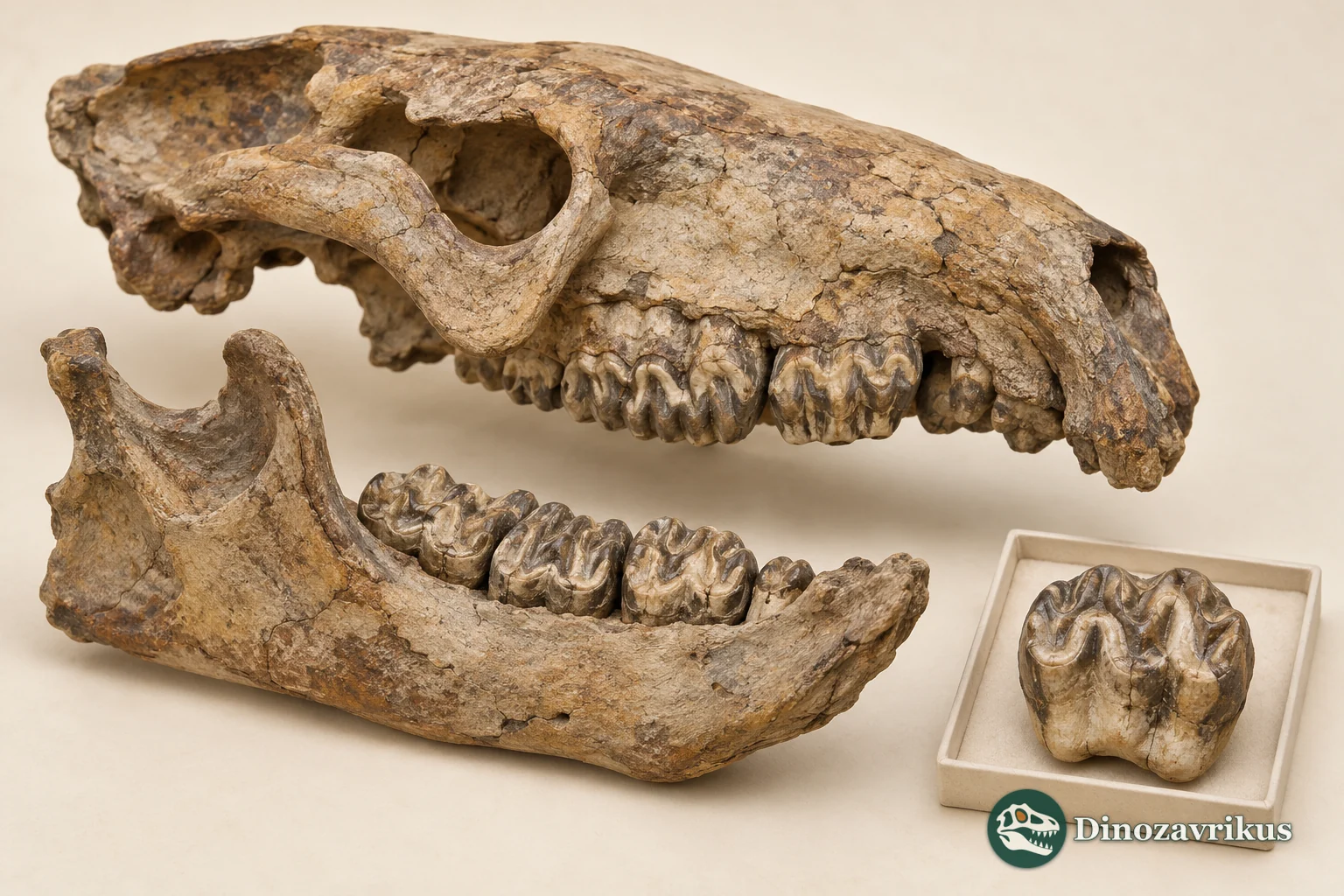
Preserved crowns directly show crenulated enamel and large premolars. A plant-based, relatively hard-food diet is a functional interpretation of their form.
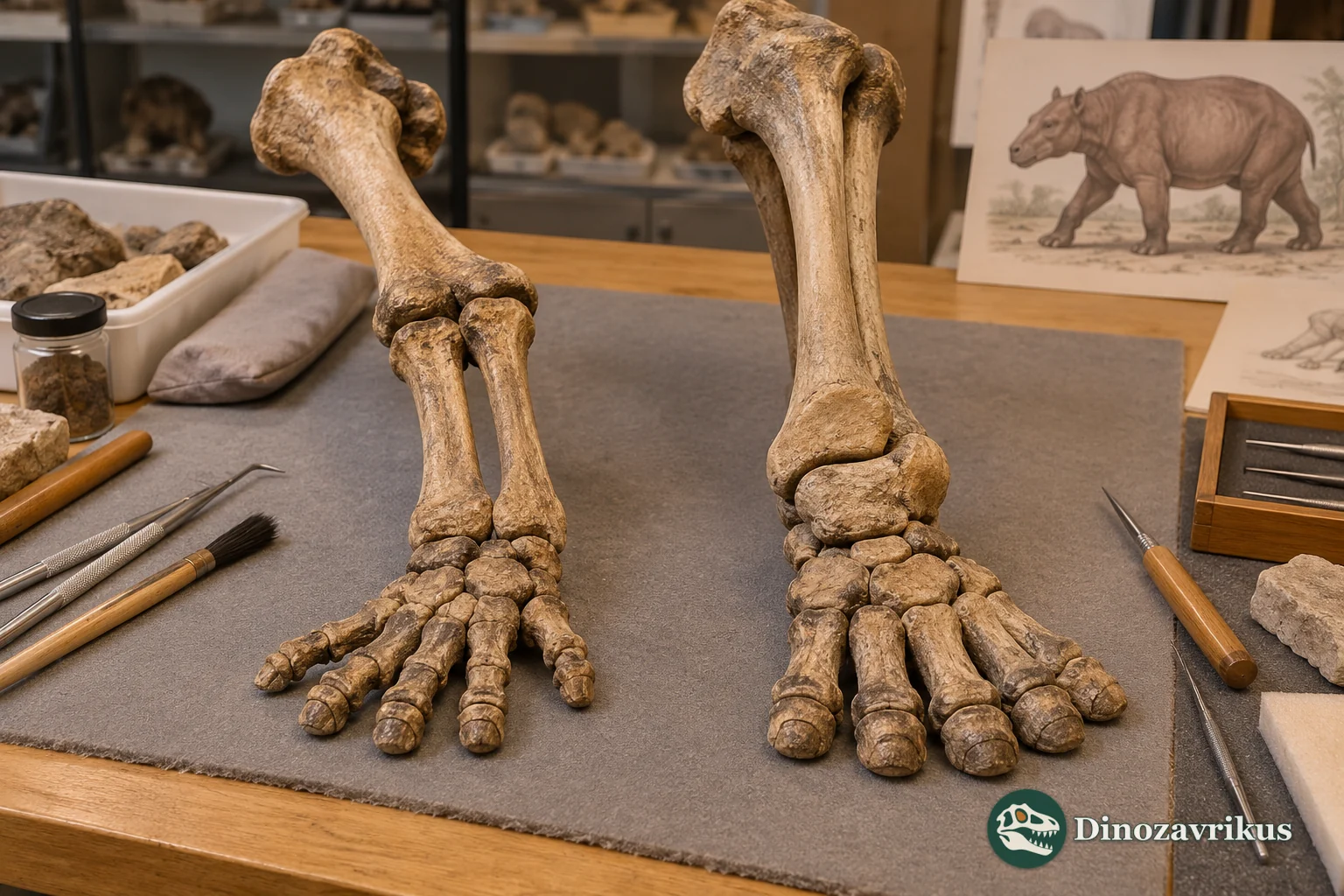
Forelimb and foot anatomy support a mainly terrestrial stance. Possible climbing or digging ability is inferred from joint and muscle-attachment morphology, not observed behaviour.
The published estimate uses the combined midshaft circumferences of humerus and femur in a comparative equation. It is not a weighed animal or an exact value for every individual.
From Cope's jaws to a name-bearing lectotype
Edward Drinker Cope named P. carinidens in 1881 without selecting a single holotype. In their 2018 redescription, Sarah Shelley, Thomas Williamson and Stephen Brusatte fixed AMNH 3620 as the lectotype. It consists of partial left and right lower jaws bearing deciduous premolars from the Nacimiento Formation in New Mexico. A lectotype anchors the name to real material; it is not a claim that the material preserves a full skull.
The revision also treated the previously named P. gilmorei and P. superstes as junior synonyms of P. carinidens. Their proposed distinguishing dental traits fall within the variation seen in the larger sample. This is a research judgement based on comparative material, not a rule that every historic name in a collection denotes a separate species. The authors retained one accepted species for the genus in their treatment.
Enlarged premolars and a composite picture of the skull
Later fossils include skull and jaw pieces curated at the New Mexico Museum of Natural History and Science. No single entirely complete skull is known. Together the specimens show a broad face, moderately elongated rostrum, relatively small braincase and prominent crests. The combination is more informative than the old jaws alone, though missing parts remain missing even when a museum display appears complete.
The upper and lower premolars are enlarged relative to the molars. Tall central cusps and strongly crenulated enamel distinguish the teeth, including from the related Carsioptychus. Such anatomy supports a functional reading of processing plant material, perhaps relatively hard items. It does not identify each food species or a fixed percentage of seeds in the diet.
What the bones say about weight and movement
The described limb bones are substantial. Shelley and colleagues inferred a primarily terrestrial, plantigrade animal, with the whole foot contacting the ground. Some features of the forelimb and ankle permit movement over obstacles and perhaps some climbing or digging ability. They do not prove how often an individual climbed a trunk or excavated a burrow.
The often-quoted mass of roughly 20 kg has a specified method. The authors measured the minimum midshaft circumferences of the humerus and femur and used their sum in a comparative long-bone equation. That is a model estimate for studied material, subject to sampling and calibration, rather than the weight of every member of the species.
A Paleocene animal in changing western landscapes
The Nacimiento Formation of the San Juan Basin contains river and lake deposits, paleosols and a long sequence of terrestrial fossils. Periptychus is also reported from Paleocene deposits in Utah, Wyoming, Texas, Montana and Colorado. The 2018 account places the genus at approximately 63.3–61.7 million years ago; the date of a particular skull depends on its layer, not just that broad genus range.
Plant and isotope evidence suggests a mosaic of vegetated and more open areas. Enamel isotope results for P. carinidens are consistent with feeding in comparatively open, drier settings within that mosaic. The cover scene evokes a possible river margin; it cannot specify a documented moment, coat colour or exact plant community. The wider Palaeogene history places this early mammal radiation in time. The much older Late Cretaceous Didelphodon was a different mammal lineage, not its neighbour in a Paleocene forest.
Frequently asked questions
Was Periptychus an ancestor of modern hoofed mammals?
No direct ancestry is established. It belonged to extinct Periptychidae; a sturdy ungulate-like outline does not prove kinship with one living order.
Why is there a lectotype instead of an original holotype?
Cope did not choose a single holotype in 1881. The 2018 revision fixed the partial jaws AMNH 3620 as the name-bearing lectotype.
How reliable is the 20 kg figure?
It is an approximate estimate derived from humeral and femoral shaft circumferences using a comparative equation, not a measured living weight.
Could Periptychus climb or dig?
Its forelimb anatomy permits those possibilities, but does not show that it habitually lived in trees or dug burrows. The principal interpretation is terrestrial.